Event submissions
Published
This submission belongs to the session S2. Food Nutrition and Functional Foods of the event The 5th International Electronic Conference on Foods
Published date
25 Oct, 2024
Academic Editor
'%3e%3cpath%20d='M12.6657%2010.9104C12.4185%2010.325%2012.0599%209.79327%2011.6097%209.34482C11.1609%208.89508%2010.6293%208.5365%2010.0442%208.28888C10.0389%208.28626%2010.0337%208.28495%2010.0285%208.28233C10.8446%207.69279%2011.3752%206.73249%2011.3752%205.64904C11.3752%203.8542%209.92103%202.39999%208.1262%202.39999C6.33136%202.39999%204.87715%203.8542%204.87715%205.64904C4.87715%206.73249%205.40774%207.69279%206.22393%208.28364C6.21869%208.28626%206.21345%208.28757%206.20821%208.29019C5.62129%208.5378%205.09463%208.89284%204.64265%209.34613C4.1929%209.79493%203.83432%2010.3266%203.58671%2010.9117C3.34345%2011.4845%203.21226%2012.0987%203.20023%2012.7209C3.19988%2012.7349%203.20233%2012.7488%203.20744%2012.7619C3.21255%2012.7749%203.22022%2012.7867%203.22998%2012.7968C3.23975%2012.8068%203.25142%2012.8147%203.26431%2012.8202C3.2772%2012.8256%203.29105%2012.8284%203.30504%2012.8284H4.09109C4.14874%2012.8284%204.19459%2012.7825%204.1959%2012.7262C4.2221%2011.7148%204.62823%2010.7676%205.34617%2010.0497C6.08899%209.30683%207.0755%208.89808%208.1262%208.89808C9.17689%208.89808%2010.1634%209.30683%2010.9062%2010.0497C11.6242%2010.7676%2012.0303%2011.7148%2012.0565%2012.7262C12.0578%2012.7838%2012.1037%2012.8284%2012.1613%2012.8284H12.9474C12.9613%2012.8284%2012.9752%2012.8256%2012.9881%2012.8202C13.001%2012.8147%2013.0126%2012.8068%2013.0224%2012.7968C13.0322%2012.7867%2013.0398%2012.7749%2013.0449%2012.7619C13.0501%2012.7488%2013.0525%2012.7349%2013.0522%2012.7209C13.0391%2012.0947%2012.9094%2011.4855%2012.6657%2010.9104ZM8.1262%207.9024C7.52486%207.9024%206.9589%207.6679%206.53312%207.24211C6.10733%206.81633%205.87283%206.25037%205.87283%205.64904C5.87283%205.0477%206.10733%204.48174%206.53312%204.05596C6.9589%203.63018%207.52486%203.39567%208.1262%203.39567C8.72753%203.39567%209.29349%203.63018%209.71927%204.05596C10.1451%204.48174%2010.3796%205.0477%2010.3796%205.64904C10.3796%206.25037%2010.1451%206.81633%209.71927%207.24211C9.29349%207.6679%208.72753%207.9024%208.1262%207.9024Z'%20fill='%235D1EE1'/%3e%3c/g%3e%3c/svg%3e) Antonello Santini
Antonello SantiniCitation
Ana Divito, Roberta Ansorena, Pilar Buera, Rosario Goyeneche, Nicolas Villagran, Guido Rolandelli, Cristina Dos Santos, Karina Di Scala, Glass transition, isotherms and microstructure evaluation of thyme-enriched pumpkin snacks, in Proceedings of The 5th International Electronic Conference on Foods, 28 October–30 October 2024, MDPI: Basel, Switzerland
Share
Email
Facebook
Twitter
LinkedIn
Glass transition, isotherms and microstructure evaluation of thyme-enriched pumpkin snacks
'%3e%3cpath%20d='M12.6647%2010.9104C12.4176%2010.325%2012.0589%209.7933%2011.6088%209.34485C11.16%208.89511%2010.6283%208.53653%2010.0432%208.28891C10.038%208.28629%2010.0327%208.28498%2010.0275%208.28236C10.8437%207.69282%2011.3743%206.73252%2011.3743%205.64907C11.3743%203.85423%209.92005%202.40002%208.12522%202.40002C6.33038%202.40002%204.87618%203.85423%204.87618%205.64907C4.87618%206.73252%205.40677%207.69282%206.22296%208.28367C6.21772%208.28629%206.21248%208.2876%206.20724%208.29022C5.62031%208.53783%205.09365%208.89287%204.64167%209.34616C4.19192%209.79496%203.83334%2010.3266%203.58573%2010.9117C3.34247%2011.4846%203.21128%2012.0987%203.19925%2012.721C3.1989%2012.735%203.20135%2012.7489%203.20646%2012.7619C3.21157%2012.7749%203.21924%2012.7868%203.22901%2012.7968C3.23877%2012.8068%203.25045%2012.8148%203.26334%2012.8202C3.27623%2012.8256%203.29007%2012.8284%203.30406%2012.8284H4.09012C4.14776%2012.8284%204.19362%2012.7825%204.19493%2012.7262C4.22113%2011.7148%204.62726%2010.7676%205.34519%2010.0497C6.08802%209.30686%207.07452%208.89811%208.12522%208.89811C9.17592%208.89811%2010.1624%209.30686%2010.9052%2010.0497C11.6232%2010.7676%2012.0293%2011.7148%2012.0555%2012.7262C12.0568%2012.7839%2012.1027%2012.8284%2012.1603%2012.8284H12.9464C12.9604%2012.8284%2012.9742%2012.8256%2012.9871%2012.8202C13%2012.8148%2013.0117%2012.8068%2013.0214%2012.7968C13.0312%2012.7868%2013.0389%2012.7749%2013.044%2012.7619C13.0491%2012.7489%2013.0515%2012.735%2013.0512%2012.721C13.0381%2012.0947%2012.9084%2011.4856%2012.6647%2010.9104ZM8.12522%207.90243C7.52388%207.90243%206.95792%207.66793%206.53214%207.24215C6.10636%206.81636%205.87185%206.2504%205.87185%205.64907C5.87185%205.04773%206.10636%204.48177%206.53214%204.05599C6.95792%203.63021%207.52388%203.3957%208.12522%203.3957C8.72655%203.3957%209.29252%203.63021%209.7183%204.05599C10.1441%204.48177%2010.3786%205.04773%2010.3786%205.64907C10.3786%206.2504%2010.1441%206.81636%209.7183%207.24215C9.29252%207.66793%208.72655%207.90243%208.12522%207.90243Z'%20fill='%235D1EE1'/%3e%3c/g%3e%3c/svg%3e)
Ana Divito 1,2
Roberta Ansorena 1,3
Pilar Buera 3,4
Rosario Goyeneche 1,3
Nicolas Villagran 4
Guido Rolandelli 3,4
Cristina Dos Santos 4
Karina Di Scala 1,3
1. Grupo de Investigación en Ingeniería en Alimentos (GIIA), Facultad de Ingeniería, Universidad Nacional de Mar del Plata.
2. Agencia Nacional de Promoción Científica y Tecnológica (ANPCyT), Argentina
3. Consejo Nacional de Investigaciones Científicas y Técnicas (CONICET), Argentina.
4. Facultad de Ciencias Exactas y Naturales, Departamentos de Industrias y Departamento de Química Orgánica, Universidad de Buenos Aires.
Abstract
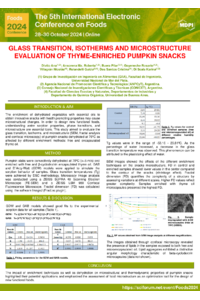
The enrichment of dehydrated vegetables with essential oils to obtain innovative snacks with health promoting properties may cause microstructural changes. In order to design new functional foods, developing water sorption properties and phase/state transitions, as well as microstructure assessments (by fractal analysis and confocal microscopy) are considered relevant tools. Pumpkin slabs were convectively dehydrated at 70ºC and enriched with free and β-cyclodextrin encapsulated thyme oil. GAB and D'Arcy and Watt (DW) models were applied to simulate the sorption behavior of the samples. Glass transition temperatures (Tg) were achieved by DSC methodology. Microscopy image analysis (fractal and confocal) was performed at the center and contours of the samples by means of ImageJ software (FracLac plugin), using images obtained with a Scanning Electron Microscope (FE-SEM) SUPRA 40 (ZEISS) with a magnification range of 500 to 5000X. The GAB and DW models showed good fits to the experimental sorption data for all samples. Thermograms showed the water plasticization effects and that the Tg were in the range of -53.16 - 29.81ºC. The SEM images showed the effects of the different enrichment techniques on the snacks' microstructure, evidenced by differences in the spatial arrangement of the cell and the intercellular space. Fractal dimensions (FDs) in the control and enriched samples showed lower values in the center compared to the contour of the snacks (shrinkage effect). Samples enriched with thyme oil microcapsules presented the highest FDs. The images obtained through confocal microscopy revealed the presence of lipids in the samples exposed to both free and microencapsulated oil. Lipid aggregates exhibited a distinctive angular morphology characteristic of beta-cyclodextrin microcapsules. The impact of enrichment techniques on the microstructural and thermodynamic properties of snacks highlighted their potential applications and emphasized the assessment of food microstructure as an optimization tool for the design of new functional foods based on bioactive compounds.
Keywords
MICROSTRUCTURE
FRACTAL ANALYSIS
PHASE/STATE TRANSITIONS
FUNCTIONAL FOODS
PUMPKIN SNACKS
Poster
Poster Divito Ana - Foods 2024.pdf
Isolation of lactic acid bacteria and yeasts from fermented corn gruels with angiotensin-converting enzyme (ACE) and hydroxymethylglutaryl-coenzyme A (HMG-CoA) reductase-inhibitory activities
Preparation and characterization of canola oil-based nanoemulsions