Event submissions
Published
This submission belongs to the session S5. Chemistry and Physicochemical Properties of Foods of the event The 5th International Electronic Conference on Foods
Published date
25 Oct, 2024
Academic Editor
'%3e%3cpath%20d='M12.6657%2010.9104C12.4185%2010.325%2012.0599%209.79327%2011.6097%209.34482C11.1609%208.89508%2010.6293%208.5365%2010.0442%208.28888C10.0389%208.28626%2010.0337%208.28495%2010.0285%208.28233C10.8446%207.69279%2011.3752%206.73249%2011.3752%205.64904C11.3752%203.8542%209.92103%202.39999%208.1262%202.39999C6.33136%202.39999%204.87715%203.8542%204.87715%205.64904C4.87715%206.73249%205.40774%207.69279%206.22393%208.28364C6.21869%208.28626%206.21345%208.28757%206.20821%208.29019C5.62129%208.5378%205.09463%208.89284%204.64265%209.34613C4.1929%209.79493%203.83432%2010.3266%203.58671%2010.9117C3.34345%2011.4845%203.21226%2012.0987%203.20023%2012.7209C3.19988%2012.7349%203.20233%2012.7488%203.20744%2012.7619C3.21255%2012.7749%203.22022%2012.7867%203.22998%2012.7968C3.23975%2012.8068%203.25142%2012.8147%203.26431%2012.8202C3.2772%2012.8256%203.29105%2012.8284%203.30504%2012.8284H4.09109C4.14874%2012.8284%204.19459%2012.7825%204.1959%2012.7262C4.2221%2011.7148%204.62823%2010.7676%205.34617%2010.0497C6.08899%209.30683%207.0755%208.89808%208.1262%208.89808C9.17689%208.89808%2010.1634%209.30683%2010.9062%2010.0497C11.6242%2010.7676%2012.0303%2011.7148%2012.0565%2012.7262C12.0578%2012.7838%2012.1037%2012.8284%2012.1613%2012.8284H12.9474C12.9613%2012.8284%2012.9752%2012.8256%2012.9881%2012.8202C13.001%2012.8147%2013.0126%2012.8068%2013.0224%2012.7968C13.0322%2012.7867%2013.0398%2012.7749%2013.0449%2012.7619C13.0501%2012.7488%2013.0525%2012.7349%2013.0522%2012.7209C13.0391%2012.0947%2012.9094%2011.4855%2012.6657%2010.9104ZM8.1262%207.9024C7.52486%207.9024%206.9589%207.6679%206.53312%207.24211C6.10733%206.81633%205.87283%206.25037%205.87283%205.64904C5.87283%205.0477%206.10733%204.48174%206.53312%204.05596C6.9589%203.63018%207.52486%203.39567%208.1262%203.39567C8.72753%203.39567%209.29349%203.63018%209.71927%204.05596C10.1451%204.48174%2010.3796%205.0477%2010.3796%205.64904C10.3796%206.25037%2010.1451%206.81633%209.71927%207.24211C9.29349%207.6679%208.72753%207.9024%208.1262%207.9024Z'%20fill='%235D1EE1'/%3e%3c/g%3e%3c/svg%3e) Joana Amaral
Joana AmaralCitation
Maria Avila, Valeria Silva, Melissa Vivanco, Saby Zegarra, Mayra Anticona, Characterization of the phenolic profile of sacha inchi (plukenetia volubilis) shell extract, in Proceedings of The 5th International Electronic Conference on Foods, 28 October–30 October 2024, MDPI: Basel, Switzerland
Share
Email
Facebook
Twitter
LinkedIn
Characterization of the phenolic profile of sacha inchi (plukenetia volubilis) shell extract
'%3e%3cpath%20d='M12.6647%2010.9104C12.4176%2010.325%2012.0589%209.7933%2011.6088%209.34485C11.16%208.89511%2010.6283%208.53653%2010.0432%208.28891C10.038%208.28629%2010.0327%208.28498%2010.0275%208.28236C10.8437%207.69282%2011.3743%206.73252%2011.3743%205.64907C11.3743%203.85423%209.92005%202.40002%208.12522%202.40002C6.33038%202.40002%204.87618%203.85423%204.87618%205.64907C4.87618%206.73252%205.40677%207.69282%206.22296%208.28367C6.21772%208.28629%206.21248%208.2876%206.20724%208.29022C5.62031%208.53783%205.09365%208.89287%204.64167%209.34616C4.19192%209.79496%203.83334%2010.3266%203.58573%2010.9117C3.34247%2011.4846%203.21128%2012.0987%203.19925%2012.721C3.1989%2012.735%203.20135%2012.7489%203.20646%2012.7619C3.21157%2012.7749%203.21924%2012.7868%203.22901%2012.7968C3.23877%2012.8068%203.25045%2012.8148%203.26334%2012.8202C3.27623%2012.8256%203.29007%2012.8284%203.30406%2012.8284H4.09012C4.14776%2012.8284%204.19362%2012.7825%204.19493%2012.7262C4.22113%2011.7148%204.62726%2010.7676%205.34519%2010.0497C6.08802%209.30686%207.07452%208.89811%208.12522%208.89811C9.17592%208.89811%2010.1624%209.30686%2010.9052%2010.0497C11.6232%2010.7676%2012.0293%2011.7148%2012.0555%2012.7262C12.0568%2012.7839%2012.1027%2012.8284%2012.1603%2012.8284H12.9464C12.9604%2012.8284%2012.9742%2012.8256%2012.9871%2012.8202C13%2012.8148%2013.0117%2012.8068%2013.0214%2012.7968C13.0312%2012.7868%2013.0389%2012.7749%2013.044%2012.7619C13.0491%2012.7489%2013.0515%2012.735%2013.0512%2012.721C13.0381%2012.0947%2012.9084%2011.4856%2012.6647%2010.9104ZM8.12522%207.90243C7.52388%207.90243%206.95792%207.66793%206.53214%207.24215C6.10636%206.81636%205.87185%206.2504%205.87185%205.64907C5.87185%205.04773%206.10636%204.48177%206.53214%204.05599C6.95792%203.63021%207.52388%203.3957%208.12522%203.3957C8.72655%203.3957%209.29252%203.63021%209.7183%204.05599C10.1441%204.48177%2010.3786%205.04773%2010.3786%205.64907C10.3786%206.2504%2010.1441%206.81636%209.7183%207.24215C9.29252%207.66793%208.72655%207.90243%208.12522%207.90243Z'%20fill='%235D1EE1'/%3e%3c/g%3e%3c/svg%3e)
Maria Avila 1
Valeria Silva 1
Melissa Vivanco 1
Saby Zegarra 1

Mayra Anticona 2
1. Nutrition and Dietetics Program, Faculty of Health Sciences, Universidad Peruana de Ciencias Aplicadas, Av. Alameda San Marcos 370, 15067, Chorrillos, Lima, Peru.
2. - Research Unit in Nutrition, Health, Functional Foods, and Nutraceuticals, Universidad San Ignacio de Loyola (UNUSAN-USIL), Av. La Fontana 550, 15024, Lima, Peru.
-Nutrition and Dietetics Program, Faculty of Health Sciences, Universidad San Ignacio de
Abstract
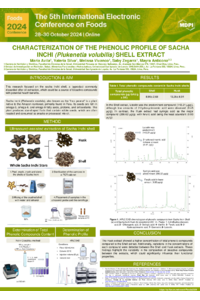
Introduction: This research focused on the sacha inchi shell, a byproduct commonly discarded after oil extraction, which could be a source of bioactive compounds with potential health benefits.
Methodology: Two ethanolic extracts from the sacha inchi shell, named Sacha Inchi Estrella (SIE) and Sacha Inchi Almendra (SIA), were obtained using ultrasound-assisted extraction using the Benchmark Scientific Pulse 150 ultrasonic homogenizer at a frequency of 20 kHz and intensity of 150 W. The process was carried out over a period of 15 minutes at a temperature of 35 °C, with pulses of 1 second ON and 2 seconds OFF. The total phenolic content was determined using the Folin-Ciocalteu method, and the phenolic profile was characterized by high-performance liquid chromatography with a diode-array detector (HPLC-DAD).
Results: The results showed that SIA contained 8,86 ± 2.68 µg GAE/g dry shell, while SIE contained 13,35 ± 8.04 µg GAE/g dry shell. Both extracts contained phenolic acids and flavonoids. In the SIA extract, luteolin was the predominant compound (143.21 µg/g), although low amounts of 2-hydroxycinnamic acid were observed (0.45 µg/g). In contrast, the SIE extract had syringic acid as the major compound (286.62 µg/g), with ferulic acid being the least abundant (0.93 µg/g).
Conclusions: The SIE extract showed a higher concentration of total phenolic compounds compared to the SIA extract. Additionally, variations in the concentrations of each compound were detected between the SIA and SIE shell extracts. These findings highlight the variability in the composition of bioactive compounds between the extracts, which could significantly influence their functional properties.
Keywords
Sacha Inchi
shell
extract
phenolic compounds
Poster
CHARACTERIZATION OF THE PHENOLIC PROFILE OF SACHA INCHI (Plukenetia volubilis) SHELL EXTRACT.pdf
Multisensory Interaction Patterns in Food Innovation Development: A Case Study of Gustatory Interaction
Exploring Phenylalanine Gels: Innovations in Food Gelling Agents