Event submissions
Published
This submission belongs to the session S2. Food Nutrition and Functional Foods of the event The 5th International Electronic Conference on Foods
Published date
25 Oct, 2024
Academic Editor
'%3e%3cpath%20d='M12.6657%2010.9104C12.4185%2010.325%2012.0599%209.79327%2011.6097%209.34482C11.1609%208.89508%2010.6293%208.5365%2010.0442%208.28888C10.0389%208.28626%2010.0337%208.28495%2010.0285%208.28233C10.8446%207.69279%2011.3752%206.73249%2011.3752%205.64904C11.3752%203.8542%209.92103%202.39999%208.1262%202.39999C6.33136%202.39999%204.87715%203.8542%204.87715%205.64904C4.87715%206.73249%205.40774%207.69279%206.22393%208.28364C6.21869%208.28626%206.21345%208.28757%206.20821%208.29019C5.62129%208.5378%205.09463%208.89284%204.64265%209.34613C4.1929%209.79493%203.83432%2010.3266%203.58671%2010.9117C3.34345%2011.4845%203.21226%2012.0987%203.20023%2012.7209C3.19988%2012.7349%203.20233%2012.7488%203.20744%2012.7619C3.21255%2012.7749%203.22022%2012.7867%203.22998%2012.7968C3.23975%2012.8068%203.25142%2012.8147%203.26431%2012.8202C3.2772%2012.8256%203.29105%2012.8284%203.30504%2012.8284H4.09109C4.14874%2012.8284%204.19459%2012.7825%204.1959%2012.7262C4.2221%2011.7148%204.62823%2010.7676%205.34617%2010.0497C6.08899%209.30683%207.0755%208.89808%208.1262%208.89808C9.17689%208.89808%2010.1634%209.30683%2010.9062%2010.0497C11.6242%2010.7676%2012.0303%2011.7148%2012.0565%2012.7262C12.0578%2012.7838%2012.1037%2012.8284%2012.1613%2012.8284H12.9474C12.9613%2012.8284%2012.9752%2012.8256%2012.9881%2012.8202C13.001%2012.8147%2013.0126%2012.8068%2013.0224%2012.7968C13.0322%2012.7867%2013.0398%2012.7749%2013.0449%2012.7619C13.0501%2012.7488%2013.0525%2012.7349%2013.0522%2012.7209C13.0391%2012.0947%2012.9094%2011.4855%2012.6657%2010.9104ZM8.1262%207.9024C7.52486%207.9024%206.9589%207.6679%206.53312%207.24211C6.10733%206.81633%205.87283%206.25037%205.87283%205.64904C5.87283%205.0477%206.10733%204.48174%206.53312%204.05596C6.9589%203.63018%207.52486%203.39567%208.1262%203.39567C8.72753%203.39567%209.29349%203.63018%209.71927%204.05596C10.1451%204.48174%2010.3796%205.0477%2010.3796%205.64904C10.3796%206.25037%2010.1451%206.81633%209.71927%207.24211C9.29349%207.6679%208.72753%207.9024%208.1262%207.9024Z'%20fill='%235D1EE1'/%3e%3c/g%3e%3c/svg%3e) Antonello Santini
Antonello SantiniCitation
Susana Diez, María Clara Tarifa, Daniela Salvatori, Lorena Franceschinis, Functional ingredients based on Jerusalem artichoke: technological properties, antioxidant activity, and prebiotic capacity, in Proceedings of The 5th International Electronic Conference on Foods, 28 October–30 October 2024, MDPI: Basel, Switzerland
Share
Email
Facebook
Twitter
LinkedIn
Functional ingredients based on Jerusalem artichoke: technological properties, antioxidant activity, and prebiotic capacity
'%3e%3cpath%20d='M12.6647%2010.9104C12.4176%2010.325%2012.0589%209.7933%2011.6088%209.34485C11.16%208.89511%2010.6283%208.53653%2010.0432%208.28891C10.038%208.28629%2010.0327%208.28498%2010.0275%208.28236C10.8437%207.69282%2011.3743%206.73252%2011.3743%205.64907C11.3743%203.85423%209.92005%202.40002%208.12522%202.40002C6.33038%202.40002%204.87618%203.85423%204.87618%205.64907C4.87618%206.73252%205.40677%207.69282%206.22296%208.28367C6.21772%208.28629%206.21248%208.2876%206.20724%208.29022C5.62031%208.53783%205.09365%208.89287%204.64167%209.34616C4.19192%209.79496%203.83334%2010.3266%203.58573%2010.9117C3.34247%2011.4846%203.21128%2012.0987%203.19925%2012.721C3.1989%2012.735%203.20135%2012.7489%203.20646%2012.7619C3.21157%2012.7749%203.21924%2012.7868%203.22901%2012.7968C3.23877%2012.8068%203.25045%2012.8148%203.26334%2012.8202C3.27623%2012.8256%203.29007%2012.8284%203.30406%2012.8284H4.09012C4.14776%2012.8284%204.19362%2012.7825%204.19493%2012.7262C4.22113%2011.7148%204.62726%2010.7676%205.34519%2010.0497C6.08802%209.30686%207.07452%208.89811%208.12522%208.89811C9.17592%208.89811%2010.1624%209.30686%2010.9052%2010.0497C11.6232%2010.7676%2012.0293%2011.7148%2012.0555%2012.7262C12.0568%2012.7839%2012.1027%2012.8284%2012.1603%2012.8284H12.9464C12.9604%2012.8284%2012.9742%2012.8256%2012.9871%2012.8202C13%2012.8148%2013.0117%2012.8068%2013.0214%2012.7968C13.0312%2012.7868%2013.0389%2012.7749%2013.044%2012.7619C13.0491%2012.7489%2013.0515%2012.735%2013.0512%2012.721C13.0381%2012.0947%2012.9084%2011.4856%2012.6647%2010.9104ZM8.12522%207.90243C7.52388%207.90243%206.95792%207.66793%206.53214%207.24215C6.10636%206.81636%205.87185%206.2504%205.87185%205.64907C5.87185%205.04773%206.10636%204.48177%206.53214%204.05599C6.95792%203.63021%207.52388%203.3957%208.12522%203.3957C8.72655%203.3957%209.29252%203.63021%209.7183%204.05599C10.1441%204.48177%2010.3786%205.04773%2010.3786%205.64907C10.3786%206.2504%2010.1441%206.81636%209.7183%207.24215C9.29252%207.66793%208.72655%207.90243%208.12522%207.90243Z'%20fill='%235D1EE1'/%3e%3c/g%3e%3c/svg%3e)
Susana Diez 1,2
María Clara Tarifa 3

Daniela Salvatori 2,4
Lorena Franceschinis 2,4
1. PROBIEN (CONICET-UNCo), Universidad Nacional del Comahue, Neuquén, (8300), Argentina
2. Facultad de Ciencias y Tecnología de los Alimentos, Universidad Nacional del Comahue, Villa Regina, (8336), Argentina
3. CIT RÍO NEGRO (CONICET-UNRN), Universidad Nacional de Río Negro, Villa Regina, (8336), Argentina
4. PROBIEN (CONICET-UNCo), Universidad Nacional del Comahue, Neuquén, (8300), Argentina
Abstract
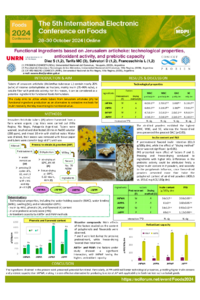
This study aims to utilize whole tubers of Jerusalem artichoke (JA) for functional ingredient production as an alternative to extractive methods for inulin recovery, thereby maximizing its nutritional value. A 22 experimental design with “pretreatment” and “drying method” as factors was used. Levels for “pretreatment”: water immersion (W) and pressing (3 cycles of 5, 10, and 13 tn, 1 min) with citric acid dip pH=3.5 (P). Levels for “drying method”: air-drying at 60ºC, 5% HR (A) and freeze-drying (0.22 mbars, T=-84ºC, 48 h) (F). After milling, the JA powders (JAPWA, JAPPA, JAPWF, JAPPF) were analyzed for their technological properties, including the capacity of water holding (WHC), water binding (WBC), swelling (SC), and oil absorption (OAC). Their inulin, mineral, phenolic, and flavonoid content was also determined. Additionally, their in vitro prebiotic activity score (PAS) and antioxidant capacity were measured using the ABTS+˙ and FRAP methods. The air-dried powders exhibited the highest WHC, WBC, and SC, whereas the freeze-dried ones presented the greatest OAC (p<0.05). The “pretreatment” showed a significant effect on inulin content, and P favored retention (61±3 g/100 g ms). However, the “drying method” did not have a significant effect on inulin content. The highest PAS was observed in JAPPF (1.12±0.08), while the lowest was registered for JAPWA (0.58±0.04). These differences could be attributed to the influence of polyphenols, since freeze-dried powders presented more than twice the polyphenol content of air-dried powders (400±5 vs. 193±6 mg AGE/100g ms). JAPPA exhibited better technological properties, providing higher inulin content and prebiotic capacity than JAPWA, making it a cost-effective alternative for producing functional JAP with applicability in food matrices such as baked goods.
Keywords
Helianthus tuberosus L.
air-drying
freeze-drying
inulin
phenolic compounds
Poster
Diez et al. Session Food Nutrition and Functional Foods.pdf
L-theanine extends the lifespan of C. elegans by reducing the end products of advanced glycosylation
Effect of added carbohydrates on the quality of sourdough and sourdough bread