Event submissions
Published
This submission belongs to the session S3. Sustainable Food Security and Food System of the event The 5th International Electronic Conference on Foods
Published date
25 Oct, 2024
Academic Editor
'%3e%3cpath%20d='M12.6657%2010.9104C12.4185%2010.325%2012.0599%209.79327%2011.6097%209.34482C11.1609%208.89508%2010.6293%208.5365%2010.0442%208.28888C10.0389%208.28626%2010.0337%208.28495%2010.0285%208.28233C10.8446%207.69279%2011.3752%206.73249%2011.3752%205.64904C11.3752%203.8542%209.92103%202.39999%208.1262%202.39999C6.33136%202.39999%204.87715%203.8542%204.87715%205.64904C4.87715%206.73249%205.40774%207.69279%206.22393%208.28364C6.21869%208.28626%206.21345%208.28757%206.20821%208.29019C5.62129%208.5378%205.09463%208.89284%204.64265%209.34613C4.1929%209.79493%203.83432%2010.3266%203.58671%2010.9117C3.34345%2011.4845%203.21226%2012.0987%203.20023%2012.7209C3.19988%2012.7349%203.20233%2012.7488%203.20744%2012.7619C3.21255%2012.7749%203.22022%2012.7867%203.22998%2012.7968C3.23975%2012.8068%203.25142%2012.8147%203.26431%2012.8202C3.2772%2012.8256%203.29105%2012.8284%203.30504%2012.8284H4.09109C4.14874%2012.8284%204.19459%2012.7825%204.1959%2012.7262C4.2221%2011.7148%204.62823%2010.7676%205.34617%2010.0497C6.08899%209.30683%207.0755%208.89808%208.1262%208.89808C9.17689%208.89808%2010.1634%209.30683%2010.9062%2010.0497C11.6242%2010.7676%2012.0303%2011.7148%2012.0565%2012.7262C12.0578%2012.7838%2012.1037%2012.8284%2012.1613%2012.8284H12.9474C12.9613%2012.8284%2012.9752%2012.8256%2012.9881%2012.8202C13.001%2012.8147%2013.0126%2012.8068%2013.0224%2012.7968C13.0322%2012.7867%2013.0398%2012.7749%2013.0449%2012.7619C13.0501%2012.7488%2013.0525%2012.7349%2013.0522%2012.7209C13.0391%2012.0947%2012.9094%2011.4855%2012.6657%2010.9104ZM8.1262%207.9024C7.52486%207.9024%206.9589%207.6679%206.53312%207.24211C6.10733%206.81633%205.87283%206.25037%205.87283%205.64904C5.87283%205.0477%206.10733%204.48174%206.53312%204.05596C6.9589%203.63018%207.52486%203.39567%208.1262%203.39567C8.72753%203.39567%209.29349%203.63018%209.71927%204.05596C10.1451%204.48174%2010.3796%205.0477%2010.3796%205.64904C10.3796%206.25037%2010.1451%206.81633%209.71927%207.24211C9.29349%207.6679%208.72753%207.9024%208.1262%207.9024Z'%20fill='%235D1EE1'/%3e%3c/g%3e%3c/svg%3e) Theodoros Varzakas
Theodoros VarzakasCitation
Kahkashan Perveen, Asma A. Al-Huqail, Sandip Debnath, Alanoud T. Alfagham, Faheema Khan, Fakhrul Islam Monshi, Enhancing Soybean Drought Resilience with Natural Compounds: How Curcumin and Lupenone Influence Heme Oxygenase-1, in Proceedings of The 5th International Electronic Conference on Foods, 28 October–30 October 2024, MDPI: Basel, Switzerland
Share
Email
Facebook
Twitter
LinkedIn
Enhancing Soybean Drought Resilience with Natural Compounds: How Curcumin and Lupenone Influence Heme Oxygenase-1
'%3e%3cpath%20d='M12.6647%2010.9104C12.4176%2010.325%2012.0589%209.7933%2011.6088%209.34485C11.16%208.89511%2010.6283%208.53653%2010.0432%208.28891C10.038%208.28629%2010.0327%208.28498%2010.0275%208.28236C10.8437%207.69282%2011.3743%206.73252%2011.3743%205.64907C11.3743%203.85423%209.92005%202.40002%208.12522%202.40002C6.33038%202.40002%204.87618%203.85423%204.87618%205.64907C4.87618%206.73252%205.40677%207.69282%206.22296%208.28367C6.21772%208.28629%206.21248%208.2876%206.20724%208.29022C5.62031%208.53783%205.09365%208.89287%204.64167%209.34616C4.19192%209.79496%203.83334%2010.3266%203.58573%2010.9117C3.34247%2011.4846%203.21128%2012.0987%203.19925%2012.721C3.1989%2012.735%203.20135%2012.7489%203.20646%2012.7619C3.21157%2012.7749%203.21924%2012.7868%203.22901%2012.7968C3.23877%2012.8068%203.25045%2012.8148%203.26334%2012.8202C3.27623%2012.8256%203.29007%2012.8284%203.30406%2012.8284H4.09012C4.14776%2012.8284%204.19362%2012.7825%204.19493%2012.7262C4.22113%2011.7148%204.62726%2010.7676%205.34519%2010.0497C6.08802%209.30686%207.07452%208.89811%208.12522%208.89811C9.17592%208.89811%2010.1624%209.30686%2010.9052%2010.0497C11.6232%2010.7676%2012.0293%2011.7148%2012.0555%2012.7262C12.0568%2012.7839%2012.1027%2012.8284%2012.1603%2012.8284H12.9464C12.9604%2012.8284%2012.9742%2012.8256%2012.9871%2012.8202C13%2012.8148%2013.0117%2012.8068%2013.0214%2012.7968C13.0312%2012.7868%2013.0389%2012.7749%2013.044%2012.7619C13.0491%2012.7489%2013.0515%2012.735%2013.0512%2012.721C13.0381%2012.0947%2012.9084%2011.4856%2012.6647%2010.9104ZM8.12522%207.90243C7.52388%207.90243%206.95792%207.66793%206.53214%207.24215C6.10636%206.81636%205.87185%206.2504%205.87185%205.64907C5.87185%205.04773%206.10636%204.48177%206.53214%204.05599C6.95792%203.63021%207.52388%203.3957%208.12522%203.3957C8.72655%203.3957%209.29252%203.63021%209.7183%204.05599C10.1441%204.48177%2010.3786%205.04773%2010.3786%205.64907C10.3786%206.2504%2010.1441%206.81636%209.7183%207.24215C9.29252%207.66793%208.72655%207.90243%208.12522%207.90243Z'%20fill='%235D1EE1'/%3e%3c/g%3e%3c/svg%3e)
Kahkashan Perveen 1
Asma A. Al-Huqail 1
Sandip Debnath 2
Alanoud T. Alfagham 1
Faheema Khan 1

Fakhrul Islam Monshi 3
1. Chair of Department of Botany & Microbiology, College of Science, King Saud University, Riyadh-11495, Saudi Arabia
2. Department of Genetics and Plant Breeding, Institute of Agriculture, Visva-Bharati University, Sriniketan, West Bengal-731236, India
3. Department of Genetics and Plant Breeding, Sylhet Agricultural University, Sylhet-3100, Bangladesh.
Abstract
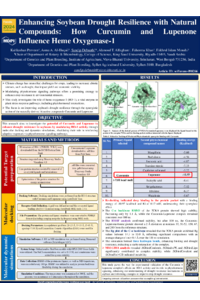
Climate change exacerbates drought, impacting crop yields and food security. This study investigates how the bioactive compounds Curcumin and Lupenone can enhance drought resilience in soybean (Glycine max) by modulating the enzyme heme oxygenase-1 (HO-1), which is crucial for stress responses. We used molecular docking and molecular dynamics (MD) simulations to explore the interactions between these compounds and HO-1. Our molecular docking analysis revealed that Curcumin and Lupenone exhibit strong binding affinities to HO-1, with Curcumin displaying a binding free energy (ΔG) of -7.81 kcal/mol, and the Curcumin+Lupenone complex showing a significantly enhanced binding energy of -12.57 kcal/mol. This complex demonstrated high stability, indicated by a total internal energy of 0.67 kJ/mol and low torsion energy of 0.03 kJ/mol, suggesting a synergistic effect that could potentiate HO-1’s role in drought stress adaptation. MD simulations over 100 ns further confirmed the stability of the Curcumin+Lupenone-HO-1 complex, with minimal root mean square deviation (RMSD) fluctuations and consistent root mean square fluctuation (RMSF) values. The simulations indicated robust hydrogen bonding interactions, contributing to the complex's stability and potential effectiveness in vivo. The radius of gyration (Rg) values oscillated between 14.7 to 15.0 Å, indicating the significant compactness and stability of the protein–ligand complex. These findings lay the groundwork for future experimental validation in live plants and examining their impact on phytohormone signaling pathways through comprehensive laboratory and field studies. Understanding the downstream signaling networks and specific targets influenced by these compounds could deepen insights into the molecular mechanisms underlying drought resistance in soybeans and potentially other crops. This research offers promising strategies for sustainable agricultural practices, enhancing crop resilience to drought and supporting global food security. By integrating natural bioactive compounds into crop management, we can develop innovative solutions to mitigate the adverse effects of climate change on agriculture.
Keywords
Soybean
Curcumin
Lupenone
Phytohormone signaling
Drought resistance
Molecular docking
HO-1
Food security
Sustainability
Poster
Soybean HO-1+C+L_updated .pdf
Phytochemical characterization and antioxidant activity evaluation of the bioactive compounds in fruits (pulp and pits) of wild and cultivated forms of cherry laurel (Prunus laurocerasus) in Georgia
Flour composition and starch functional and physicochemical properties of runner bean (Phaseolus coccineus) starches