Event submissions
Published
This submission belongs to the session S2. Food Nutrition and Functional Foods of the event The 5th International Electronic Conference on Foods
Published date
25 Oct, 2024
Academic Editor
'%3e%3cpath%20d='M12.6657%2010.9104C12.4185%2010.325%2012.0599%209.79327%2011.6097%209.34482C11.1609%208.89508%2010.6293%208.5365%2010.0442%208.28888C10.0389%208.28626%2010.0337%208.28495%2010.0285%208.28233C10.8446%207.69279%2011.3752%206.73249%2011.3752%205.64904C11.3752%203.8542%209.92103%202.39999%208.1262%202.39999C6.33136%202.39999%204.87715%203.8542%204.87715%205.64904C4.87715%206.73249%205.40774%207.69279%206.22393%208.28364C6.21869%208.28626%206.21345%208.28757%206.20821%208.29019C5.62129%208.5378%205.09463%208.89284%204.64265%209.34613C4.1929%209.79493%203.83432%2010.3266%203.58671%2010.9117C3.34345%2011.4845%203.21226%2012.0987%203.20023%2012.7209C3.19988%2012.7349%203.20233%2012.7488%203.20744%2012.7619C3.21255%2012.7749%203.22022%2012.7867%203.22998%2012.7968C3.23975%2012.8068%203.25142%2012.8147%203.26431%2012.8202C3.2772%2012.8256%203.29105%2012.8284%203.30504%2012.8284H4.09109C4.14874%2012.8284%204.19459%2012.7825%204.1959%2012.7262C4.2221%2011.7148%204.62823%2010.7676%205.34617%2010.0497C6.08899%209.30683%207.0755%208.89808%208.1262%208.89808C9.17689%208.89808%2010.1634%209.30683%2010.9062%2010.0497C11.6242%2010.7676%2012.0303%2011.7148%2012.0565%2012.7262C12.0578%2012.7838%2012.1037%2012.8284%2012.1613%2012.8284H12.9474C12.9613%2012.8284%2012.9752%2012.8256%2012.9881%2012.8202C13.001%2012.8147%2013.0126%2012.8068%2013.0224%2012.7968C13.0322%2012.7867%2013.0398%2012.7749%2013.0449%2012.7619C13.0501%2012.7488%2013.0525%2012.7349%2013.0522%2012.7209C13.0391%2012.0947%2012.9094%2011.4855%2012.6657%2010.9104ZM8.1262%207.9024C7.52486%207.9024%206.9589%207.6679%206.53312%207.24211C6.10733%206.81633%205.87283%206.25037%205.87283%205.64904C5.87283%205.0477%206.10733%204.48174%206.53312%204.05596C6.9589%203.63018%207.52486%203.39567%208.1262%203.39567C8.72753%203.39567%209.29349%203.63018%209.71927%204.05596C10.1451%204.48174%2010.3796%205.0477%2010.3796%205.64904C10.3796%206.25037%2010.1451%206.81633%209.71927%207.24211C9.29349%207.6679%208.72753%207.9024%208.1262%207.9024Z'%20fill='%235D1EE1'/%3e%3c/g%3e%3c/svg%3e) Antonello Santini
Antonello SantiniCitation
Selene Isabel Alvarez-Chávez, Itzury Reyes-Ramírez, Luis Guillermo González-Olivares, Jesús Guadalupe Pérez-Flores, Elizabeth Contreras-López, Laura García-Curiel, Laura Berenice Olvera-Rosales, Emmanuel Pérez-Escalante, WPC-80 hydrolysates as a promising functional ingredient for diabetes control via DPP-IV inhibition, in Proceedings of The 5th International Electronic Conference on Foods, 28 October–30 October 2024, MDPI: Basel, Switzerland
Share
Email
Facebook
Twitter
LinkedIn
WPC-80 hydrolysates as a promising functional ingredient for diabetes control via DPP-IV inhibition
'%3e%3cpath%20d='M12.6647%2010.9104C12.4176%2010.325%2012.0589%209.7933%2011.6088%209.34485C11.16%208.89511%2010.6283%208.53653%2010.0432%208.28891C10.038%208.28629%2010.0327%208.28498%2010.0275%208.28236C10.8437%207.69282%2011.3743%206.73252%2011.3743%205.64907C11.3743%203.85423%209.92005%202.40002%208.12522%202.40002C6.33038%202.40002%204.87618%203.85423%204.87618%205.64907C4.87618%206.73252%205.40677%207.69282%206.22296%208.28367C6.21772%208.28629%206.21248%208.2876%206.20724%208.29022C5.62031%208.53783%205.09365%208.89287%204.64167%209.34616C4.19192%209.79496%203.83334%2010.3266%203.58573%2010.9117C3.34247%2011.4846%203.21128%2012.0987%203.19925%2012.721C3.1989%2012.735%203.20135%2012.7489%203.20646%2012.7619C3.21157%2012.7749%203.21924%2012.7868%203.22901%2012.7968C3.23877%2012.8068%203.25045%2012.8148%203.26334%2012.8202C3.27623%2012.8256%203.29007%2012.8284%203.30406%2012.8284H4.09012C4.14776%2012.8284%204.19362%2012.7825%204.19493%2012.7262C4.22113%2011.7148%204.62726%2010.7676%205.34519%2010.0497C6.08802%209.30686%207.07452%208.89811%208.12522%208.89811C9.17592%208.89811%2010.1624%209.30686%2010.9052%2010.0497C11.6232%2010.7676%2012.0293%2011.7148%2012.0555%2012.7262C12.0568%2012.7839%2012.1027%2012.8284%2012.1603%2012.8284H12.9464C12.9604%2012.8284%2012.9742%2012.8256%2012.9871%2012.8202C13%2012.8148%2013.0117%2012.8068%2013.0214%2012.7968C13.0312%2012.7868%2013.0389%2012.7749%2013.044%2012.7619C13.0491%2012.7489%2013.0515%2012.735%2013.0512%2012.721C13.0381%2012.0947%2012.9084%2011.4856%2012.6647%2010.9104ZM8.12522%207.90243C7.52388%207.90243%206.95792%207.66793%206.53214%207.24215C6.10636%206.81636%205.87185%206.2504%205.87185%205.64907C5.87185%205.04773%206.10636%204.48177%206.53214%204.05599C6.95792%203.63021%207.52388%203.3957%208.12522%203.3957C8.72655%203.3957%209.29252%203.63021%209.7183%204.05599C10.1441%204.48177%2010.3786%205.04773%2010.3786%205.64907C10.3786%206.2504%2010.1441%206.81636%209.7183%207.24215C9.29252%207.66793%208.72655%207.90243%208.12522%207.90243Z'%20fill='%235D1EE1'/%3e%3c/g%3e%3c/svg%3e)
Selene Isabel Alvarez-Chávez 1
Itzury Reyes-Ramírez 1

Luis Guillermo González-Olivares 1

Jesús Guadalupe Pérez-Flores 1
Elizabeth Contreras-López 1
Laura García-Curiel 2

Laura Berenice Olvera-Rosales 1
Emmanuel Pérez-Escalante 1,3
1. Área Académica de Química. Universidad Autónoma del Estado de Hidalgo. Ciudad del Conocimiento. Carretera Pachuca-Tulancingo km 4.5 Colonia Carboneras. CP. 42184. Mineral de la Reforma, Hidalgo, México.
2. Área Académica de Enfermería. Instituto de Ciencias de la Salud. Universidad Autónoma del Estado de Hidalgo. Circuito Ex-Hacienda La Concepción S/N, Carretera Pachuca-Actopan. CP. 42060. San Agustín Tlaxiaca, Hidalgo, México.
3. Departamento de Biotecnología. División de Ciencias Biológicas y de la Salud. Universidad Autónoma Metropolitana, Unidad Iztapalapa. Av. San Rafael Atlixco 186 CP. 09340. Ciudad de México, México.
Abstract
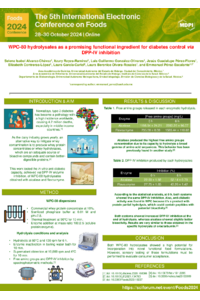
Nowadays, type 2 diabetes has become a pathology with a high incidence worldwide, causing 4.2 million deaths, especially in middle-income countries. As the dairy industry grows yearly, an alternative way to mitigate whey contamination is to produce whey protein concentrates or whey hydrolysates, which are an adequate source of bioactive compounds and contain better-digestible proteins. Thus, this work tested the in vitro anti-diabetic capacity, achieved via DPP-IV enzyme inhibition, of WPC-80 hydrolysates obtained with alcalase and flavourzyme. WPC-80 powder was dispersed at 10% (w/v) in sterile phosphate buffer (0.01 M, pH=7.5). Then, the dispersion was heated at 90°C for 10 min. Enzymatic hydrolysis was performed by enzyme addition at a 100:2.5 mass ratio (soluble protein: enzyme), and the reaction proceeded for 6 h at 60°C and 130 rpm. Hydrolysis was stopped by boiling water treatment for 10 min, and samples were centrifugated at 10,000 rpm and 4°C for 10 min. Supernatants were used for hydrolysis degree determination and for the DPP-IV inhibition test using spectrophotometric methods. Free amino group concentration was slightly superior with alcalase, rising from 1198.04±24.21 to 2283.26±96.07 mg/L from 0 to 6 h, while in flavourzyme hydrolysis, it was 735.00±0.00 at 0 h and 1585.44±110.68 mg/L at 6 h. According to statistical analysis, both systems showed the same anti-diabetic capacity at the beginning of the hydrolysis, which was 22.03±1.92% for alcalase and 27.75±1.85% for flavourzyme. At the end of hydrolysis, alcalase exhibited slightly better DPP-IV inhibition, at 52.14±0.78%, compared to flavourzyme, at 43.26±1.42%. In conclusion, both WPC-80 hydrolysates showed a high potential to be incorporated into novel functional food formulations. However, sensory testing of those formulations must be performed to evaluate consumer acceptance.
Keywords
whey concentrate
enzymatic hydrolysis
antidiabetic capacity
Poster
sciforum-098264.pdf
Importance of food waste reporting for collaboration between Australian retail, farming, and food rescue organizations
Effects of Alginate and Glycerol Concentrations Combined with Calcium Chloride as Edible Coatings on Mass Transfer During Osmotic Dehydration of Ginger Slices