Event submissions
Published
This submission belongs to the session S4. Food Microbiology of the event The 5th International Electronic Conference on Foods
Published date
25 Oct, 2024
Academic Editor
'%3e%3cpath%20d='M12.6657%2010.9104C12.4185%2010.325%2012.0599%209.79327%2011.6097%209.34482C11.1609%208.89508%2010.6293%208.5365%2010.0442%208.28888C10.0389%208.28626%2010.0337%208.28495%2010.0285%208.28233C10.8446%207.69279%2011.3752%206.73249%2011.3752%205.64904C11.3752%203.8542%209.92103%202.39999%208.1262%202.39999C6.33136%202.39999%204.87715%203.8542%204.87715%205.64904C4.87715%206.73249%205.40774%207.69279%206.22393%208.28364C6.21869%208.28626%206.21345%208.28757%206.20821%208.29019C5.62129%208.5378%205.09463%208.89284%204.64265%209.34613C4.1929%209.79493%203.83432%2010.3266%203.58671%2010.9117C3.34345%2011.4845%203.21226%2012.0987%203.20023%2012.7209C3.19988%2012.7349%203.20233%2012.7488%203.20744%2012.7619C3.21255%2012.7749%203.22022%2012.7867%203.22998%2012.7968C3.23975%2012.8068%203.25142%2012.8147%203.26431%2012.8202C3.2772%2012.8256%203.29105%2012.8284%203.30504%2012.8284H4.09109C4.14874%2012.8284%204.19459%2012.7825%204.1959%2012.7262C4.2221%2011.7148%204.62823%2010.7676%205.34617%2010.0497C6.08899%209.30683%207.0755%208.89808%208.1262%208.89808C9.17689%208.89808%2010.1634%209.30683%2010.9062%2010.0497C11.6242%2010.7676%2012.0303%2011.7148%2012.0565%2012.7262C12.0578%2012.7838%2012.1037%2012.8284%2012.1613%2012.8284H12.9474C12.9613%2012.8284%2012.9752%2012.8256%2012.9881%2012.8202C13.001%2012.8147%2013.0126%2012.8068%2013.0224%2012.7968C13.0322%2012.7867%2013.0398%2012.7749%2013.0449%2012.7619C13.0501%2012.7488%2013.0525%2012.7349%2013.0522%2012.7209C13.0391%2012.0947%2012.9094%2011.4855%2012.6657%2010.9104ZM8.1262%207.9024C7.52486%207.9024%206.9589%207.6679%206.53312%207.24211C6.10733%206.81633%205.87283%206.25037%205.87283%205.64904C5.87283%205.0477%206.10733%204.48174%206.53312%204.05596C6.9589%203.63018%207.52486%203.39567%208.1262%203.39567C8.72753%203.39567%209.29349%203.63018%209.71927%204.05596C10.1451%204.48174%2010.3796%205.0477%2010.3796%205.64904C10.3796%206.25037%2010.1451%206.81633%209.71927%207.24211C9.29349%207.6679%208.72753%207.9024%208.1262%207.9024Z'%20fill='%235D1EE1'/%3e%3c/g%3e%3c/svg%3e) Antonio Bevilacqua
Antonio BevilacquaCitation
Behnaz Azimzadeh, Muiz O. Akinyemi, Bukola Onarinde, The Encapsulation of essential oils of rosemary, cinnamon, oregano, and thyme in Saccharomyces cerevisiae to enhance their antimicrobial activity in selected foods, in Proceedings of The 5th International Electronic Conference on Foods, 28 October–30 October 2024, MDPI: Basel, Switzerland
Share
Email
Facebook
Twitter
LinkedIn
The Encapsulation of essential oils of rosemary, cinnamon, oregano, and thyme in Saccharomyces cerevisiae to enhance their antimicrobial activity in selected foods
'%3e%3cpath%20d='M12.6647%2010.9104C12.4176%2010.325%2012.0589%209.7933%2011.6088%209.34485C11.16%208.89511%2010.6283%208.53653%2010.0432%208.28891C10.038%208.28629%2010.0327%208.28498%2010.0275%208.28236C10.8437%207.69282%2011.3743%206.73252%2011.3743%205.64907C11.3743%203.85423%209.92005%202.40002%208.12522%202.40002C6.33038%202.40002%204.87618%203.85423%204.87618%205.64907C4.87618%206.73252%205.40677%207.69282%206.22296%208.28367C6.21772%208.28629%206.21248%208.2876%206.20724%208.29022C5.62031%208.53783%205.09365%208.89287%204.64167%209.34616C4.19192%209.79496%203.83334%2010.3266%203.58573%2010.9117C3.34247%2011.4846%203.21128%2012.0987%203.19925%2012.721C3.1989%2012.735%203.20135%2012.7489%203.20646%2012.7619C3.21157%2012.7749%203.21924%2012.7868%203.22901%2012.7968C3.23877%2012.8068%203.25045%2012.8148%203.26334%2012.8202C3.27623%2012.8256%203.29007%2012.8284%203.30406%2012.8284H4.09012C4.14776%2012.8284%204.19362%2012.7825%204.19493%2012.7262C4.22113%2011.7148%204.62726%2010.7676%205.34519%2010.0497C6.08802%209.30686%207.07452%208.89811%208.12522%208.89811C9.17592%208.89811%2010.1624%209.30686%2010.9052%2010.0497C11.6232%2010.7676%2012.0293%2011.7148%2012.0555%2012.7262C12.0568%2012.7839%2012.1027%2012.8284%2012.1603%2012.8284H12.9464C12.9604%2012.8284%2012.9742%2012.8256%2012.9871%2012.8202C13%2012.8148%2013.0117%2012.8068%2013.0214%2012.7968C13.0312%2012.7868%2013.0389%2012.7749%2013.044%2012.7619C13.0491%2012.7489%2013.0515%2012.735%2013.0512%2012.721C13.0381%2012.0947%2012.9084%2011.4856%2012.6647%2010.9104ZM8.12522%207.90243C7.52388%207.90243%206.95792%207.66793%206.53214%207.24215C6.10636%206.81636%205.87185%206.2504%205.87185%205.64907C5.87185%205.04773%206.10636%204.48177%206.53214%204.05599C6.95792%203.63021%207.52388%203.3957%208.12522%203.3957C8.72655%203.3957%209.29252%203.63021%209.7183%204.05599C10.1441%204.48177%2010.3786%205.04773%2010.3786%205.64907C10.3786%206.2504%2010.1441%206.81636%209.7183%207.24215C9.29252%207.66793%208.72655%207.90243%208.12522%207.90243Z'%20fill='%235D1EE1'/%3e%3c/g%3e%3c/svg%3e)
Behnaz Azimzadeh 1
Muiz O. Akinyemi 1
Bukola Onarinde 1
1. University of Lincoln
Abstract
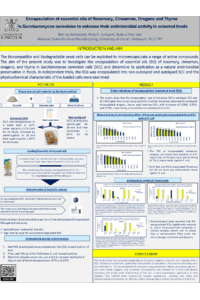
In this study, we aimed to investigate the potential of Saccharomyces cerevisiae cells (SCCs) as a vector and bio-preservative by encapsulating them with essential oils (EOs) from rosemary, cinnamon, oregano, and thyme. The encapsulation process was conducted through autolysis at temperatures ranging from 20 to 45°C for 15 minutes, with a non-autolysed control group. The morphological characteristics of the encapsulated cells were analysed using scanning electron microscopy, while the encapsulated EOs were quantified using gas chromatography–mass spectrometry. The antibacterial activity of free and encapsulated EOs was assessed against Escherichia coli using the agar well diffusion and overlay methods. Additionally, their potential as a bio preservative was evaluated by storing raw ham in vacuum- and non-vacuum-sealed containers at ambient (23 °C) and chilled (10 °C) temperatures. All experiments were conducted in triplicate. Our results indicate that autolysis at 45°C for 15 minutes yielded the highest quantity of encapsulated cinnamon (38.84 ±3.97 mg), oregano (35.54 ±3.16 mg), thyme (22.02 ±2.05 mg), and rosemary (20.58 ±4.51 mg) oil per 100 mg SCCs. The non-autolysed SCCs encapsulated lower amounts of each essential oil, ranging between 10.82 ±2.21 and 26.06 ±3.87 mg per 100 mg SCCs. The minimum inhibitory concentrations of encapsulated cinnamon, oregano, and thyme were 8.41 mg, 8.51 mg, and 23.06 mg, respectively, against E. coli. It was observed that coating ham with yeast cells loaded with the MIC of each essential oil and storing them in either vacuum- or non-vacuum-sealed containers at 10 and 23 °C was sufficient to completely prevent the proliferation of E. coli (1.5 x 10^8 CFU/ml) in the ham during six days of storage. The results of this study demonstrate the potential of encapsulated SCCs as a bio preservative, but additional research is needed to determine their effect on food quality and shelf life.
Keywords
Keywords: Essential oil
Yeast
Food safety
Food preservation
Poster
Behnaz Azimzadeh (POSTER) .pdf
Evaluation of Bacteriostatic Effect of Rosemary and Oregano Essential Oil Against a Non-Pathogenic Surrogate of Salmonella spp. (E. coli ATCC 9637)
Enhancing double-layer emulsion stability with ultrasound technology: application of citrus residues for improved sustainability