Event submissions
Published
This submission belongs to the session S1. Innovation in Food Technology and Engineering of the event The 5th International Electronic Conference on Foods
Published date
25 Oct, 2024
Academic Editor
'%3e%3cpath%20d='M12.6657%2010.9104C12.4185%2010.325%2012.0599%209.79327%2011.6097%209.34482C11.1609%208.89508%2010.6293%208.5365%2010.0442%208.28888C10.0389%208.28626%2010.0337%208.28495%2010.0285%208.28233C10.8446%207.69279%2011.3752%206.73249%2011.3752%205.64904C11.3752%203.8542%209.92103%202.39999%208.1262%202.39999C6.33136%202.39999%204.87715%203.8542%204.87715%205.64904C4.87715%206.73249%205.40774%207.69279%206.22393%208.28364C6.21869%208.28626%206.21345%208.28757%206.20821%208.29019C5.62129%208.5378%205.09463%208.89284%204.64265%209.34613C4.1929%209.79493%203.83432%2010.3266%203.58671%2010.9117C3.34345%2011.4845%203.21226%2012.0987%203.20023%2012.7209C3.19988%2012.7349%203.20233%2012.7488%203.20744%2012.7619C3.21255%2012.7749%203.22022%2012.7867%203.22998%2012.7968C3.23975%2012.8068%203.25142%2012.8147%203.26431%2012.8202C3.2772%2012.8256%203.29105%2012.8284%203.30504%2012.8284H4.09109C4.14874%2012.8284%204.19459%2012.7825%204.1959%2012.7262C4.2221%2011.7148%204.62823%2010.7676%205.34617%2010.0497C6.08899%209.30683%207.0755%208.89808%208.1262%208.89808C9.17689%208.89808%2010.1634%209.30683%2010.9062%2010.0497C11.6242%2010.7676%2012.0303%2011.7148%2012.0565%2012.7262C12.0578%2012.7838%2012.1037%2012.8284%2012.1613%2012.8284H12.9474C12.9613%2012.8284%2012.9752%2012.8256%2012.9881%2012.8202C13.001%2012.8147%2013.0126%2012.8068%2013.0224%2012.7968C13.0322%2012.7867%2013.0398%2012.7749%2013.0449%2012.7619C13.0501%2012.7488%2013.0525%2012.7349%2013.0522%2012.7209C13.0391%2012.0947%2012.9094%2011.4855%2012.6657%2010.9104ZM8.1262%207.9024C7.52486%207.9024%206.9589%207.6679%206.53312%207.24211C6.10733%206.81633%205.87283%206.25037%205.87283%205.64904C5.87283%205.0477%206.10733%204.48174%206.53312%204.05596C6.9589%203.63018%207.52486%203.39567%208.1262%203.39567C8.72753%203.39567%209.29349%203.63018%209.71927%204.05596C10.1451%204.48174%2010.3796%205.0477%2010.3796%205.64904C10.3796%206.25037%2010.1451%206.81633%209.71927%207.24211C9.29349%207.6679%208.72753%207.9024%208.1262%207.9024Z'%20fill='%235D1EE1'/%3e%3c/g%3e%3c/svg%3e) Moktar Hamdi
Moktar HamdiCitation
Mónica María Umaña Zamora, Miguel Ángel Moreno Armijo, Valeria Eim, Esperanza Dalmau, Antoni Femenia, Enhancing double-layer emulsion stability with ultrasound technology: application of citrus residues for improved sustainability, in Proceedings of The 5th International Electronic Conference on Foods, 28 October–30 October 2024, MDPI: Basel, Switzerland
Share
Email
Facebook
Twitter
LinkedIn
Enhancing double-layer emulsion stability with ultrasound technology: application of citrus residues for improved sustainability
'%3e%3cpath%20d='M12.6647%2010.9104C12.4176%2010.325%2012.0589%209.7933%2011.6088%209.34485C11.16%208.89511%2010.6283%208.53653%2010.0432%208.28891C10.038%208.28629%2010.0327%208.28498%2010.0275%208.28236C10.8437%207.69282%2011.3743%206.73252%2011.3743%205.64907C11.3743%203.85423%209.92005%202.40002%208.12522%202.40002C6.33038%202.40002%204.87618%203.85423%204.87618%205.64907C4.87618%206.73252%205.40677%207.69282%206.22296%208.28367C6.21772%208.28629%206.21248%208.2876%206.20724%208.29022C5.62031%208.53783%205.09365%208.89287%204.64167%209.34616C4.19192%209.79496%203.83334%2010.3266%203.58573%2010.9117C3.34247%2011.4846%203.21128%2012.0987%203.19925%2012.721C3.1989%2012.735%203.20135%2012.7489%203.20646%2012.7619C3.21157%2012.7749%203.21924%2012.7868%203.22901%2012.7968C3.23877%2012.8068%203.25045%2012.8148%203.26334%2012.8202C3.27623%2012.8256%203.29007%2012.8284%203.30406%2012.8284H4.09012C4.14776%2012.8284%204.19362%2012.7825%204.19493%2012.7262C4.22113%2011.7148%204.62726%2010.7676%205.34519%2010.0497C6.08802%209.30686%207.07452%208.89811%208.12522%208.89811C9.17592%208.89811%2010.1624%209.30686%2010.9052%2010.0497C11.6232%2010.7676%2012.0293%2011.7148%2012.0555%2012.7262C12.0568%2012.7839%2012.1027%2012.8284%2012.1603%2012.8284H12.9464C12.9604%2012.8284%2012.9742%2012.8256%2012.9871%2012.8202C13%2012.8148%2013.0117%2012.8068%2013.0214%2012.7968C13.0312%2012.7868%2013.0389%2012.7749%2013.044%2012.7619C13.0491%2012.7489%2013.0515%2012.735%2013.0512%2012.721C13.0381%2012.0947%2012.9084%2011.4856%2012.6647%2010.9104ZM8.12522%207.90243C7.52388%207.90243%206.95792%207.66793%206.53214%207.24215C6.10636%206.81636%205.87185%206.2504%205.87185%205.64907C5.87185%205.04773%206.10636%204.48177%206.53214%204.05599C6.95792%203.63021%207.52388%203.3957%208.12522%203.3957C8.72655%203.3957%209.29252%203.63021%209.7183%204.05599C10.1441%204.48177%2010.3786%205.04773%2010.3786%205.64907C10.3786%206.2504%2010.1441%206.81636%209.7183%207.24215C9.29252%207.66793%208.72655%207.90243%208.12522%207.90243Z'%20fill='%235D1EE1'/%3e%3c/g%3e%3c/svg%3e)
Mónica María Umaña Zamora 1
Miguel Ángel Moreno Armijo 1
Valeria Eim 1
Esperanza Dalmau 1
Antoni Femenia 1
1. Universitat de les Illes Balears
Abstract
Introduction:
In the food industry, emulsions are crucial components of various products. The use
of ultrasounds in the preparation of emulsions is gaining attention due to their ability
to stabilize emulsions through cavitation effects. Double-layer emulsions stabilized
using proteins and polysaccharides are particularly noteworthy due to the natural
origin of these polymers. Natural polysaccharides, such as pectins, can be sourced
from citrus industry residues, with oranges contributing approximately 50% of their
weight as waste.
Methods:
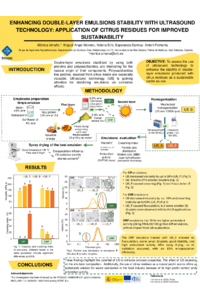
This study investigates ultrasound application by probe (154±10 W/L) or by bath
(50±4 W/L) in the stabilization of double-layer emulsions containing sunflower oil
(4% of the emulsion) in water, soy protein (0.3% of the emulsion), and either
commercial pure pectins (Sigma Aldrich) (0.2% of the emulsion) or an orange
residue rich in pectins (23±1 g/100 g dry base) (2.4% of the emulsion). The
emulsions were analyzed by assessing their viscosity, creaming index, and
microstructure and the best emulsion was spray-dried to microencapsulate the oil.
Results:
The results indicated that applying ultrasound via a probe to emulsions with
commercial pectin compromised its microstructure, causing flocculation. In
contrast, ultrasound applied via a bath led to smaller droplets (31% smaller median
droplet size) without damaging the microstructure. For emulsions prepared with the
orange by-product, both ultrasound methods produced smaller droplets, reduced
viscosity by approximately 10%, and the creaming indices were 93% and 50% lower for probe
and bath applications, respectively, compared to emulsions without ultrasound,
but the emulsion treated with probe showed some flocculation. The orange residue
emulsion treated with bath was spray-dried and showed a high encapsulation
efficiency of the oil (83%).
Conclusions:
These findings highlight the potential of ultrasound treatments to enhance emulsion
properties. Additionally, the use of citrus residues as a natural pectin source offers
a sustainable solution for waste valorization in the food industry.
Keywords
pectins: double-layer emulsions: citrus residues
Poster
POSTER umaña emulsions def.pdf
The Encapsulation of essential oils of rosemary, cinnamon, oregano, and thyme in Saccharomyces cerevisiae to enhance their antimicrobial activity in selected foods
Tequila 100% Agave Silver Class—Pink Hue: Innovative fusion of traditional and current techniques in the Tequila Industry