Event submissions
Published
This submission belongs to the session S4. Food Microbiology of the event The 5th International Electronic Conference on Foods
Published date
25 Oct, 2024
Academic Editor
'%3e%3cpath%20d='M12.6657%2010.9104C12.4185%2010.325%2012.0599%209.79327%2011.6097%209.34482C11.1609%208.89508%2010.6293%208.5365%2010.0442%208.28888C10.0389%208.28626%2010.0337%208.28495%2010.0285%208.28233C10.8446%207.69279%2011.3752%206.73249%2011.3752%205.64904C11.3752%203.8542%209.92103%202.39999%208.1262%202.39999C6.33136%202.39999%204.87715%203.8542%204.87715%205.64904C4.87715%206.73249%205.40774%207.69279%206.22393%208.28364C6.21869%208.28626%206.21345%208.28757%206.20821%208.29019C5.62129%208.5378%205.09463%208.89284%204.64265%209.34613C4.1929%209.79493%203.83432%2010.3266%203.58671%2010.9117C3.34345%2011.4845%203.21226%2012.0987%203.20023%2012.7209C3.19988%2012.7349%203.20233%2012.7488%203.20744%2012.7619C3.21255%2012.7749%203.22022%2012.7867%203.22998%2012.7968C3.23975%2012.8068%203.25142%2012.8147%203.26431%2012.8202C3.2772%2012.8256%203.29105%2012.8284%203.30504%2012.8284H4.09109C4.14874%2012.8284%204.19459%2012.7825%204.1959%2012.7262C4.2221%2011.7148%204.62823%2010.7676%205.34617%2010.0497C6.08899%209.30683%207.0755%208.89808%208.1262%208.89808C9.17689%208.89808%2010.1634%209.30683%2010.9062%2010.0497C11.6242%2010.7676%2012.0303%2011.7148%2012.0565%2012.7262C12.0578%2012.7838%2012.1037%2012.8284%2012.1613%2012.8284H12.9474C12.9613%2012.8284%2012.9752%2012.8256%2012.9881%2012.8202C13.001%2012.8147%2013.0126%2012.8068%2013.0224%2012.7968C13.0322%2012.7867%2013.0398%2012.7749%2013.0449%2012.7619C13.0501%2012.7488%2013.0525%2012.7349%2013.0522%2012.7209C13.0391%2012.0947%2012.9094%2011.4855%2012.6657%2010.9104ZM8.1262%207.9024C7.52486%207.9024%206.9589%207.6679%206.53312%207.24211C6.10733%206.81633%205.87283%206.25037%205.87283%205.64904C5.87283%205.0477%206.10733%204.48174%206.53312%204.05596C6.9589%203.63018%207.52486%203.39567%208.1262%203.39567C8.72753%203.39567%209.29349%203.63018%209.71927%204.05596C10.1451%204.48174%2010.3796%205.0477%2010.3796%205.64904C10.3796%206.25037%2010.1451%206.81633%209.71927%207.24211C9.29349%207.6679%208.72753%207.9024%208.1262%207.9024Z'%20fill='%235D1EE1'/%3e%3c/g%3e%3c/svg%3e) Antonio Bevilacqua
Antonio BevilacquaCitation
Ariel Gianecini, Lucia Cipolla, Florencia Rocca, Josefina Campos, Tomás Poklepovich, Mónica Prieto, Genomic Surveillance of Listeria monocytogenes from Human sources and Food Products in Argentina, in Proceedings of The 5th International Electronic Conference on Foods, 28 October–30 October 2024, MDPI: Basel, Switzerland
Share
Email
Facebook
Twitter
LinkedIn
Genomic Surveillance of Listeria monocytogenes from Human sources and Food Products in Argentina
'%3e%3cpath%20d='M12.6647%2010.9104C12.4176%2010.325%2012.0589%209.7933%2011.6088%209.34485C11.16%208.89511%2010.6283%208.53653%2010.0432%208.28891C10.038%208.28629%2010.0327%208.28498%2010.0275%208.28236C10.8437%207.69282%2011.3743%206.73252%2011.3743%205.64907C11.3743%203.85423%209.92005%202.40002%208.12522%202.40002C6.33038%202.40002%204.87618%203.85423%204.87618%205.64907C4.87618%206.73252%205.40677%207.69282%206.22296%208.28367C6.21772%208.28629%206.21248%208.2876%206.20724%208.29022C5.62031%208.53783%205.09365%208.89287%204.64167%209.34616C4.19192%209.79496%203.83334%2010.3266%203.58573%2010.9117C3.34247%2011.4846%203.21128%2012.0987%203.19925%2012.721C3.1989%2012.735%203.20135%2012.7489%203.20646%2012.7619C3.21157%2012.7749%203.21924%2012.7868%203.22901%2012.7968C3.23877%2012.8068%203.25045%2012.8148%203.26334%2012.8202C3.27623%2012.8256%203.29007%2012.8284%203.30406%2012.8284H4.09012C4.14776%2012.8284%204.19362%2012.7825%204.19493%2012.7262C4.22113%2011.7148%204.62726%2010.7676%205.34519%2010.0497C6.08802%209.30686%207.07452%208.89811%208.12522%208.89811C9.17592%208.89811%2010.1624%209.30686%2010.9052%2010.0497C11.6232%2010.7676%2012.0293%2011.7148%2012.0555%2012.7262C12.0568%2012.7839%2012.1027%2012.8284%2012.1603%2012.8284H12.9464C12.9604%2012.8284%2012.9742%2012.8256%2012.9871%2012.8202C13%2012.8148%2013.0117%2012.8068%2013.0214%2012.7968C13.0312%2012.7868%2013.0389%2012.7749%2013.044%2012.7619C13.0491%2012.7489%2013.0515%2012.735%2013.0512%2012.721C13.0381%2012.0947%2012.9084%2011.4856%2012.6647%2010.9104ZM8.12522%207.90243C7.52388%207.90243%206.95792%207.66793%206.53214%207.24215C6.10636%206.81636%205.87185%206.2504%205.87185%205.64907C5.87185%205.04773%206.10636%204.48177%206.53214%204.05599C6.95792%203.63021%207.52388%203.3957%208.12522%203.3957C8.72655%203.3957%209.29252%203.63021%209.7183%204.05599C10.1441%204.48177%2010.3786%205.04773%2010.3786%205.64907C10.3786%206.2504%2010.1441%206.81636%209.7183%207.24215C9.29252%207.66793%208.72655%207.90243%208.12522%207.90243Z'%20fill='%235D1EE1'/%3e%3c/g%3e%3c/svg%3e)
Ariel Gianecini 1
Lucia Cipolla 1
Florencia Rocca 1
Josefina Campos 2
Tomás Poklepovich 2
Mónica Prieto 1
1. National Reference Laboratory, INEI-ANLIS "Dr. Carlos G. Malbrán"
2. Genomics and Bioinformatics Unit, ANLIS “Dr. Carlos G. Malbrán”
Abstract
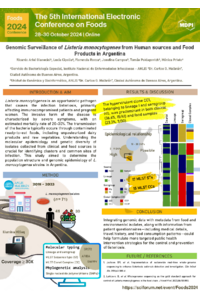
Listeria monocytogenes is an opportunistic pathogen that causes the infection listeriosis, primarily affecting immunocompromised patients and pregnant women. The invasive form of the disease is characterized by severe symptoms, with an estimated mortality rate of 20–30%. The transmission of the bacteria typically occurs through contaminated ready-to-eat foods, including unpasteurized dairy products and raw vegetables. Understanding the molecular epidemiology and genetic diversity of isolates collected from clinical and food sources is crucial for identifying clusters and common sites of infection. This study aimed to determine the population structure and genomic epidemiology of L. monocytogenes strains in Argentina. Between 2018 and 2023, we analyzed 71 isolates in total: 41 from human sources and 30 from food products. These isolates were submitted to the National Reference Laboratory at the INEI-ANLIS "Dr. Carlos G. Malbrán". Whole-genome sequencing analysis categorized the strains into two lineages, four serogroups, seventeen sequence types, and fifteen clonal complexes (CCs). Clinical isolates were mainly associated with lineage I (65.1%, 28/43), while food isolates were mainly linked to lineage II (53.6%, 15/28). The hypervirulent clone CC1, belonging to lineage I and serogroup IVb, was predominant in both clinical (36.6%, 15/41) and food samples (23.3%, 7/30). Single-nucleotide polymorphism, or SNP, analysis showed high (0-10 SNPs) and possible (11-30 SNPs) epidemiological relationships between isolates from humans and/or food samples. These findings suggest the presence of transmission chains and common sites of infection, underscoring the need to strengthen the genomic surveillance of L. monocytogenes in Argentina. Integrating genomic data with metadata from food and environmental isolates, along with information from patient questionnaires—including medical details, travel history, and food consumption patterns—could help formulate more targeted public health intervention strategies for the control and prevention of listeriosis.
Keywords
Listeria monocytogenes
Whole Genome Sequencing
Surveillance
Clonal Complex
Poster
food_2024_listeria.pdf
Tequila 100% Agave Silver Class—Pink Hue: Innovative fusion of traditional and current techniques in the Tequila Industry
Assessing 3d printability and glycemic indices of marzipan with different natural sweeteners