Event submissions
Published
This submission belongs to the session S5. Chemistry and Physicochemical Properties of Foods of the event The 5th International Electronic Conference on Foods
Published date
25 Oct, 2024
Academic Editor
'%3e%3cpath%20d='M12.6657%2010.9104C12.4185%2010.325%2012.0599%209.79327%2011.6097%209.34482C11.1609%208.89508%2010.6293%208.5365%2010.0442%208.28888C10.0389%208.28626%2010.0337%208.28495%2010.0285%208.28233C10.8446%207.69279%2011.3752%206.73249%2011.3752%205.64904C11.3752%203.8542%209.92103%202.39999%208.1262%202.39999C6.33136%202.39999%204.87715%203.8542%204.87715%205.64904C4.87715%206.73249%205.40774%207.69279%206.22393%208.28364C6.21869%208.28626%206.21345%208.28757%206.20821%208.29019C5.62129%208.5378%205.09463%208.89284%204.64265%209.34613C4.1929%209.79493%203.83432%2010.3266%203.58671%2010.9117C3.34345%2011.4845%203.21226%2012.0987%203.20023%2012.7209C3.19988%2012.7349%203.20233%2012.7488%203.20744%2012.7619C3.21255%2012.7749%203.22022%2012.7867%203.22998%2012.7968C3.23975%2012.8068%203.25142%2012.8147%203.26431%2012.8202C3.2772%2012.8256%203.29105%2012.8284%203.30504%2012.8284H4.09109C4.14874%2012.8284%204.19459%2012.7825%204.1959%2012.7262C4.2221%2011.7148%204.62823%2010.7676%205.34617%2010.0497C6.08899%209.30683%207.0755%208.89808%208.1262%208.89808C9.17689%208.89808%2010.1634%209.30683%2010.9062%2010.0497C11.6242%2010.7676%2012.0303%2011.7148%2012.0565%2012.7262C12.0578%2012.7838%2012.1037%2012.8284%2012.1613%2012.8284H12.9474C12.9613%2012.8284%2012.9752%2012.8256%2012.9881%2012.8202C13.001%2012.8147%2013.0126%2012.8068%2013.0224%2012.7968C13.0322%2012.7867%2013.0398%2012.7749%2013.0449%2012.7619C13.0501%2012.7488%2013.0525%2012.7349%2013.0522%2012.7209C13.0391%2012.0947%2012.9094%2011.4855%2012.6657%2010.9104ZM8.1262%207.9024C7.52486%207.9024%206.9589%207.6679%206.53312%207.24211C6.10733%206.81633%205.87283%206.25037%205.87283%205.64904C5.87283%205.0477%206.10733%204.48174%206.53312%204.05596C6.9589%203.63018%207.52486%203.39567%208.1262%203.39567C8.72753%203.39567%209.29349%203.63018%209.71927%204.05596C10.1451%204.48174%2010.3796%205.0477%2010.3796%205.64904C10.3796%206.25037%2010.1451%206.81633%209.71927%207.24211C9.29349%207.6679%208.72753%207.9024%208.1262%207.9024Z'%20fill='%235D1EE1'/%3e%3c/g%3e%3c/svg%3e) Joana Amaral
Joana AmaralCitation
Linda Boamah, Esther Awurama Asante, Victoria Ama Adjah, Mary Marshall, Evaluating the potential for partial reduction in sugar in milk chocolate using sweet whey powder, in Proceedings of The 5th International Electronic Conference on Foods, 28 October–30 October 2024, MDPI: Basel, Switzerland
Share
Email
Facebook
Twitter
LinkedIn
Evaluating the potential for partial reduction in sugar in milk chocolate using sweet whey powder
'%3e%3cpath%20d='M12.6647%2010.9104C12.4176%2010.325%2012.0589%209.7933%2011.6088%209.34485C11.16%208.89511%2010.6283%208.53653%2010.0432%208.28891C10.038%208.28629%2010.0327%208.28498%2010.0275%208.28236C10.8437%207.69282%2011.3743%206.73252%2011.3743%205.64907C11.3743%203.85423%209.92005%202.40002%208.12522%202.40002C6.33038%202.40002%204.87618%203.85423%204.87618%205.64907C4.87618%206.73252%205.40677%207.69282%206.22296%208.28367C6.21772%208.28629%206.21248%208.2876%206.20724%208.29022C5.62031%208.53783%205.09365%208.89287%204.64167%209.34616C4.19192%209.79496%203.83334%2010.3266%203.58573%2010.9117C3.34247%2011.4846%203.21128%2012.0987%203.19925%2012.721C3.1989%2012.735%203.20135%2012.7489%203.20646%2012.7619C3.21157%2012.7749%203.21924%2012.7868%203.22901%2012.7968C3.23877%2012.8068%203.25045%2012.8148%203.26334%2012.8202C3.27623%2012.8256%203.29007%2012.8284%203.30406%2012.8284H4.09012C4.14776%2012.8284%204.19362%2012.7825%204.19493%2012.7262C4.22113%2011.7148%204.62726%2010.7676%205.34519%2010.0497C6.08802%209.30686%207.07452%208.89811%208.12522%208.89811C9.17592%208.89811%2010.1624%209.30686%2010.9052%2010.0497C11.6232%2010.7676%2012.0293%2011.7148%2012.0555%2012.7262C12.0568%2012.7839%2012.1027%2012.8284%2012.1603%2012.8284H12.9464C12.9604%2012.8284%2012.9742%2012.8256%2012.9871%2012.8202C13%2012.8148%2013.0117%2012.8068%2013.0214%2012.7968C13.0312%2012.7868%2013.0389%2012.7749%2013.044%2012.7619C13.0491%2012.7489%2013.0515%2012.735%2013.0512%2012.721C13.0381%2012.0947%2012.9084%2011.4856%2012.6647%2010.9104ZM8.12522%207.90243C7.52388%207.90243%206.95792%207.66793%206.53214%207.24215C6.10636%206.81636%205.87185%206.2504%205.87185%205.64907C5.87185%205.04773%206.10636%204.48177%206.53214%204.05599C6.95792%203.63021%207.52388%203.3957%208.12522%203.3957C8.72655%203.3957%209.29252%203.63021%209.7183%204.05599C10.1441%204.48177%2010.3786%205.04773%2010.3786%205.64907C10.3786%206.2504%2010.1441%206.81636%209.7183%207.24215C9.29252%207.66793%208.72655%207.90243%208.12522%207.90243Z'%20fill='%235D1EE1'/%3e%3c/g%3e%3c/svg%3e)
Linda Boamah 1
Esther Awurama Asante 2
Victoria Ama Adjah 3
Mary Marshall 1
1. Research and Development department, NICHE Confectionery Ghana Limited, P.M.B 36, Free Zone Enclave, Community 1-Tema, Ghana
2. Hungarian University of Agriculture and Life Sciences, 1118 Budapest, Villányi út 29-43, Hungary
3. Production department, NICHE Confectionery Ghana Limited, P.M.B 36, Free Zone Enclave, Community 1-Tema, Ghana
Abstract
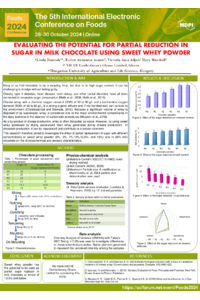
With the growing demand for healthier, reduced-sugar, and sustainable products, sweet whey powder has become an attractive ingredient for chocolate manufacturers who want to offer a healthier option to their customers. Because a significant volume of whey is disposed of as wastewater, whey is considered the major environmental contaminant in the dairy business in the absence of sustainable procedures. Whey can be repurposed into other ingredients, like sweet whey (produced by drying pasteurized fresh whey generated during cheese production) to be used in chocolate production to contribute to a circular economy. Sweet whey with fewer calories can reduce the calorie content when used to replace sugar for health-conscious individuals. This research therefore aimed to evaluate the potential for a partial reduction in sugar in milk chocolate using sweet whey powder.
Milk chocolate samples were produced by reducing the sugar content and replacing the sugar with sweet whey powder in different amounts (RO-0%, R1-5%, R2-7%, R3-10%, R4-12.5%, and R5-15%) w/w. The physicochemical properties (particle size, ash, and moisture) and the sensory properties (descriptive using 12 highly trained panel) were investigated.
The results indicated that the replacement of sugar with sweet whey significantly impacted the ash content (RO=2.55%, R1=2.79%, R2=2.94%, R3=3.11%, R4=3.36%, R5=3.54%), moisture content (RO=0.61%, R1=0.81%, R2=0.80%, R3=1.01%, R4=1.21%, R5=1.21%), and particle size (RO=25 µm, R1=16 µm, R2=16 µm, R3=14 µm, R4=12µm, R5=10.5 µm) as the sweet whey powder content increased. The following attributes showed similar results to those the control (p ≥ 0.05),: texture, flavor, sweetness, and mouthfeel; saltiness, on the other hand, showed significant differences between the samples (p ≤ 0.05).
It can be concluded that sweet whey powder has the potential to be used as an ingredient in reduced-sugar milk chocolate at levels of 12.5% and below.
Keywords
Chocolate
Sweet whey
Calories
Sugar
Healthy
Poster
BOAMAH ET. AL. POSTER.pdf
Antioxidant, anti-inflammatory, anti-diabetic, and cytotoxic potential of ethanolic leaf extracts from Englerina woodfordiodes M. Gilbert and Oncocalyx fischeri (Ebgl.) M. Gilbert
Bioinformatical characterization and machine learning classification of seed storage proteins