Event submissions
Published
This submission belongs to the session S1. Innovation in Food Technology and Engineering of the event The 5th International Electronic Conference on Foods
Published date
25 Oct, 2024
Academic Editor
'%3e%3cpath%20d='M12.6657%2010.9104C12.4185%2010.325%2012.0599%209.79327%2011.6097%209.34482C11.1609%208.89508%2010.6293%208.5365%2010.0442%208.28888C10.0389%208.28626%2010.0337%208.28495%2010.0285%208.28233C10.8446%207.69279%2011.3752%206.73249%2011.3752%205.64904C11.3752%203.8542%209.92103%202.39999%208.1262%202.39999C6.33136%202.39999%204.87715%203.8542%204.87715%205.64904C4.87715%206.73249%205.40774%207.69279%206.22393%208.28364C6.21869%208.28626%206.21345%208.28757%206.20821%208.29019C5.62129%208.5378%205.09463%208.89284%204.64265%209.34613C4.1929%209.79493%203.83432%2010.3266%203.58671%2010.9117C3.34345%2011.4845%203.21226%2012.0987%203.20023%2012.7209C3.19988%2012.7349%203.20233%2012.7488%203.20744%2012.7619C3.21255%2012.7749%203.22022%2012.7867%203.22998%2012.7968C3.23975%2012.8068%203.25142%2012.8147%203.26431%2012.8202C3.2772%2012.8256%203.29105%2012.8284%203.30504%2012.8284H4.09109C4.14874%2012.8284%204.19459%2012.7825%204.1959%2012.7262C4.2221%2011.7148%204.62823%2010.7676%205.34617%2010.0497C6.08899%209.30683%207.0755%208.89808%208.1262%208.89808C9.17689%208.89808%2010.1634%209.30683%2010.9062%2010.0497C11.6242%2010.7676%2012.0303%2011.7148%2012.0565%2012.7262C12.0578%2012.7838%2012.1037%2012.8284%2012.1613%2012.8284H12.9474C12.9613%2012.8284%2012.9752%2012.8256%2012.9881%2012.8202C13.001%2012.8147%2013.0126%2012.8068%2013.0224%2012.7968C13.0322%2012.7867%2013.0398%2012.7749%2013.0449%2012.7619C13.0501%2012.7488%2013.0525%2012.7349%2013.0522%2012.7209C13.0391%2012.0947%2012.9094%2011.4855%2012.6657%2010.9104ZM8.1262%207.9024C7.52486%207.9024%206.9589%207.6679%206.53312%207.24211C6.10733%206.81633%205.87283%206.25037%205.87283%205.64904C5.87283%205.0477%206.10733%204.48174%206.53312%204.05596C6.9589%203.63018%207.52486%203.39567%208.1262%203.39567C8.72753%203.39567%209.29349%203.63018%209.71927%204.05596C10.1451%204.48174%2010.3796%205.0477%2010.3796%205.64904C10.3796%206.25037%2010.1451%206.81633%209.71927%207.24211C9.29349%207.6679%208.72753%207.9024%208.1262%207.9024Z'%20fill='%235D1EE1'/%3e%3c/g%3e%3c/svg%3e) Moktar Hamdi
Moktar HamdiCitation
Albert Sebastià, Carlotta Lombardo, Noelia Pallares, Juan Manuel Castagnini, Francisco J. Barba, Manuel Salgado-Ramos, Francisco J. Marti-Quijal, Efficient Extraction of Bioactive Compounds from Black Truffles: Comparing Supercritical Fluid and Pressurized Liquid Extraction Techniques, in Proceedings of The 5th International Electronic Conference on Foods, 28 October–30 October 2024, MDPI: Basel, Switzerland
Share
Email
Facebook
Twitter
LinkedIn
Efficient Extraction of Bioactive Compounds from Black Truffles: Comparing Supercritical Fluid and Pressurized Liquid Extraction Techniques
'%3e%3cpath%20d='M12.6647%2010.9104C12.4176%2010.325%2012.0589%209.7933%2011.6088%209.34485C11.16%208.89511%2010.6283%208.53653%2010.0432%208.28891C10.038%208.28629%2010.0327%208.28498%2010.0275%208.28236C10.8437%207.69282%2011.3743%206.73252%2011.3743%205.64907C11.3743%203.85423%209.92005%202.40002%208.12522%202.40002C6.33038%202.40002%204.87618%203.85423%204.87618%205.64907C4.87618%206.73252%205.40677%207.69282%206.22296%208.28367C6.21772%208.28629%206.21248%208.2876%206.20724%208.29022C5.62031%208.53783%205.09365%208.89287%204.64167%209.34616C4.19192%209.79496%203.83334%2010.3266%203.58573%2010.9117C3.34247%2011.4846%203.21128%2012.0987%203.19925%2012.721C3.1989%2012.735%203.20135%2012.7489%203.20646%2012.7619C3.21157%2012.7749%203.21924%2012.7868%203.22901%2012.7968C3.23877%2012.8068%203.25045%2012.8148%203.26334%2012.8202C3.27623%2012.8256%203.29007%2012.8284%203.30406%2012.8284H4.09012C4.14776%2012.8284%204.19362%2012.7825%204.19493%2012.7262C4.22113%2011.7148%204.62726%2010.7676%205.34519%2010.0497C6.08802%209.30686%207.07452%208.89811%208.12522%208.89811C9.17592%208.89811%2010.1624%209.30686%2010.9052%2010.0497C11.6232%2010.7676%2012.0293%2011.7148%2012.0555%2012.7262C12.0568%2012.7839%2012.1027%2012.8284%2012.1603%2012.8284H12.9464C12.9604%2012.8284%2012.9742%2012.8256%2012.9871%2012.8202C13%2012.8148%2013.0117%2012.8068%2013.0214%2012.7968C13.0312%2012.7868%2013.0389%2012.7749%2013.044%2012.7619C13.0491%2012.7489%2013.0515%2012.735%2013.0512%2012.721C13.0381%2012.0947%2012.9084%2011.4856%2012.6647%2010.9104ZM8.12522%207.90243C7.52388%207.90243%206.95792%207.66793%206.53214%207.24215C6.10636%206.81636%205.87185%206.2504%205.87185%205.64907C5.87185%205.04773%206.10636%204.48177%206.53214%204.05599C6.95792%203.63021%207.52388%203.3957%208.12522%203.3957C8.72655%203.3957%209.29252%203.63021%209.7183%204.05599C10.1441%204.48177%2010.3786%205.04773%2010.3786%205.64907C10.3786%206.2504%2010.1441%206.81636%209.7183%207.24215C9.29252%207.66793%208.72655%207.90243%208.12522%207.90243Z'%20fill='%235D1EE1'/%3e%3c/g%3e%3c/svg%3e)
Albert Sebastià 1
Carlotta Lombardo 1
Noelia Pallares 1

Juan Manuel Castagnini 1

Francisco J. Barba 1
Manuel Salgado-Ramos 1,2
Francisco J. Marti-Quijal 1
1. Preventive Medicine and Public Health, Food Science, Toxicology and Forensic Medicine Department, Faculty of Pharmacy and Food Sciences, Universitat de València, Avda. Vicent Andrés Estellés, s/n, 46100 Burjassot, Spain.
2. Departamento de Química Inorgánica, Orgánica y Bioquímica. Facultad de Ciencias y Tecnologías Químicas, Universidad de Castilla-La Mancha, Avenida Camilo José Cela s/n, 13071, Ciudad Real, Spain
Abstract
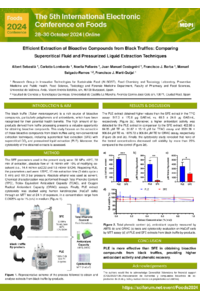
Introduction: The black truffle (Tuber melanosporum) is a rich source of bioactive compounds, particularly polyphenols and antioxidants, which have been recognized for their potential health benefits. The high amount of by-products derived from truffle processing presents a valuable opportunity for obtaining bioactive compounds. This study focuses on the extraction of these bioactive compounds from black truffles using non-conventional extraction techniques, including supercritical fluid extraction (SFE) and pressurized liquid extraction (PLE). Moreover, the cytotoxicity of the obtained extracts is assessed. Methods: The SFE parameters used in the present study were 30 MPa, 40°C, and 30 min of extraction at a flow of 16 ml/min and 10% EtOH. Regarding PLE, the parameters used were 100% ethanol, 3 cycles of extraction, and 120ºC. Chemical characterization was performed through Total Phenolic Content (TPC), Trolox Equivalent Antioxidant Capacity (TEAC), and Oxygen Radical Antioxidant Capacity (ORAC) assays. Finally, PLE extract cytotoxicity was studied using human keratinocytes (HaCaT cells) through an MTT test at 24 h of exposure, in a concentration range from 0.0625% up to 1% (v/v) in medium. Results: The PLE extract obtained higher values than the SFE extract in the TPC assay. Moreover, a higher antioxidant activity was detected for the PLE extract in comparison to the SFE extract: 402.80±84.85 µM TE vs. 31.67±15.16 µM for TEAC assay and 3531.36±906.84 µM TE vs. 1875.72±906.84 µM TE for ORAC assay, respectively. Finally, the cytotoxicity study revealed that none of the tested concentrations decreased cell viability by more than 25% compared to the control. Conclusion: PLE is more effective than SFE in obtaining bioactive compounds from black truffles, providing higher antioxidant activity and phenolic recovery.
Acknowledgements: The authors would like to acknowledge Generalitat Valenciana for financial support (CIGE/2023/108—Recuperación de nutrientes y compuestos bioactivos de co-productos de chufa y trufa y evaluación de sus propiedades saludables).
Keywords
truffle
polyphenols
PLE
SFE
cytotoxicity
Poster
Poster_FranMarti.pdf
BIOMASS AND PIGMENT PRODUCTION OF Monascus purpuresus IN Chenopodium quinoa-BASED CULTURE MEDIA
Effect of environmental factors on biofilm formation by Pseudononas aeruginosa isolated from dairy processing lines