Event submissions
Published
This submission belongs to the session S2. Food Nutrition and Functional Foods of the event The 5th International Electronic Conference on Foods
Published date
25 Oct, 2024
Academic Editor
'%3e%3cpath%20d='M12.6657%2010.9104C12.4185%2010.325%2012.0599%209.79327%2011.6097%209.34482C11.1609%208.89508%2010.6293%208.5365%2010.0442%208.28888C10.0389%208.28626%2010.0337%208.28495%2010.0285%208.28233C10.8446%207.69279%2011.3752%206.73249%2011.3752%205.64904C11.3752%203.8542%209.92103%202.39999%208.1262%202.39999C6.33136%202.39999%204.87715%203.8542%204.87715%205.64904C4.87715%206.73249%205.40774%207.69279%206.22393%208.28364C6.21869%208.28626%206.21345%208.28757%206.20821%208.29019C5.62129%208.5378%205.09463%208.89284%204.64265%209.34613C4.1929%209.79493%203.83432%2010.3266%203.58671%2010.9117C3.34345%2011.4845%203.21226%2012.0987%203.20023%2012.7209C3.19988%2012.7349%203.20233%2012.7488%203.20744%2012.7619C3.21255%2012.7749%203.22022%2012.7867%203.22998%2012.7968C3.23975%2012.8068%203.25142%2012.8147%203.26431%2012.8202C3.2772%2012.8256%203.29105%2012.8284%203.30504%2012.8284H4.09109C4.14874%2012.8284%204.19459%2012.7825%204.1959%2012.7262C4.2221%2011.7148%204.62823%2010.7676%205.34617%2010.0497C6.08899%209.30683%207.0755%208.89808%208.1262%208.89808C9.17689%208.89808%2010.1634%209.30683%2010.9062%2010.0497C11.6242%2010.7676%2012.0303%2011.7148%2012.0565%2012.7262C12.0578%2012.7838%2012.1037%2012.8284%2012.1613%2012.8284H12.9474C12.9613%2012.8284%2012.9752%2012.8256%2012.9881%2012.8202C13.001%2012.8147%2013.0126%2012.8068%2013.0224%2012.7968C13.0322%2012.7867%2013.0398%2012.7749%2013.0449%2012.7619C13.0501%2012.7488%2013.0525%2012.7349%2013.0522%2012.7209C13.0391%2012.0947%2012.9094%2011.4855%2012.6657%2010.9104ZM8.1262%207.9024C7.52486%207.9024%206.9589%207.6679%206.53312%207.24211C6.10733%206.81633%205.87283%206.25037%205.87283%205.64904C5.87283%205.0477%206.10733%204.48174%206.53312%204.05596C6.9589%203.63018%207.52486%203.39567%208.1262%203.39567C8.72753%203.39567%209.29349%203.63018%209.71927%204.05596C10.1451%204.48174%2010.3796%205.0477%2010.3796%205.64904C10.3796%206.25037%2010.1451%206.81633%209.71927%207.24211C9.29349%207.6679%208.72753%207.9024%208.1262%207.9024Z'%20fill='%235D1EE1'/%3e%3c/g%3e%3c/svg%3e) Antonello Santini
Antonello SantiniCitation
Marianela Desireé Rodriguez, Alberto Leon, Mariela Bustos, Hydrolyzed legume flours: An alternative for improving protein and starch digestion in infant pureé, in Proceedings of The 5th International Electronic Conference on Foods, 28 October–30 October 2024, MDPI: Basel, Switzerland
Share
Email
Facebook
Twitter
LinkedIn
Hydrolyzed legume flours: An alternative for improving protein and starch digestion in infant pureé
'%3e%3cpath%20d='M12.6647%2010.9104C12.4176%2010.325%2012.0589%209.7933%2011.6088%209.34485C11.16%208.89511%2010.6283%208.53653%2010.0432%208.28891C10.038%208.28629%2010.0327%208.28498%2010.0275%208.28236C10.8437%207.69282%2011.3743%206.73252%2011.3743%205.64907C11.3743%203.85423%209.92005%202.40002%208.12522%202.40002C6.33038%202.40002%204.87618%203.85423%204.87618%205.64907C4.87618%206.73252%205.40677%207.69282%206.22296%208.28367C6.21772%208.28629%206.21248%208.2876%206.20724%208.29022C5.62031%208.53783%205.09365%208.89287%204.64167%209.34616C4.19192%209.79496%203.83334%2010.3266%203.58573%2010.9117C3.34247%2011.4846%203.21128%2012.0987%203.19925%2012.721C3.1989%2012.735%203.20135%2012.7489%203.20646%2012.7619C3.21157%2012.7749%203.21924%2012.7868%203.22901%2012.7968C3.23877%2012.8068%203.25045%2012.8148%203.26334%2012.8202C3.27623%2012.8256%203.29007%2012.8284%203.30406%2012.8284H4.09012C4.14776%2012.8284%204.19362%2012.7825%204.19493%2012.7262C4.22113%2011.7148%204.62726%2010.7676%205.34519%2010.0497C6.08802%209.30686%207.07452%208.89811%208.12522%208.89811C9.17592%208.89811%2010.1624%209.30686%2010.9052%2010.0497C11.6232%2010.7676%2012.0293%2011.7148%2012.0555%2012.7262C12.0568%2012.7839%2012.1027%2012.8284%2012.1603%2012.8284H12.9464C12.9604%2012.8284%2012.9742%2012.8256%2012.9871%2012.8202C13%2012.8148%2013.0117%2012.8068%2013.0214%2012.7968C13.0312%2012.7868%2013.0389%2012.7749%2013.044%2012.7619C13.0491%2012.7489%2013.0515%2012.735%2013.0512%2012.721C13.0381%2012.0947%2012.9084%2011.4856%2012.6647%2010.9104ZM8.12522%207.90243C7.52388%207.90243%206.95792%207.66793%206.53214%207.24215C6.10636%206.81636%205.87185%206.2504%205.87185%205.64907C5.87185%205.04773%206.10636%204.48177%206.53214%204.05599C6.95792%203.63021%207.52388%203.3957%208.12522%203.3957C8.72655%203.3957%209.29252%203.63021%209.7183%204.05599C10.1441%204.48177%2010.3786%205.04773%2010.3786%205.64907C10.3786%206.2504%2010.1441%206.81636%209.7183%207.24215C9.29252%207.66793%208.72655%207.90243%208.12522%207.90243Z'%20fill='%235D1EE1'/%3e%3c/g%3e%3c/svg%3e)
Marianela Desireé Rodriguez 1
Alberto Leon 1,2
Mariela Bustos 1,2
1. Instituto de Ciencia y tecnología de los Alimentos Córdoba (ICyTAC), Conicet - UNC. Córdoba, Argentina.
2. Facultad de Ciencias Agropecuarias, Universidad Nacional de Córdoba, Argentina.
Abstract
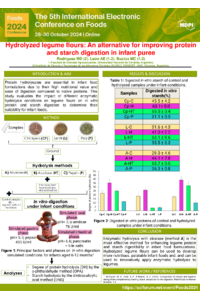
Protein hydrolysates are essential in infant food formulations due to their high nutritional value and ease of digestion compared to native proteins. This study evaluates the impact of different enzymatic hydrolysis conditions on legume flours on in vitro protein and starch digestion to determine their suitability for infant foods. Chickpeas, lentils, and peas were ground and subjected to three hydrolysis methods: A) alcalase, B) heat treatment and mild acid before alcalase, and C) pepsin. Non-hydrolyzed flours served as controls. In vitro digestion simulated conditions for infants aged 6-12 months. Five grams of puree was tested with a 50:50 w/v food/fluid saliva ratio (oral phase,pH 7.0, 75 U/ml amylase); the ratio was 63:37 for the gastric phase (pH 5.3, 485 U/ml pepsin), and 62:38 for the intestinal phase (pH 6.6, 0.2 mg/ml pancreatin, 2.5 mg/ml bile salts). After digestion, the degree of protein hydrolysis (DH) was determined using the orthophthaldehyde method, and starch hydrolysis was measured using the dinitrosalicylic acid method. A samples showed the highest DH, at 35.1, 26.2, and 38.7 g/100g for chickpeas, lentils, and peas, respectively, which significantly higher values than were observed in the controls (22.0, 18.2, and 17.6 g/100g) p<0.05. B samples showed increased DH for chickpeas (24.9 g/100g) and peas (31.9 g/100g), but decreased DH for lentils (3.4 g/100g), p<0.05. C samples exhibited decreased DH in all samples. Starch hydrolysis increased under method A (63.1, 41.0, and 44.1 g/100g for chickpeas, lentils, and peas) compared to that in the controls (45.5, 31.6, 29.0 g/100g), p<0.05. Method B also increased starch hydrolysis (65.0, 63.1, and 65.7 g/100g for chickpeas, lentils, and peas), with p<0.05. Method C had varied effects: a decrease in chickpeas, an increase in lentils, and no difference in peas. Enzymatic hydrolysis with alcalase (method A) is the most effective method for enhancing legume protein and starch digestibility in infant food formulations. Hydrolyzed legume flours can be used to develop more nutritious, palatable infant foods and, and can be used to innovatively apply enzymatic hydrolysis to legumes.
Keywords
protein hydrolysis
alcalase
pepsin
protein production
protein quality
complementary feeding
Poster
Hydrolyzed legumes - Foods 2024.pdf
Potential valorization of apricot oil as a functional food: antioxidant properties and health benefits
Evaluation of the functional potential of beverages made from regional plant matrices