Event submissions
Published
This submission belongs to the session S4. Food Microbiology of the event The 5th International Electronic Conference on Foods
Published date
25 Oct, 2024
Academic Editor
'%3e%3cpath%20d='M12.6657%2010.9104C12.4185%2010.325%2012.0599%209.79327%2011.6097%209.34482C11.1609%208.89508%2010.6293%208.5365%2010.0442%208.28888C10.0389%208.28626%2010.0337%208.28495%2010.0285%208.28233C10.8446%207.69279%2011.3752%206.73249%2011.3752%205.64904C11.3752%203.8542%209.92103%202.39999%208.1262%202.39999C6.33136%202.39999%204.87715%203.8542%204.87715%205.64904C4.87715%206.73249%205.40774%207.69279%206.22393%208.28364C6.21869%208.28626%206.21345%208.28757%206.20821%208.29019C5.62129%208.5378%205.09463%208.89284%204.64265%209.34613C4.1929%209.79493%203.83432%2010.3266%203.58671%2010.9117C3.34345%2011.4845%203.21226%2012.0987%203.20023%2012.7209C3.19988%2012.7349%203.20233%2012.7488%203.20744%2012.7619C3.21255%2012.7749%203.22022%2012.7867%203.22998%2012.7968C3.23975%2012.8068%203.25142%2012.8147%203.26431%2012.8202C3.2772%2012.8256%203.29105%2012.8284%203.30504%2012.8284H4.09109C4.14874%2012.8284%204.19459%2012.7825%204.1959%2012.7262C4.2221%2011.7148%204.62823%2010.7676%205.34617%2010.0497C6.08899%209.30683%207.0755%208.89808%208.1262%208.89808C9.17689%208.89808%2010.1634%209.30683%2010.9062%2010.0497C11.6242%2010.7676%2012.0303%2011.7148%2012.0565%2012.7262C12.0578%2012.7838%2012.1037%2012.8284%2012.1613%2012.8284H12.9474C12.9613%2012.8284%2012.9752%2012.8256%2012.9881%2012.8202C13.001%2012.8147%2013.0126%2012.8068%2013.0224%2012.7968C13.0322%2012.7867%2013.0398%2012.7749%2013.0449%2012.7619C13.0501%2012.7488%2013.0525%2012.7349%2013.0522%2012.7209C13.0391%2012.0947%2012.9094%2011.4855%2012.6657%2010.9104ZM8.1262%207.9024C7.52486%207.9024%206.9589%207.6679%206.53312%207.24211C6.10733%206.81633%205.87283%206.25037%205.87283%205.64904C5.87283%205.0477%206.10733%204.48174%206.53312%204.05596C6.9589%203.63018%207.52486%203.39567%208.1262%203.39567C8.72753%203.39567%209.29349%203.63018%209.71927%204.05596C10.1451%204.48174%2010.3796%205.0477%2010.3796%205.64904C10.3796%206.25037%2010.1451%206.81633%209.71927%207.24211C9.29349%207.6679%208.72753%207.9024%208.1262%207.9024Z'%20fill='%235D1EE1'/%3e%3c/g%3e%3c/svg%3e) Antonio Bevilacqua
Antonio BevilacquaCitation
Jimena Gentiluomo, Cynthia Maiztegui, Analía Bret, Carla Schesi, Rosana Massa, Natalia Deza, Ariela Baschkier, Eduardo Manfredi, Silvia Spioussas, Santiago Mingorance, Sergio Epszteyn, Claudia Carolina Carbonari, Elizabeth Miliwebsky, Characterization of Shiga toxin-producing Escherichia coli in strains isolated from raw and cooked hamburgers in Argentina, in Proceedings of The 5th International Electronic Conference on Foods, 28 October–30 October 2024, MDPI: Basel, Switzerland
Share
Email
Facebook
Twitter
LinkedIn
Characterization of Shiga toxin-producing Escherichia coli in strains isolated from raw and cooked hamburgers in Argentina
'%3e%3cpath%20d='M12.6647%2010.9104C12.4176%2010.325%2012.0589%209.7933%2011.6088%209.34485C11.16%208.89511%2010.6283%208.53653%2010.0432%208.28891C10.038%208.28629%2010.0327%208.28498%2010.0275%208.28236C10.8437%207.69282%2011.3743%206.73252%2011.3743%205.64907C11.3743%203.85423%209.92005%202.40002%208.12522%202.40002C6.33038%202.40002%204.87618%203.85423%204.87618%205.64907C4.87618%206.73252%205.40677%207.69282%206.22296%208.28367C6.21772%208.28629%206.21248%208.2876%206.20724%208.29022C5.62031%208.53783%205.09365%208.89287%204.64167%209.34616C4.19192%209.79496%203.83334%2010.3266%203.58573%2010.9117C3.34247%2011.4846%203.21128%2012.0987%203.19925%2012.721C3.1989%2012.735%203.20135%2012.7489%203.20646%2012.7619C3.21157%2012.7749%203.21924%2012.7868%203.22901%2012.7968C3.23877%2012.8068%203.25045%2012.8148%203.26334%2012.8202C3.27623%2012.8256%203.29007%2012.8284%203.30406%2012.8284H4.09012C4.14776%2012.8284%204.19362%2012.7825%204.19493%2012.7262C4.22113%2011.7148%204.62726%2010.7676%205.34519%2010.0497C6.08802%209.30686%207.07452%208.89811%208.12522%208.89811C9.17592%208.89811%2010.1624%209.30686%2010.9052%2010.0497C11.6232%2010.7676%2012.0293%2011.7148%2012.0555%2012.7262C12.0568%2012.7839%2012.1027%2012.8284%2012.1603%2012.8284H12.9464C12.9604%2012.8284%2012.9742%2012.8256%2012.9871%2012.8202C13%2012.8148%2013.0117%2012.8068%2013.0214%2012.7968C13.0312%2012.7868%2013.0389%2012.7749%2013.044%2012.7619C13.0491%2012.7489%2013.0515%2012.735%2013.0512%2012.721C13.0381%2012.0947%2012.9084%2011.4856%2012.6647%2010.9104ZM8.12522%207.90243C7.52388%207.90243%206.95792%207.66793%206.53214%207.24215C6.10636%206.81636%205.87185%206.2504%205.87185%205.64907C5.87185%205.04773%206.10636%204.48177%206.53214%204.05599C6.95792%203.63021%207.52388%203.3957%208.12522%203.3957C8.72655%203.3957%209.29252%203.63021%209.7183%204.05599C10.1441%204.48177%2010.3786%205.04773%2010.3786%205.64907C10.3786%206.2504%2010.1441%206.81636%209.7183%207.24215C9.29252%207.66793%208.72655%207.90243%208.12522%207.90243Z'%20fill='%235D1EE1'/%3e%3c/g%3e%3c/svg%3e)
Jimena Gentiluomo 1
Cynthia Maiztegui 1
Analía Bret 1
Carla Schesi 1
Rosana Massa 1
Natalia Deza 1
Ariela Baschkier 1
Eduardo Manfredi 1
Silvia Spioussas 2
Santiago Mingorance 2
Sergio Epszteyn 2
Claudia Carolina Carbonari 1
Elizabeth Miliwebsky 1
1. Instituto Nacional de Enfermedades Infecciosas Dr Carlos G. Malbrán
2. Dirección General de Higiene y Seguridad Alimentaria - GCABA
Abstract
In Argentina, Shiga toxin-producing Escherichia coli (STEC) is the primary aetiological agent of haemolytic uremic syndrome (HUS), and E. coli O157:H7 is the predominant serotype. The consumption of undercooked ground meat or cross-contamination during food preparation are also common routes of STEC infection.
In Buenos Aires, as a part of monitoring, samples of raw and cooked hamburgers were obtained from a fast food restaurant and were studied at the local bromatology laboratory. The isolated STEC strains were pheno-genotypically characterized using traditional methods and sent to the National Reference Laboratory for massive whole-genome sequencing. The strains were sequenced with the Illumina platform and were analyzed based on a command line scheme: FastQC, Kraken, MLST, ARIBA (Virulencefinder/Plasmidfinder/Resfinder), srst2, Unicycler, ipcress, Prokka, and Snippy. In all samples of raw and cooked hamburgers, E.coli O157:H7 stx1a/stx2c/eae/ehxA (ST7816) was isolated, and the following virulence genes were detected: astA, iha, traT, espA, espB, espJ, gad, chuA, eae, iss, nleA, nleB, nleC, ompT, terC, tir, stx1, and stx2. These virulence genes are mainly related to adherence, secretion system, and toxins. The strains are not part of a hypervirulent clade. In the sequences, no genes associated with resistance were detected and showed only seven SNPs of difference, indicating high genetic similarity between the isolates. In our country, the prevalence of HUS in the pediatric population has reached worrying numbers and the consumption of hamburgers in fast food chains is a common practice. We consider it essential that random samples continue to be studied in this type of establishments, since we were able to demonstrate that the cooking process affects the presence of the pathogen in food. The application of good hygiene practices in the handling of said foods is important to reduce the risk of transmission of STEC infection.
Keywords
STEC O157:H7
WGS
RISK
Poster
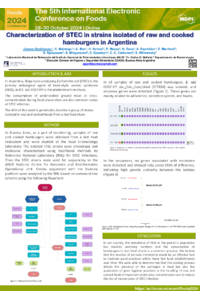
Characterization of STEC in strains isolated of raw and cooked hamburgers in Argentina_Gentiluomo_Foods2024.pdf
Evaluation of the functional potential of beverages made from regional plant matrices
Circular economy in the agri-food sector: valorization studies of vegetable by-products