Event submissions
Published
This submission belongs to the session S4. Food Microbiology of the event The 5th International Electronic Conference on Foods
Published date
25 Oct, 2024
Academic Editor
'%3e%3cpath%20d='M12.6657%2010.9104C12.4185%2010.325%2012.0599%209.79327%2011.6097%209.34482C11.1609%208.89508%2010.6293%208.5365%2010.0442%208.28888C10.0389%208.28626%2010.0337%208.28495%2010.0285%208.28233C10.8446%207.69279%2011.3752%206.73249%2011.3752%205.64904C11.3752%203.8542%209.92103%202.39999%208.1262%202.39999C6.33136%202.39999%204.87715%203.8542%204.87715%205.64904C4.87715%206.73249%205.40774%207.69279%206.22393%208.28364C6.21869%208.28626%206.21345%208.28757%206.20821%208.29019C5.62129%208.5378%205.09463%208.89284%204.64265%209.34613C4.1929%209.79493%203.83432%2010.3266%203.58671%2010.9117C3.34345%2011.4845%203.21226%2012.0987%203.20023%2012.7209C3.19988%2012.7349%203.20233%2012.7488%203.20744%2012.7619C3.21255%2012.7749%203.22022%2012.7867%203.22998%2012.7968C3.23975%2012.8068%203.25142%2012.8147%203.26431%2012.8202C3.2772%2012.8256%203.29105%2012.8284%203.30504%2012.8284H4.09109C4.14874%2012.8284%204.19459%2012.7825%204.1959%2012.7262C4.2221%2011.7148%204.62823%2010.7676%205.34617%2010.0497C6.08899%209.30683%207.0755%208.89808%208.1262%208.89808C9.17689%208.89808%2010.1634%209.30683%2010.9062%2010.0497C11.6242%2010.7676%2012.0303%2011.7148%2012.0565%2012.7262C12.0578%2012.7838%2012.1037%2012.8284%2012.1613%2012.8284H12.9474C12.9613%2012.8284%2012.9752%2012.8256%2012.9881%2012.8202C13.001%2012.8147%2013.0126%2012.8068%2013.0224%2012.7968C13.0322%2012.7867%2013.0398%2012.7749%2013.0449%2012.7619C13.0501%2012.7488%2013.0525%2012.7349%2013.0522%2012.7209C13.0391%2012.0947%2012.9094%2011.4855%2012.6657%2010.9104ZM8.1262%207.9024C7.52486%207.9024%206.9589%207.6679%206.53312%207.24211C6.10733%206.81633%205.87283%206.25037%205.87283%205.64904C5.87283%205.0477%206.10733%204.48174%206.53312%204.05596C6.9589%203.63018%207.52486%203.39567%208.1262%203.39567C8.72753%203.39567%209.29349%203.63018%209.71927%204.05596C10.1451%204.48174%2010.3796%205.0477%2010.3796%205.64904C10.3796%206.25037%2010.1451%206.81633%209.71927%207.24211C9.29349%207.6679%208.72753%207.9024%208.1262%207.9024Z'%20fill='%235D1EE1'/%3e%3c/g%3e%3c/svg%3e) Antonio Bevilacqua
Antonio BevilacquaCitation
Goran Slivšek, Nives Matković, Ivan Dolanc, Sandra Mijač, Marin Marinović, Silvija Petković, Miran Čoklo, The Antibacterial Potential of the Bioactive Cinnamon Compound Trans-cinnamaldehyde against Pseudomonas aeruginosa: A Computational Biology and Chemistry Perspective, in Proceedings of The 5th International Electronic Conference on Foods, 28 October–30 October 2024, MDPI: Basel, Switzerland
Share
Email
Facebook
Twitter
LinkedIn
The Antibacterial Potential of the Bioactive Cinnamon Compound Trans-cinnamaldehyde against Pseudomonas aeruginosa: A Computational Biology and Chemistry Perspective

Goran Slivšek 1,2,3
'%3e%3cpath%20d='M12.6647%2010.9104C12.4176%2010.325%2012.0589%209.7933%2011.6088%209.34485C11.16%208.89511%2010.6283%208.53653%2010.0432%208.28891C10.038%208.28629%2010.0327%208.28498%2010.0275%208.28236C10.8437%207.69282%2011.3743%206.73252%2011.3743%205.64907C11.3743%203.85423%209.92005%202.40002%208.12522%202.40002C6.33038%202.40002%204.87618%203.85423%204.87618%205.64907C4.87618%206.73252%205.40677%207.69282%206.22296%208.28367C6.21772%208.28629%206.21248%208.2876%206.20724%208.29022C5.62031%208.53783%205.09365%208.89287%204.64167%209.34616C4.19192%209.79496%203.83334%2010.3266%203.58573%2010.9117C3.34247%2011.4846%203.21128%2012.0987%203.19925%2012.721C3.1989%2012.735%203.20135%2012.7489%203.20646%2012.7619C3.21157%2012.7749%203.21924%2012.7868%203.22901%2012.7968C3.23877%2012.8068%203.25045%2012.8148%203.26334%2012.8202C3.27623%2012.8256%203.29007%2012.8284%203.30406%2012.8284H4.09012C4.14776%2012.8284%204.19362%2012.7825%204.19493%2012.7262C4.22113%2011.7148%204.62726%2010.7676%205.34519%2010.0497C6.08802%209.30686%207.07452%208.89811%208.12522%208.89811C9.17592%208.89811%2010.1624%209.30686%2010.9052%2010.0497C11.6232%2010.7676%2012.0293%2011.7148%2012.0555%2012.7262C12.0568%2012.7839%2012.1027%2012.8284%2012.1603%2012.8284H12.9464C12.9604%2012.8284%2012.9742%2012.8256%2012.9871%2012.8202C13%2012.8148%2013.0117%2012.8068%2013.0214%2012.7968C13.0312%2012.7868%2013.0389%2012.7749%2013.044%2012.7619C13.0491%2012.7489%2013.0515%2012.735%2013.0512%2012.721C13.0381%2012.0947%2012.9084%2011.4856%2012.6647%2010.9104ZM8.12522%207.90243C7.52388%207.90243%206.95792%207.66793%206.53214%207.24215C6.10636%206.81636%205.87185%206.2504%205.87185%205.64907C5.87185%205.04773%206.10636%204.48177%206.53214%204.05599C6.95792%203.63021%207.52388%203.3957%208.12522%203.3957C8.72655%203.3957%209.29252%203.63021%209.7183%204.05599C10.1441%204.48177%2010.3786%205.04773%2010.3786%205.64907C10.3786%206.2504%2010.1441%206.81636%209.7183%207.24215C9.29252%207.66793%208.72655%207.90243%208.12522%207.90243Z'%20fill='%235D1EE1'/%3e%3c/g%3e%3c/svg%3e)
Nives Matković 4

Ivan Dolanc 1
Sandra Mijač 5
Marin Marinović 3
Silvija Petković 2
Miran Čoklo 1
1. Centre for Applied Bioanthropology, Institute for Anthropological Research, Zagreb, Croatia
2. Faculty of Medicine, University of Zagreb, Zagreb, Croatia
3. Rijeka University Hospital Centre, Rijeka, Croatia
4. University Hospital of Split, Split, Croatia
5. Children’s Hospital Srebrnjak, Zagreb, Croatia
Abstract
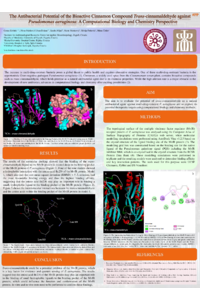
Introduction: The increase in multi-resistant bacteria poses a global threat to public health and requires alternative strategies. One of these multidrug-resistant bacteria is the opportunistic Gram-negative pathogen Pseudomonas aeruginosa. Cinnamon, a widely used spice, contains bioactive compounds such as trans-cinnamaldehyde, which holds promise as a natural antibacterial agent due to its chemical properties. While the high attrition rate is a major obstacle in the development of antibiotics, advances in computational biology and chemistry offer exciting opportunities. By streamlining candidate selection and developing targeted antibacterial agents, these tools can significantly accelerate the discovery of effective new antibiotics against multi-drug-resistant bacteria and ensure that humanity stays one step ahead of the rapid evolution of antibiotic resistance.
Methods: The pharmacokinetic properties, pharmacological potential, and bioavailability of trans-cinnamaldehyde were investigated computationally using the SwissADME tool. The topological surface of the receptor protein was investigated using CASTp, while the molecular modelling simulations were carried out using the AutoDock Vina tool. These modelling simulations were performed in triplicate, and the resulting models were analyzed to determine binding affinity and key interaction patterns. The tools used for this purpose were UCSF Chimaera, PyMol, and DS Visualiser.
Results: Docking simulations showed that trans-cinnamaldehyde has a binding affinity for the active sites of key proteins in Pseudomonas aeruginosa. The compound demonstrated consistent interaction patterns, indicating a possible disruption of bacterial integrity. These results suggest that trans-cinnamaldehyde can effectively inhibit essential functions of Pseudomonas aeruginosa.
Conclusions: The use of a computational approach in biology and chemistry can facilitate access to resources for the development of new antibiotics. Confirmation of the potential of trans-cinnamaldehyde as an antibacterial agent against Pseudomonas aeruginosa requires in vitro testing to determine its efficacy.
Keywords
antibacterial agents
cheminformatics
Cinnamomum zeylanicum
computational biology
multi-drug resistance
Pseudomonas aeruginosa
trans-cinnamaldehyde
Poster
E-poster (Slivšek et al.).pdf
Plant-Mediated Green Synthesis of Nanoparticles: Current Developments and Future Prospects
Exploring the Therapeutic Potential of Artemisia herba-alba in Preventing Chronic Colitis