Event submissions
Published
This submission belongs to the session S4. Food Microbiology of the event The 5th International Electronic Conference on Foods
Published date
25 Oct, 2024
Academic Editor
'%3e%3cpath%20d='M12.6657%2010.9104C12.4185%2010.325%2012.0599%209.79327%2011.6097%209.34482C11.1609%208.89508%2010.6293%208.5365%2010.0442%208.28888C10.0389%208.28626%2010.0337%208.28495%2010.0285%208.28233C10.8446%207.69279%2011.3752%206.73249%2011.3752%205.64904C11.3752%203.8542%209.92103%202.39999%208.1262%202.39999C6.33136%202.39999%204.87715%203.8542%204.87715%205.64904C4.87715%206.73249%205.40774%207.69279%206.22393%208.28364C6.21869%208.28626%206.21345%208.28757%206.20821%208.29019C5.62129%208.5378%205.09463%208.89284%204.64265%209.34613C4.1929%209.79493%203.83432%2010.3266%203.58671%2010.9117C3.34345%2011.4845%203.21226%2012.0987%203.20023%2012.7209C3.19988%2012.7349%203.20233%2012.7488%203.20744%2012.7619C3.21255%2012.7749%203.22022%2012.7867%203.22998%2012.7968C3.23975%2012.8068%203.25142%2012.8147%203.26431%2012.8202C3.2772%2012.8256%203.29105%2012.8284%203.30504%2012.8284H4.09109C4.14874%2012.8284%204.19459%2012.7825%204.1959%2012.7262C4.2221%2011.7148%204.62823%2010.7676%205.34617%2010.0497C6.08899%209.30683%207.0755%208.89808%208.1262%208.89808C9.17689%208.89808%2010.1634%209.30683%2010.9062%2010.0497C11.6242%2010.7676%2012.0303%2011.7148%2012.0565%2012.7262C12.0578%2012.7838%2012.1037%2012.8284%2012.1613%2012.8284H12.9474C12.9613%2012.8284%2012.9752%2012.8256%2012.9881%2012.8202C13.001%2012.8147%2013.0126%2012.8068%2013.0224%2012.7968C13.0322%2012.7867%2013.0398%2012.7749%2013.0449%2012.7619C13.0501%2012.7488%2013.0525%2012.7349%2013.0522%2012.7209C13.0391%2012.0947%2012.9094%2011.4855%2012.6657%2010.9104ZM8.1262%207.9024C7.52486%207.9024%206.9589%207.6679%206.53312%207.24211C6.10733%206.81633%205.87283%206.25037%205.87283%205.64904C5.87283%205.0477%206.10733%204.48174%206.53312%204.05596C6.9589%203.63018%207.52486%203.39567%208.1262%203.39567C8.72753%203.39567%209.29349%203.63018%209.71927%204.05596C10.1451%204.48174%2010.3796%205.0477%2010.3796%205.64904C10.3796%206.25037%2010.1451%206.81633%209.71927%207.24211C9.29349%207.6679%208.72753%207.9024%208.1262%207.9024Z'%20fill='%235D1EE1'/%3e%3c/g%3e%3c/svg%3e) Antonio Bevilacqua
Antonio BevilacquaCitation
Francesco Buccioni, Chiara Rossi, Sara Palmieri, Annalisa Serio, Francesca Maggio, Chiara Purgatorio, Antonello Paparella, Characterization of Diaporthe toxica associated with lupin beans: growth, spore production, phomopsin-A and alkaloid biosynthesis, in Proceedings of The 5th International Electronic Conference on Foods, 28 October–30 October 2024, MDPI: Basel, Switzerland
Share
Email
Facebook
Twitter
LinkedIn
Characterization of Diaporthe toxica associated with lupin beans: growth, spore production, phomopsin-A and alkaloid biosynthesis
'%3e%3cpath%20d='M12.6647%2010.9104C12.4176%2010.325%2012.0589%209.7933%2011.6088%209.34485C11.16%208.89511%2010.6283%208.53653%2010.0432%208.28891C10.038%208.28629%2010.0327%208.28498%2010.0275%208.28236C10.8437%207.69282%2011.3743%206.73252%2011.3743%205.64907C11.3743%203.85423%209.92005%202.40002%208.12522%202.40002C6.33038%202.40002%204.87618%203.85423%204.87618%205.64907C4.87618%206.73252%205.40677%207.69282%206.22296%208.28367C6.21772%208.28629%206.21248%208.2876%206.20724%208.29022C5.62031%208.53783%205.09365%208.89287%204.64167%209.34616C4.19192%209.79496%203.83334%2010.3266%203.58573%2010.9117C3.34247%2011.4846%203.21128%2012.0987%203.19925%2012.721C3.1989%2012.735%203.20135%2012.7489%203.20646%2012.7619C3.21157%2012.7749%203.21924%2012.7868%203.22901%2012.7968C3.23877%2012.8068%203.25045%2012.8148%203.26334%2012.8202C3.27623%2012.8256%203.29007%2012.8284%203.30406%2012.8284H4.09012C4.14776%2012.8284%204.19362%2012.7825%204.19493%2012.7262C4.22113%2011.7148%204.62726%2010.7676%205.34519%2010.0497C6.08802%209.30686%207.07452%208.89811%208.12522%208.89811C9.17592%208.89811%2010.1624%209.30686%2010.9052%2010.0497C11.6232%2010.7676%2012.0293%2011.7148%2012.0555%2012.7262C12.0568%2012.7839%2012.1027%2012.8284%2012.1603%2012.8284H12.9464C12.9604%2012.8284%2012.9742%2012.8256%2012.9871%2012.8202C13%2012.8148%2013.0117%2012.8068%2013.0214%2012.7968C13.0312%2012.7868%2013.0389%2012.7749%2013.044%2012.7619C13.0491%2012.7489%2013.0515%2012.735%2013.0512%2012.721C13.0381%2012.0947%2012.9084%2011.4856%2012.6647%2010.9104ZM8.12522%207.90243C7.52388%207.90243%206.95792%207.66793%206.53214%207.24215C6.10636%206.81636%205.87185%206.2504%205.87185%205.64907C5.87185%205.04773%206.10636%204.48177%206.53214%204.05599C6.95792%203.63021%207.52388%203.3957%208.12522%203.3957C8.72655%203.3957%209.29252%203.63021%209.7183%204.05599C10.1441%204.48177%2010.3786%205.04773%2010.3786%205.64907C10.3786%206.2504%2010.1441%206.81636%209.7183%207.24215C9.29252%207.66793%208.72655%207.90243%208.12522%207.90243Z'%20fill='%235D1EE1'/%3e%3c/g%3e%3c/svg%3e)
Francesco Buccioni 1
Chiara Rossi 1
Sara Palmieri 1

Annalisa Serio 1

Francesca Maggio 1
Chiara Purgatorio 1

Antonello Paparella 1
1. University of Teramo
Abstract
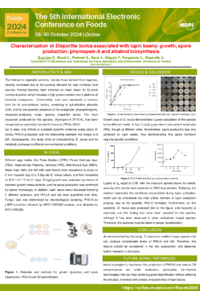
Introduction: Increasing interest in lupin as a plant-based protein source for human consumption has raised concerns regarding its safety. Actually, lupin could be affected by a phytopathogenic fungus named Diaporthe toxica, which can produce phomopsin-A (PHO-A). This mycotoxin causes hepatic damage in animals and has been recently recognised as potentially harmful for humans. Given the limited literature available on this species, an investigation into its metabolism and PHO-A biosynthesis pathway is necessary.
Methods: Oat Flake Medium (OFM), Potato Dextrose Agar (PDA), yeast extract, peptone, Dextrose Agar (YPD), Malt Extract Agar (MEA) and Water Agar (WA) were inoculated by using a mycelial plug and incubated at 25.0 °C for 21 days to evaluate the growth of Diaporthe toxica on different substrates using mycelium diameter measurements. The same agar media, together with WA with lupin beans, were used to evaluate the spore production. Furthermore, WA with lupin beans inoculated following three different protocols was used to investigate the production of PHO-A and alkaloids.
Results: The results revealed a high adaptability of the Diaporthe toxica that grew on all the media, even if the spore production was only achieved on WA with lupin beans. PHO-A production evidenced a diverse fungal adaptation in the three different scenarios. In ideal conditions, PHO-A reached 1082.17 ppm concentration after 21 days, while in the conditions encountered in commercial lupins it reached values of 75.09 and 155.83 ppm depending on the inoculation technique. The quantification of alkaloids revealed that their concentration increased over time in inoculated lupin beans.
Conclusion: The results highlighted an adaptability of Diaporthe toxica to different media, and differences in PHO-A production. Conversely, spore production was only evident in one case. Alkaloid production poses new challenges, but further research is necessary. In conclusion, a significant update was provided on Diaporthe toxica that might help to contain the related risks.
Keywords
lupin beans
Diaporthe toxica
phomopsin
alkaloids
Poster
Poster virtual conference Foods Buccioni F..pdf
Detection of Fumonisins in Maize Using Near-Infrared Spectroscopy
DEVELOPMENT OF ALMOND MILK–FRUIT SORBET COMPOSITIONS WITH A RECORD OF THEIR PHYSICO-CHEMICAL, BIOLOGICAL, NUTRITIONAL, AND TEXTURAL PROPERTIES.