Event submissions
Published
This submission belongs to the session S1. Innovation in Food Technology and Engineering of the event The 5th International Electronic Conference on Foods
Published date
25 Oct, 2024
Academic Editor
'%3e%3cpath%20d='M12.6657%2010.9104C12.4185%2010.325%2012.0599%209.79327%2011.6097%209.34482C11.1609%208.89508%2010.6293%208.5365%2010.0442%208.28888C10.0389%208.28626%2010.0337%208.28495%2010.0285%208.28233C10.8446%207.69279%2011.3752%206.73249%2011.3752%205.64904C11.3752%203.8542%209.92103%202.39999%208.1262%202.39999C6.33136%202.39999%204.87715%203.8542%204.87715%205.64904C4.87715%206.73249%205.40774%207.69279%206.22393%208.28364C6.21869%208.28626%206.21345%208.28757%206.20821%208.29019C5.62129%208.5378%205.09463%208.89284%204.64265%209.34613C4.1929%209.79493%203.83432%2010.3266%203.58671%2010.9117C3.34345%2011.4845%203.21226%2012.0987%203.20023%2012.7209C3.19988%2012.7349%203.20233%2012.7488%203.20744%2012.7619C3.21255%2012.7749%203.22022%2012.7867%203.22998%2012.7968C3.23975%2012.8068%203.25142%2012.8147%203.26431%2012.8202C3.2772%2012.8256%203.29105%2012.8284%203.30504%2012.8284H4.09109C4.14874%2012.8284%204.19459%2012.7825%204.1959%2012.7262C4.2221%2011.7148%204.62823%2010.7676%205.34617%2010.0497C6.08899%209.30683%207.0755%208.89808%208.1262%208.89808C9.17689%208.89808%2010.1634%209.30683%2010.9062%2010.0497C11.6242%2010.7676%2012.0303%2011.7148%2012.0565%2012.7262C12.0578%2012.7838%2012.1037%2012.8284%2012.1613%2012.8284H12.9474C12.9613%2012.8284%2012.9752%2012.8256%2012.9881%2012.8202C13.001%2012.8147%2013.0126%2012.8068%2013.0224%2012.7968C13.0322%2012.7867%2013.0398%2012.7749%2013.0449%2012.7619C13.0501%2012.7488%2013.0525%2012.7349%2013.0522%2012.7209C13.0391%2012.0947%2012.9094%2011.4855%2012.6657%2010.9104ZM8.1262%207.9024C7.52486%207.9024%206.9589%207.6679%206.53312%207.24211C6.10733%206.81633%205.87283%206.25037%205.87283%205.64904C5.87283%205.0477%206.10733%204.48174%206.53312%204.05596C6.9589%203.63018%207.52486%203.39567%208.1262%203.39567C8.72753%203.39567%209.29349%203.63018%209.71927%204.05596C10.1451%204.48174%2010.3796%205.0477%2010.3796%205.64904C10.3796%206.25037%2010.1451%206.81633%209.71927%207.24211C9.29349%207.6679%208.72753%207.9024%208.1262%207.9024Z'%20fill='%235D1EE1'/%3e%3c/g%3e%3c/svg%3e) Moktar Hamdi
Moktar HamdiCitation
Dr. Shwetha M.S, Divya S, S. Adhvaija, Diya Anna Thomas, DEVELOPMENT AND ANALYSIS OF STEVIA- AND SUCRALOSE-BASED CHOCOLATE-CHIP COOKIES, in Proceedings of The 5th International Electronic Conference on Foods, 28 October–30 October 2024, MDPI: Basel, Switzerland
Share
Email
Facebook
Twitter
LinkedIn
DEVELOPMENT AND ANALYSIS OF STEVIA- AND SUCRALOSE-BASED CHOCOLATE-CHIP COOKIES
'%3e%3cpath%20d='M12.6647%2010.9104C12.4176%2010.325%2012.0589%209.7933%2011.6088%209.34485C11.16%208.89511%2010.6283%208.53653%2010.0432%208.28891C10.038%208.28629%2010.0327%208.28498%2010.0275%208.28236C10.8437%207.69282%2011.3743%206.73252%2011.3743%205.64907C11.3743%203.85423%209.92005%202.40002%208.12522%202.40002C6.33038%202.40002%204.87618%203.85423%204.87618%205.64907C4.87618%206.73252%205.40677%207.69282%206.22296%208.28367C6.21772%208.28629%206.21248%208.2876%206.20724%208.29022C5.62031%208.53783%205.09365%208.89287%204.64167%209.34616C4.19192%209.79496%203.83334%2010.3266%203.58573%2010.9117C3.34247%2011.4846%203.21128%2012.0987%203.19925%2012.721C3.1989%2012.735%203.20135%2012.7489%203.20646%2012.7619C3.21157%2012.7749%203.21924%2012.7868%203.22901%2012.7968C3.23877%2012.8068%203.25045%2012.8148%203.26334%2012.8202C3.27623%2012.8256%203.29007%2012.8284%203.30406%2012.8284H4.09012C4.14776%2012.8284%204.19362%2012.7825%204.19493%2012.7262C4.22113%2011.7148%204.62726%2010.7676%205.34519%2010.0497C6.08802%209.30686%207.07452%208.89811%208.12522%208.89811C9.17592%208.89811%2010.1624%209.30686%2010.9052%2010.0497C11.6232%2010.7676%2012.0293%2011.7148%2012.0555%2012.7262C12.0568%2012.7839%2012.1027%2012.8284%2012.1603%2012.8284H12.9464C12.9604%2012.8284%2012.9742%2012.8256%2012.9871%2012.8202C13%2012.8148%2013.0117%2012.8068%2013.0214%2012.7968C13.0312%2012.7868%2013.0389%2012.7749%2013.044%2012.7619C13.0491%2012.7489%2013.0515%2012.735%2013.0512%2012.721C13.0381%2012.0947%2012.9084%2011.4856%2012.6647%2010.9104ZM8.12522%207.90243C7.52388%207.90243%206.95792%207.66793%206.53214%207.24215C6.10636%206.81636%205.87185%206.2504%205.87185%205.64907C5.87185%205.04773%206.10636%204.48177%206.53214%204.05599C6.95792%203.63021%207.52388%203.3957%208.12522%203.3957C8.72655%203.3957%209.29252%203.63021%209.7183%204.05599C10.1441%204.48177%2010.3786%205.04773%2010.3786%205.64907C10.3786%206.2504%2010.1441%206.81636%209.7183%207.24215C9.29252%207.66793%208.72655%207.90243%208.12522%207.90243Z'%20fill='%235D1EE1'/%3e%3c/g%3e%3c/svg%3e)
Dr. Shwetha M.S 1
Divya S 2
S. Adhvaija 3
Diya Anna Thomas 4
1. Assistant Professor, Department of Food Technology , JAIN (Deemed-to-be University)
2. JAIN( Deemed to be University)
3. JAIN(Deemed to be University)
4. JAIN (Deemed-to-be University)
Abstract
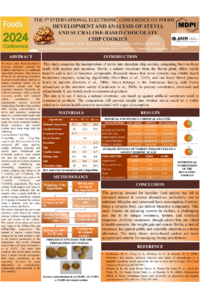
In recent years, there has been a growing consumer demand for healthier alternatives to traditional sugar-laden products. This trend is driven by an increasing awareness of adverse health effects. Stevia is a natural sweetener known for its zero-calorie content and high sweetness intensity. Sucralose, an artificial sweetener, offers a similar sweetness profile with minimal caloric contribution. The experimental process involved formulating chocolate-chip cookies with varying concentrations of stevia and sucralose, comparing them to a control batch made with sucrose. The cookies were prepared using the classic creamery method. Stevia, sucralose, and control cookies have been made with the following concentrations: 1.4g/100g, 21.5g/100g, and 4.2g/100g, respectively.
Physicochemical tests measured pH, water activity, weight, thickness, diameter, and spread ratio. Nutritional and proximate analysis were carried out, and the cookies made of sucralose and stevia had a moisture content of 4.86±0.07g and 4.64±0.05g, respectively. Ash content analysis was found to be 2.11±0.07g and 2.73±0.04g. The pH of the samples was seen to be 7.13±0.02, 7.43±0.03, and 7.52±0.02, respectively. The water activity of all samples was found to be 0.4, which indicates that the samples have a good shelf-life at ambient storage conditions. A panel of 18 people evaluated the cookies using a hedonic scale for taste, texture, aroma, and flavor.
The results indicated that stevia and sucralose could effectively replace sucrose without compromising the taste and texture of the cookies. The amount of sucralose and stevia was found to be 0.036g/100g and 0.090g/100g, respectively. The amount of sucrose content being reduced in the final product is due to the process parameters of the experiment. The results obtained were in line with those of Handa C. et al (2012). The study also confirms that stevia-based cookies have a better overall acceptance. This study contributes to the expanding literature on sugar alternatives in confectionery, emphasizing their potential in the food industry.
Keywords
Stevia
Sucralose
Sugar alternatives
Sensory evaluation
Physicochemical Tests
Sweetness Profile
Poster
DEVELOPMENT AND ANALYSIS OF STEVIA AND SUCRALOSE BASED CHOCO CHIP COOKIES.pdf
DEVELOPMENT OF ALMOND MILK–FRUIT SORBET COMPOSITIONS WITH A RECORD OF THEIR PHYSICO-CHEMICAL, BIOLOGICAL, NUTRITIONAL, AND TEXTURAL PROPERTIES.
Effect of different stabilisers on physicochemical, rheological and microstructural properties of chickpea-based yogurt