Event submissions
Published
This submission belongs to the session S2. Food Nutrition and Functional Foods of the event The 5th International Electronic Conference on Foods
Published date
25 Oct, 2024
Academic Editor
'%3e%3cpath%20d='M12.6657%2010.9104C12.4185%2010.325%2012.0599%209.79327%2011.6097%209.34482C11.1609%208.89508%2010.6293%208.5365%2010.0442%208.28888C10.0389%208.28626%2010.0337%208.28495%2010.0285%208.28233C10.8446%207.69279%2011.3752%206.73249%2011.3752%205.64904C11.3752%203.8542%209.92103%202.39999%208.1262%202.39999C6.33136%202.39999%204.87715%203.8542%204.87715%205.64904C4.87715%206.73249%205.40774%207.69279%206.22393%208.28364C6.21869%208.28626%206.21345%208.28757%206.20821%208.29019C5.62129%208.5378%205.09463%208.89284%204.64265%209.34613C4.1929%209.79493%203.83432%2010.3266%203.58671%2010.9117C3.34345%2011.4845%203.21226%2012.0987%203.20023%2012.7209C3.19988%2012.7349%203.20233%2012.7488%203.20744%2012.7619C3.21255%2012.7749%203.22022%2012.7867%203.22998%2012.7968C3.23975%2012.8068%203.25142%2012.8147%203.26431%2012.8202C3.2772%2012.8256%203.29105%2012.8284%203.30504%2012.8284H4.09109C4.14874%2012.8284%204.19459%2012.7825%204.1959%2012.7262C4.2221%2011.7148%204.62823%2010.7676%205.34617%2010.0497C6.08899%209.30683%207.0755%208.89808%208.1262%208.89808C9.17689%208.89808%2010.1634%209.30683%2010.9062%2010.0497C11.6242%2010.7676%2012.0303%2011.7148%2012.0565%2012.7262C12.0578%2012.7838%2012.1037%2012.8284%2012.1613%2012.8284H12.9474C12.9613%2012.8284%2012.9752%2012.8256%2012.9881%2012.8202C13.001%2012.8147%2013.0126%2012.8068%2013.0224%2012.7968C13.0322%2012.7867%2013.0398%2012.7749%2013.0449%2012.7619C13.0501%2012.7488%2013.0525%2012.7349%2013.0522%2012.7209C13.0391%2012.0947%2012.9094%2011.4855%2012.6657%2010.9104ZM8.1262%207.9024C7.52486%207.9024%206.9589%207.6679%206.53312%207.24211C6.10733%206.81633%205.87283%206.25037%205.87283%205.64904C5.87283%205.0477%206.10733%204.48174%206.53312%204.05596C6.9589%203.63018%207.52486%203.39567%208.1262%203.39567C8.72753%203.39567%209.29349%203.63018%209.71927%204.05596C10.1451%204.48174%2010.3796%205.0477%2010.3796%205.64904C10.3796%206.25037%2010.1451%206.81633%209.71927%207.24211C9.29349%207.6679%208.72753%207.9024%208.1262%207.9024Z'%20fill='%235D1EE1'/%3e%3c/g%3e%3c/svg%3e) Manuel Viuda-Martos
Manuel Viuda-MartosCitation
Shuai Hu, María Martín-Trueba, Silvia Cañas, Miguel Rebollo-Hernanz, Yolanda Aguilera, Vanesa Benítez, María Ángeles Martín-Cabrejas, Alicia Gil-Ramírez, Coffee Pulp Valorization Strategy: Flavonoid- and lipid-enriched food-grade ingredients obtained from an advanced extraction technology, in Proceedings of The 5th International Electronic Conference on Foods, 28 October–30 October 2024, MDPI: Basel, Switzerland
Share
Email
Facebook
Twitter
LinkedIn
Coffee Pulp Valorization Strategy: Flavonoid- and lipid-enriched food-grade ingredients obtained from an advanced extraction technology
'%3e%3cpath%20d='M12.6647%2010.9104C12.4176%2010.325%2012.0589%209.7933%2011.6088%209.34485C11.16%208.89511%2010.6283%208.53653%2010.0432%208.28891C10.038%208.28629%2010.0327%208.28498%2010.0275%208.28236C10.8437%207.69282%2011.3743%206.73252%2011.3743%205.64907C11.3743%203.85423%209.92005%202.40002%208.12522%202.40002C6.33038%202.40002%204.87618%203.85423%204.87618%205.64907C4.87618%206.73252%205.40677%207.69282%206.22296%208.28367C6.21772%208.28629%206.21248%208.2876%206.20724%208.29022C5.62031%208.53783%205.09365%208.89287%204.64167%209.34616C4.19192%209.79496%203.83334%2010.3266%203.58573%2010.9117C3.34247%2011.4846%203.21128%2012.0987%203.19925%2012.721C3.1989%2012.735%203.20135%2012.7489%203.20646%2012.7619C3.21157%2012.7749%203.21924%2012.7868%203.22901%2012.7968C3.23877%2012.8068%203.25045%2012.8148%203.26334%2012.8202C3.27623%2012.8256%203.29007%2012.8284%203.30406%2012.8284H4.09012C4.14776%2012.8284%204.19362%2012.7825%204.19493%2012.7262C4.22113%2011.7148%204.62726%2010.7676%205.34519%2010.0497C6.08802%209.30686%207.07452%208.89811%208.12522%208.89811C9.17592%208.89811%2010.1624%209.30686%2010.9052%2010.0497C11.6232%2010.7676%2012.0293%2011.7148%2012.0555%2012.7262C12.0568%2012.7839%2012.1027%2012.8284%2012.1603%2012.8284H12.9464C12.9604%2012.8284%2012.9742%2012.8256%2012.9871%2012.8202C13%2012.8148%2013.0117%2012.8068%2013.0214%2012.7968C13.0312%2012.7868%2013.0389%2012.7749%2013.044%2012.7619C13.0491%2012.7489%2013.0515%2012.735%2013.0512%2012.721C13.0381%2012.0947%2012.9084%2011.4856%2012.6647%2010.9104ZM8.12522%207.90243C7.52388%207.90243%206.95792%207.66793%206.53214%207.24215C6.10636%206.81636%205.87185%206.2504%205.87185%205.64907C5.87185%205.04773%206.10636%204.48177%206.53214%204.05599C6.95792%203.63021%207.52388%203.3957%208.12522%203.3957C8.72655%203.3957%209.29252%203.63021%209.7183%204.05599C10.1441%204.48177%2010.3786%205.04773%2010.3786%205.64907C10.3786%206.2504%2010.1441%206.81636%209.7183%207.24215C9.29252%207.66793%208.72655%207.90243%208.12522%207.90243Z'%20fill='%235D1EE1'/%3e%3c/g%3e%3c/svg%3e)
Shuai Hu 1,2

María Martín-Trueba 1,2

Silvia Cañas 1,2

Miguel Rebollo-Hernanz 1,3

Yolanda Aguilera 1,2

Vanesa Benítez 2,4

María Ángeles Martín-Cabrejas 2,4

Alicia Gil-Ramírez 1,2
1. Department of Agricultural Chemistry and Food Science, Faculty of Science, C/ Francisco Tomás y Valiente, 7. Universidad Autónoma de Madrid, 28049, Madrid, Spain.
2. Department of Production and Characterization of Novel Foods, Institute of Food Science Research, CIAL (UAM-CSIC), 28049 Madrid, Spain
3. Department of Production and Characterization of Novel Foods, Institute of Food Science Research, CIAL (UAM-CSIC), 28049 Madrid, Spain.
4. Department of Agricultural Chemistry and Food Science, Faculty of Science, C/ Francisco Tomás y Valiente, 7. Universidad Autónoma de Madrid, 28049, Madrid, Spain
Abstract
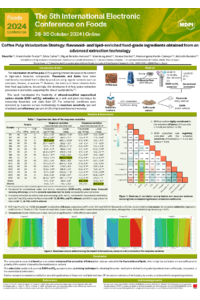
The valorization of coffee pulp (CP) is gaining interest because of its content in high-value bioactive compounds. Flavonoids and lipids have been traditionally recovered from coffee by-products using organic solvents such as methanol, hexane, or acetone. However, the toxicity of these solvents limits their food applications. Accordingly, the development of food-grade extraction processes is promoted, supporting the idea of sustainability. This work investigated the feasibility of ethanol-modified supercritical carbon dioxide (EtOH-scCO2) extraction as a safe and green technique for recovering flavonoids and lipids from CP. The extraction conditions, namely, temperature (45, 55, and 65 °C), pressure (20 and 30 MPa), and EtOH proportion (5 and 10%), were screened using response surface methodology for maximizing the selectivity and efficiency of lipid and flavonoid recovery. The results revealed that EtOH proportion significantly increased (p < 0.05) the extraction efficiency but decreased (p < 0.05) the extraction selectivity of flavonoids and lipids. Compared to conventional aqueous and ethanolic solid–liquid extractions, EtOH-scCO2 yielded lower flavonoid recovery efficiency, while the opposite was observed for lipids compared to ethanol extractions. However, a superior extraction selectivity was achieved using such advanced technology compared to conventional extractions, namely, up to 33.7 mg CE/g extract for flavonoids at 45 °C, 30 MPa, and 5% ethanol; and 505 mg /g of extract for lipids at 55 °C, 30 MPa and 5% ethanol. Overall, these results revealed that the EtOH-modified sc-CO2 extraction technology from CP could be a promising approach for obtaining flavonoid- and lipid-enriched food-grade ingredients. Hence, this research contributes to the circular bioeconomy paradigm framed on the valorization of agri-food by-products.
Keywords
Coffee pulp
By-product valorization
Ethanol-modified supercritical carbon dioxide
Flavonoids
Lipids
Food-grade ingredients
Poster
Poster-Shuai.pdf
Evaluation of bioactive amaranth compounds with hypoglycemic effect
Properties of watermelon seed oil