Event submissions
Published
This submission belongs to the session S2. Food Nutrition and Functional Foods of the event The 5th International Electronic Conference on Foods
Published date
25 Oct, 2024
Academic Editor
'%3e%3cpath%20d='M12.6657%2010.9104C12.4185%2010.325%2012.0599%209.79327%2011.6097%209.34482C11.1609%208.89508%2010.6293%208.5365%2010.0442%208.28888C10.0389%208.28626%2010.0337%208.28495%2010.0285%208.28233C10.8446%207.69279%2011.3752%206.73249%2011.3752%205.64904C11.3752%203.8542%209.92103%202.39999%208.1262%202.39999C6.33136%202.39999%204.87715%203.8542%204.87715%205.64904C4.87715%206.73249%205.40774%207.69279%206.22393%208.28364C6.21869%208.28626%206.21345%208.28757%206.20821%208.29019C5.62129%208.5378%205.09463%208.89284%204.64265%209.34613C4.1929%209.79493%203.83432%2010.3266%203.58671%2010.9117C3.34345%2011.4845%203.21226%2012.0987%203.20023%2012.7209C3.19988%2012.7349%203.20233%2012.7488%203.20744%2012.7619C3.21255%2012.7749%203.22022%2012.7867%203.22998%2012.7968C3.23975%2012.8068%203.25142%2012.8147%203.26431%2012.8202C3.2772%2012.8256%203.29105%2012.8284%203.30504%2012.8284H4.09109C4.14874%2012.8284%204.19459%2012.7825%204.1959%2012.7262C4.2221%2011.7148%204.62823%2010.7676%205.34617%2010.0497C6.08899%209.30683%207.0755%208.89808%208.1262%208.89808C9.17689%208.89808%2010.1634%209.30683%2010.9062%2010.0497C11.6242%2010.7676%2012.0303%2011.7148%2012.0565%2012.7262C12.0578%2012.7838%2012.1037%2012.8284%2012.1613%2012.8284H12.9474C12.9613%2012.8284%2012.9752%2012.8256%2012.9881%2012.8202C13.001%2012.8147%2013.0126%2012.8068%2013.0224%2012.7968C13.0322%2012.7867%2013.0398%2012.7749%2013.0449%2012.7619C13.0501%2012.7488%2013.0525%2012.7349%2013.0522%2012.7209C13.0391%2012.0947%2012.9094%2011.4855%2012.6657%2010.9104ZM8.1262%207.9024C7.52486%207.9024%206.9589%207.6679%206.53312%207.24211C6.10733%206.81633%205.87283%206.25037%205.87283%205.64904C5.87283%205.0477%206.10733%204.48174%206.53312%204.05596C6.9589%203.63018%207.52486%203.39567%208.1262%203.39567C8.72753%203.39567%209.29349%203.63018%209.71927%204.05596C10.1451%204.48174%2010.3796%205.0477%2010.3796%205.64904C10.3796%206.25037%2010.1451%206.81633%209.71927%207.24211C9.29349%207.6679%208.72753%207.9024%208.1262%207.9024Z'%20fill='%235D1EE1'/%3e%3c/g%3e%3c/svg%3e) Manuel Viuda-Martos
Manuel Viuda-MartosCitation
Yassine Mouniane, Mohammed Choukri Belkadi, Issam El-Khadir, Ahmed Chriqui, Driss Hmouni, Exploiting the potential of carob pods (Ceratonia siliqua L.) as a functional food ingredient: A review, in Proceedings of The 5th International Electronic Conference on Foods, 28 October–30 October 2024, MDPI: Basel, Switzerland
Share
Email
Facebook
Twitter
LinkedIn
Exploiting the potential of carob pods (Ceratonia siliqua L.) as a functional food ingredient: A review
'%3e%3cpath%20d='M12.6647%2010.9104C12.4176%2010.325%2012.0589%209.7933%2011.6088%209.34485C11.16%208.89511%2010.6283%208.53653%2010.0432%208.28891C10.038%208.28629%2010.0327%208.28498%2010.0275%208.28236C10.8437%207.69282%2011.3743%206.73252%2011.3743%205.64907C11.3743%203.85423%209.92005%202.40002%208.12522%202.40002C6.33038%202.40002%204.87618%203.85423%204.87618%205.64907C4.87618%206.73252%205.40677%207.69282%206.22296%208.28367C6.21772%208.28629%206.21248%208.2876%206.20724%208.29022C5.62031%208.53783%205.09365%208.89287%204.64167%209.34616C4.19192%209.79496%203.83334%2010.3266%203.58573%2010.9117C3.34247%2011.4846%203.21128%2012.0987%203.19925%2012.721C3.1989%2012.735%203.20135%2012.7489%203.20646%2012.7619C3.21157%2012.7749%203.21924%2012.7868%203.22901%2012.7968C3.23877%2012.8068%203.25045%2012.8148%203.26334%2012.8202C3.27623%2012.8256%203.29007%2012.8284%203.30406%2012.8284H4.09012C4.14776%2012.8284%204.19362%2012.7825%204.19493%2012.7262C4.22113%2011.7148%204.62726%2010.7676%205.34519%2010.0497C6.08802%209.30686%207.07452%208.89811%208.12522%208.89811C9.17592%208.89811%2010.1624%209.30686%2010.9052%2010.0497C11.6232%2010.7676%2012.0293%2011.7148%2012.0555%2012.7262C12.0568%2012.7839%2012.1027%2012.8284%2012.1603%2012.8284H12.9464C12.9604%2012.8284%2012.9742%2012.8256%2012.9871%2012.8202C13%2012.8148%2013.0117%2012.8068%2013.0214%2012.7968C13.0312%2012.7868%2013.0389%2012.7749%2013.044%2012.7619C13.0491%2012.7489%2013.0515%2012.735%2013.0512%2012.721C13.0381%2012.0947%2012.9084%2011.4856%2012.6647%2010.9104ZM8.12522%207.90243C7.52388%207.90243%206.95792%207.66793%206.53214%207.24215C6.10636%206.81636%205.87185%206.2504%205.87185%205.64907C5.87185%205.04773%206.10636%204.48177%206.53214%204.05599C6.95792%203.63021%207.52388%203.3957%208.12522%203.3957C8.72655%203.3957%209.29252%203.63021%209.7183%204.05599C10.1441%204.48177%2010.3786%205.04773%2010.3786%205.64907C10.3786%206.2504%2010.1441%206.81636%209.7183%207.24215C9.29252%207.66793%208.72655%207.90243%208.12522%207.90243Z'%20fill='%235D1EE1'/%3e%3c/g%3e%3c/svg%3e)
Yassine Mouniane 1
Mohammed Choukri Belkadi 2
Issam El-Khadir 3
Ahmed Chriqui 3
Driss Hmouni 3
1. Laboratory of Natural Resources and Sustainable Development, Faculty of Sciences, Ibn Tofaïl University—KENITRA-University Campus, Kenitra 14000, Morocco
2. Laboratory of Microbiology, Mohammed VI University Hospital, Faculty of Medicine andPharmacy, University Mohammed the First, Oujda, Morocco
3. Natural Resources and Sustainable Development laboratory, Faculty of Sciences, Ibn Tofail University, B.P 242, Kenitra, Morocco
Abstract
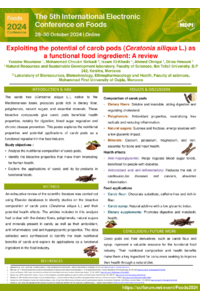
The carob tree (Ceratonia siliqua L.) is a Mediterranean plant whose fruits, known as carob pods, are rich in bioactive compounds. These compounds include dietary fibres, polyphenols, natural sugars, and essential minerals, which offer various health benefits. This study reviews the nutritional and bioactive properties of carob pods and their derivatives. A comprehensive literature review was conducted, focusing on studies that analyze the composition and health benefits of carob. Carob pods contain both soluble and insoluble dietary fibers, which aid in digestion, regulate bowel movements, control appetite, and reduce cholesterol levels. Polyphenols, such as flavonoids and tannins, provide antioxidant properties that neutralize free radicals and protect against oxidative stress, thereby reducing inflammation. The natural sugars in carob, including sucrose and fructose, serve as a natural energy source with a lower impact on blood sugar levels compared to refined sugars. Essential minerals like calcium, potassium, magnesium, and iron support various physiological functions, including bone and heart health. Carob's anti-hyperglycemic properties help regulate blood sugar levels, beneficial for diabetes management. Its antioxidant properties reduce the risk of chronic diseases such as cardiovascular diseases and certain cancers, while its anti-inflammatory properties can alleviate conditions like arthritis and inflammatory bowel disorders. Carob-based products, such as carob flour and carob syrup, hold significant potential as functional food ingredients due to their nutritional and bioactive properties. Applications include its use as a chocolate substitute, food additive, and dietary supplement aimed at improving digestive and metabolic health. Thus, carob and its derivatives represent a valuable resource for the food industry and health-conscious consumers seeking to enhance their health through nutrition.
Keywords
Carob pod
bioactive compounds
functional food
biological activity
Ceratonia siliqua L.
Poster
poster carob.pdf
Optimized Purification Processes for Isolation and Modification of Oligosaccharides from Rathi Cow’s Milk
Microbial And Antioxidant Analysis of Mint Chewable Gummies Incorporated with Moringa oleifera, Syzygium aromaticum and Plectranthus amboinicus