Event submissions
Published
This submission belongs to the session S4. Food Microbiology of the event The 5th International Electronic Conference on Foods
Published date
25 Oct, 2024
Academic Editor
'%3e%3cpath%20d='M12.6657%2010.9104C12.4185%2010.325%2012.0599%209.79327%2011.6097%209.34482C11.1609%208.89508%2010.6293%208.5365%2010.0442%208.28888C10.0389%208.28626%2010.0337%208.28495%2010.0285%208.28233C10.8446%207.69279%2011.3752%206.73249%2011.3752%205.64904C11.3752%203.8542%209.92103%202.39999%208.1262%202.39999C6.33136%202.39999%204.87715%203.8542%204.87715%205.64904C4.87715%206.73249%205.40774%207.69279%206.22393%208.28364C6.21869%208.28626%206.21345%208.28757%206.20821%208.29019C5.62129%208.5378%205.09463%208.89284%204.64265%209.34613C4.1929%209.79493%203.83432%2010.3266%203.58671%2010.9117C3.34345%2011.4845%203.21226%2012.0987%203.20023%2012.7209C3.19988%2012.7349%203.20233%2012.7488%203.20744%2012.7619C3.21255%2012.7749%203.22022%2012.7867%203.22998%2012.7968C3.23975%2012.8068%203.25142%2012.8147%203.26431%2012.8202C3.2772%2012.8256%203.29105%2012.8284%203.30504%2012.8284H4.09109C4.14874%2012.8284%204.19459%2012.7825%204.1959%2012.7262C4.2221%2011.7148%204.62823%2010.7676%205.34617%2010.0497C6.08899%209.30683%207.0755%208.89808%208.1262%208.89808C9.17689%208.89808%2010.1634%209.30683%2010.9062%2010.0497C11.6242%2010.7676%2012.0303%2011.7148%2012.0565%2012.7262C12.0578%2012.7838%2012.1037%2012.8284%2012.1613%2012.8284H12.9474C12.9613%2012.8284%2012.9752%2012.8256%2012.9881%2012.8202C13.001%2012.8147%2013.0126%2012.8068%2013.0224%2012.7968C13.0322%2012.7867%2013.0398%2012.7749%2013.0449%2012.7619C13.0501%2012.7488%2013.0525%2012.7349%2013.0522%2012.7209C13.0391%2012.0947%2012.9094%2011.4855%2012.6657%2010.9104ZM8.1262%207.9024C7.52486%207.9024%206.9589%207.6679%206.53312%207.24211C6.10733%206.81633%205.87283%206.25037%205.87283%205.64904C5.87283%205.0477%206.10733%204.48174%206.53312%204.05596C6.9589%203.63018%207.52486%203.39567%208.1262%203.39567C8.72753%203.39567%209.29349%203.63018%209.71927%204.05596C10.1451%204.48174%2010.3796%205.0477%2010.3796%205.64904C10.3796%206.25037%2010.1451%206.81633%209.71927%207.24211C9.29349%207.6679%208.72753%207.9024%208.1262%207.9024Z'%20fill='%235D1EE1'/%3e%3c/g%3e%3c/svg%3e) Antonio Bevilacqua
Antonio BevilacquaCitation
Milena Gabrielle de Jesus, Lorena Lima Ludovico, Kauã Colaço Schier, Elisana Julek, Eduardo Sirichuk de Souza, Julia Arantes Galvão, Antimicrobial Action of Organic Acids Vs. Bacteria of Food Origin, in Proceedings of The 5th International Electronic Conference on Foods, 28 October–30 October 2024, MDPI: Basel, Switzerland
Share
Email
Facebook
Twitter
LinkedIn
Antimicrobial Action of Organic Acids Vs. Bacteria of Food Origin
'%3e%3cpath%20d='M12.6647%2010.9104C12.4176%2010.325%2012.0589%209.7933%2011.6088%209.34485C11.16%208.89511%2010.6283%208.53653%2010.0432%208.28891C10.038%208.28629%2010.0327%208.28498%2010.0275%208.28236C10.8437%207.69282%2011.3743%206.73252%2011.3743%205.64907C11.3743%203.85423%209.92005%202.40002%208.12522%202.40002C6.33038%202.40002%204.87618%203.85423%204.87618%205.64907C4.87618%206.73252%205.40677%207.69282%206.22296%208.28367C6.21772%208.28629%206.21248%208.2876%206.20724%208.29022C5.62031%208.53783%205.09365%208.89287%204.64167%209.34616C4.19192%209.79496%203.83334%2010.3266%203.58573%2010.9117C3.34247%2011.4846%203.21128%2012.0987%203.19925%2012.721C3.1989%2012.735%203.20135%2012.7489%203.20646%2012.7619C3.21157%2012.7749%203.21924%2012.7868%203.22901%2012.7968C3.23877%2012.8068%203.25045%2012.8148%203.26334%2012.8202C3.27623%2012.8256%203.29007%2012.8284%203.30406%2012.8284H4.09012C4.14776%2012.8284%204.19362%2012.7825%204.19493%2012.7262C4.22113%2011.7148%204.62726%2010.7676%205.34519%2010.0497C6.08802%209.30686%207.07452%208.89811%208.12522%208.89811C9.17592%208.89811%2010.1624%209.30686%2010.9052%2010.0497C11.6232%2010.7676%2012.0293%2011.7148%2012.0555%2012.7262C12.0568%2012.7839%2012.1027%2012.8284%2012.1603%2012.8284H12.9464C12.9604%2012.8284%2012.9742%2012.8256%2012.9871%2012.8202C13%2012.8148%2013.0117%2012.8068%2013.0214%2012.7968C13.0312%2012.7868%2013.0389%2012.7749%2013.044%2012.7619C13.0491%2012.7489%2013.0515%2012.735%2013.0512%2012.721C13.0381%2012.0947%2012.9084%2011.4856%2012.6647%2010.9104ZM8.12522%207.90243C7.52388%207.90243%206.95792%207.66793%206.53214%207.24215C6.10636%206.81636%205.87185%206.2504%205.87185%205.64907C5.87185%205.04773%206.10636%204.48177%206.53214%204.05599C6.95792%203.63021%207.52388%203.3957%208.12522%203.3957C8.72655%203.3957%209.29252%203.63021%209.7183%204.05599C10.1441%204.48177%2010.3786%205.04773%2010.3786%205.64907C10.3786%206.2504%2010.1441%206.81636%209.7183%207.24215C9.29252%207.66793%208.72655%207.90243%208.12522%207.90243Z'%20fill='%235D1EE1'/%3e%3c/g%3e%3c/svg%3e)
Milena Gabrielle de Jesus 1
Lorena Lima Ludovico 1
Kauã Colaço Schier 1
Elisana Julek 2
Eduardo Sirichuk de Souza 1,3

Julia Arantes Galvão 1,3
1. Quality Control and Food Safety Laboratory - Federal University of Paraná , Curitiba/Paraná, Brazil
2. Post-Graduation Program in Veterinary Sciences - Federal University of Paraná, Curitiba/Paraná, 80035-050, Brazil
3. Post-Graduation Program in Veterinary Sciences - Federal University of Paraná
Abstract
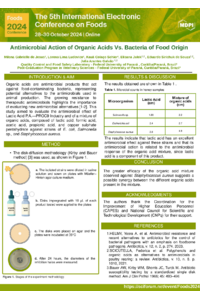
Organic acids are antimicrobial products that act against food-contaminating bacteria, representing potential alternatives to the antimicrobials used in animal production. The growing resistance to therapeutic antimicrobials highlights the importance of evaluating new antimicrobial alternatives. This study aimed to evaluate the antimicrobial effect of Lactic Acid P.A.—PROC9 Industry and of a mixture of organic acids, composed of lactic acid, formic acid, acetic acid, propionic acid, and copper sulphate pentahydrate against strains of E. coli, Salmonella sp., and Staphylococcus aureus. For this purpose, the disk-diffusion methodology (Kirby and Bauer method) was used. The isolated strains were diluted in saline solution and sown on plates with Müeller–Hinton agar culture medium. Disks impregnated with 10 µL of the lactic acid P.A. and the mixture of organic acids were applied to the plates. The results obtained were as follows: the inhibition halos on the plates treated with lactic acid P.A. were 1.89 cm for Salmonella sp., 2.4 cm for E. coli, and 2.8 cm for Staphylococcus aureus. With the mixture of organic acids, the halos observed were 2.2 cm for Salmonella sp., 2.7 cm for E. coli, and 4.9 cm for Staphylococcus aureus. The results indicate that lactic acid has an excellent antimicrobial effect against these strains and that its antimicrobial action is related to the antimicrobial response of the organic acid mixture, since lactic acid is a component of this product. The greater efficacy of the organic acid mixture observed against Staphylococcus aureus suggests a possible synergy between the different organic acids present in the mixture.
Keywords
Lactic Acid
Formic Acid
Acetic Acid
Propionic Acid
Copper Sulphate Pentahydrate
Poster
poster_milena.pdf
Microbial And Antioxidant Analysis of Mint Chewable Gummies Incorporated with Moringa oleifera, Syzygium aromaticum and Plectranthus amboinicus
Phenolic compounds of olive mill wastewater (OMW) samples from Spain and evaluation of their antioxidant potential