Event submissions
Published
This submission belongs to the session S3. Sustainable Food Security and Food System of the event The 5th International Electronic Conference on Foods
Published date
25 Oct, 2024
Academic Editor
'%3e%3cpath%20d='M12.6657%2010.9104C12.4185%2010.325%2012.0599%209.79327%2011.6097%209.34482C11.1609%208.89508%2010.6293%208.5365%2010.0442%208.28888C10.0389%208.28626%2010.0337%208.28495%2010.0285%208.28233C10.8446%207.69279%2011.3752%206.73249%2011.3752%205.64904C11.3752%203.8542%209.92103%202.39999%208.1262%202.39999C6.33136%202.39999%204.87715%203.8542%204.87715%205.64904C4.87715%206.73249%205.40774%207.69279%206.22393%208.28364C6.21869%208.28626%206.21345%208.28757%206.20821%208.29019C5.62129%208.5378%205.09463%208.89284%204.64265%209.34613C4.1929%209.79493%203.83432%2010.3266%203.58671%2010.9117C3.34345%2011.4845%203.21226%2012.0987%203.20023%2012.7209C3.19988%2012.7349%203.20233%2012.7488%203.20744%2012.7619C3.21255%2012.7749%203.22022%2012.7867%203.22998%2012.7968C3.23975%2012.8068%203.25142%2012.8147%203.26431%2012.8202C3.2772%2012.8256%203.29105%2012.8284%203.30504%2012.8284H4.09109C4.14874%2012.8284%204.19459%2012.7825%204.1959%2012.7262C4.2221%2011.7148%204.62823%2010.7676%205.34617%2010.0497C6.08899%209.30683%207.0755%208.89808%208.1262%208.89808C9.17689%208.89808%2010.1634%209.30683%2010.9062%2010.0497C11.6242%2010.7676%2012.0303%2011.7148%2012.0565%2012.7262C12.0578%2012.7838%2012.1037%2012.8284%2012.1613%2012.8284H12.9474C12.9613%2012.8284%2012.9752%2012.8256%2012.9881%2012.8202C13.001%2012.8147%2013.0126%2012.8068%2013.0224%2012.7968C13.0322%2012.7867%2013.0398%2012.7749%2013.0449%2012.7619C13.0501%2012.7488%2013.0525%2012.7349%2013.0522%2012.7209C13.0391%2012.0947%2012.9094%2011.4855%2012.6657%2010.9104ZM8.1262%207.9024C7.52486%207.9024%206.9589%207.6679%206.53312%207.24211C6.10733%206.81633%205.87283%206.25037%205.87283%205.64904C5.87283%205.0477%206.10733%204.48174%206.53312%204.05596C6.9589%203.63018%207.52486%203.39567%208.1262%203.39567C8.72753%203.39567%209.29349%203.63018%209.71927%204.05596C10.1451%204.48174%2010.3796%205.0477%2010.3796%205.64904C10.3796%206.25037%2010.1451%206.81633%209.71927%207.24211C9.29349%207.6679%208.72753%207.9024%208.1262%207.9024Z'%20fill='%235D1EE1'/%3e%3c/g%3e%3c/svg%3e) Theodoros Varzakas
Theodoros VarzakasCitation
Sergio Martínez-Terol, Francisco J Barba, Noelia Pallarés, Houda Berrada, Emilia Ferrer, Pedro V Martínez-Culebras, Phenolic compounds of olive mill wastewater (OMW) samples from Spain and evaluation of their antioxidant potential, in Proceedings of The 5th International Electronic Conference on Foods, 28 October–30 October 2024, MDPI: Basel, Switzerland
Share
Email
Facebook
Twitter
LinkedIn
Phenolic compounds of olive mill wastewater (OMW) samples from Spain and evaluation of their antioxidant potential

Sergio Martínez-Terol 1

Francisco J Barba 1
'%3e%3cpath%20d='M12.6647%2010.9104C12.4176%2010.325%2012.0589%209.7933%2011.6088%209.34485C11.16%208.89511%2010.6283%208.53653%2010.0432%208.28891C10.038%208.28629%2010.0327%208.28498%2010.0275%208.28236C10.8437%207.69282%2011.3743%206.73252%2011.3743%205.64907C11.3743%203.85423%209.92005%202.40002%208.12522%202.40002C6.33038%202.40002%204.87618%203.85423%204.87618%205.64907C4.87618%206.73252%205.40677%207.69282%206.22296%208.28367C6.21772%208.28629%206.21248%208.2876%206.20724%208.29022C5.62031%208.53783%205.09365%208.89287%204.64167%209.34616C4.19192%209.79496%203.83334%2010.3266%203.58573%2010.9117C3.34247%2011.4846%203.21128%2012.0987%203.19925%2012.721C3.1989%2012.735%203.20135%2012.7489%203.20646%2012.7619C3.21157%2012.7749%203.21924%2012.7868%203.22901%2012.7968C3.23877%2012.8068%203.25045%2012.8148%203.26334%2012.8202C3.27623%2012.8256%203.29007%2012.8284%203.30406%2012.8284H4.09012C4.14776%2012.8284%204.19362%2012.7825%204.19493%2012.7262C4.22113%2011.7148%204.62726%2010.7676%205.34519%2010.0497C6.08802%209.30686%207.07452%208.89811%208.12522%208.89811C9.17592%208.89811%2010.1624%209.30686%2010.9052%2010.0497C11.6232%2010.7676%2012.0293%2011.7148%2012.0555%2012.7262C12.0568%2012.7839%2012.1027%2012.8284%2012.1603%2012.8284H12.9464C12.9604%2012.8284%2012.9742%2012.8256%2012.9871%2012.8202C13%2012.8148%2013.0117%2012.8068%2013.0214%2012.7968C13.0312%2012.7868%2013.0389%2012.7749%2013.044%2012.7619C13.0491%2012.7489%2013.0515%2012.735%2013.0512%2012.721C13.0381%2012.0947%2012.9084%2011.4856%2012.6647%2010.9104ZM8.12522%207.90243C7.52388%207.90243%206.95792%207.66793%206.53214%207.24215C6.10636%206.81636%205.87185%206.2504%205.87185%205.64907C5.87185%205.04773%206.10636%204.48177%206.53214%204.05599C6.95792%203.63021%207.52388%203.3957%208.12522%203.3957C8.72655%203.3957%209.29252%203.63021%209.7183%204.05599C10.1441%204.48177%2010.3786%205.04773%2010.3786%205.64907C10.3786%206.2504%2010.1441%206.81636%209.7183%207.24215C9.29252%207.66793%208.72655%207.90243%208.12522%207.90243Z'%20fill='%235D1EE1'/%3e%3c/g%3e%3c/svg%3e)
Noelia Pallarés 1,2
Houda Berrada 1,2
Emilia Ferrer 1,2
Pedro V Martínez-Culebras 1
1. Grupo de Investigación en Tecnologías Innovadoras para la Alimentación Sostenible (ALISOST), Facultad de Farmacia, Universitat de València, Avda. Vicent Andrés Estellés s/n, Burjassot, 46100 València, España
2. Grupo de Investigación en Métodos alternativos para determinar efectos tóxicos y evaluación del riesgo de contaminantes y mezclas (RiskTox), Facultad de Farmacia, Universitat de València, Avda. Vicent Andrés Estellés s/n, Burjassot, 46100 València, España
Abstract
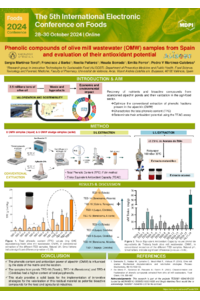
Aim: Industrial processes for olive production generate a considerable amount of oil wastewater, also known as "olive mill wastewater" (OMW), or alpechin, which is a great source of phenolic compounds. The aims of this study are to optimise the conventional extraction of the phenolic fractions present in the alpechín, to characterise the total phenolic content, and to determinate their antioxidant potential using the TEAC assay.
Method: To carry out the study, eight samples of olive mill wastewater (OMW) and five samples of alpechín sludge from abandoned ponds in the Mediterranean area and southern Spain were analysed. After sample defatting using hexane and subsequent drying in an oven, the total phenolic content and antioxidant properties of the extracts were analysed using spectrophotometric techniques.
Results: The samples of alpechín from Cordoba, Tarragona, Alicante, and Toledo, corresponding to codes TED-4, TED-15, TED-14, and TED-16, respectively, showed high TPC contents ranging from 7.2 g GAE/kg to 18.9 g GAE/kg. They also exhibited an antioxidant capacity equivalent to 10-60 micromoles of Trolox/g, significantly exceeding samples from other geographical locations. The polyphenol content of the alpechín samples was influenced by factors such as the matrix condition, seasonality, location, degree of abandonment of the ponds, and vegetation water. In addition, the pH, temperature, extraction technique, and solvent type also affected the recovery of phenolic compounds.
Conclusion: This study provides a solid basis for the implementation of innovative strategies for the valorization of this residual material as potential bioactive compounds for the food and agricultural industries.
Acknowledgements:
This research is part of the projects TED2021-129481B-C31 and TED2021-129481B-C33, funded by MCIN/AEI/10.13039/501100011033 and by the European Union “NextGenerationEU”/PRTR. Sergio Martínez-Terol would like to acknowledge TED2021-129481B-C33 for his contract.
Keywords
Olive mill wastewater (OMW)
alpechin
ponds
phenolic compounds
industry
Poster
Póster.pdf
Antimicrobial Action of Organic Acids Vs. Bacteria of Food Origin
Effect of storage on oxidative stability, polyphenol content and antioxidant activity of fat fraction extracted from chokeberry and blackcurrant seeds by ultrasound-assisted process