Event submissions
Published
This submission belongs to the session S3. Sustainable Food Security and Food System of the event The 5th International Electronic Conference on Foods
Published date
25 Oct, 2024
Academic Editor
'%3e%3cpath%20d='M12.6657%2010.9104C12.4185%2010.325%2012.0599%209.79327%2011.6097%209.34482C11.1609%208.89508%2010.6293%208.5365%2010.0442%208.28888C10.0389%208.28626%2010.0337%208.28495%2010.0285%208.28233C10.8446%207.69279%2011.3752%206.73249%2011.3752%205.64904C11.3752%203.8542%209.92103%202.39999%208.1262%202.39999C6.33136%202.39999%204.87715%203.8542%204.87715%205.64904C4.87715%206.73249%205.40774%207.69279%206.22393%208.28364C6.21869%208.28626%206.21345%208.28757%206.20821%208.29019C5.62129%208.5378%205.09463%208.89284%204.64265%209.34613C4.1929%209.79493%203.83432%2010.3266%203.58671%2010.9117C3.34345%2011.4845%203.21226%2012.0987%203.20023%2012.7209C3.19988%2012.7349%203.20233%2012.7488%203.20744%2012.7619C3.21255%2012.7749%203.22022%2012.7867%203.22998%2012.7968C3.23975%2012.8068%203.25142%2012.8147%203.26431%2012.8202C3.2772%2012.8256%203.29105%2012.8284%203.30504%2012.8284H4.09109C4.14874%2012.8284%204.19459%2012.7825%204.1959%2012.7262C4.2221%2011.7148%204.62823%2010.7676%205.34617%2010.0497C6.08899%209.30683%207.0755%208.89808%208.1262%208.89808C9.17689%208.89808%2010.1634%209.30683%2010.9062%2010.0497C11.6242%2010.7676%2012.0303%2011.7148%2012.0565%2012.7262C12.0578%2012.7838%2012.1037%2012.8284%2012.1613%2012.8284H12.9474C12.9613%2012.8284%2012.9752%2012.8256%2012.9881%2012.8202C13.001%2012.8147%2013.0126%2012.8068%2013.0224%2012.7968C13.0322%2012.7867%2013.0398%2012.7749%2013.0449%2012.7619C13.0501%2012.7488%2013.0525%2012.7349%2013.0522%2012.7209C13.0391%2012.0947%2012.9094%2011.4855%2012.6657%2010.9104ZM8.1262%207.9024C7.52486%207.9024%206.9589%207.6679%206.53312%207.24211C6.10733%206.81633%205.87283%206.25037%205.87283%205.64904C5.87283%205.0477%206.10733%204.48174%206.53312%204.05596C6.9589%203.63018%207.52486%203.39567%208.1262%203.39567C8.72753%203.39567%209.29349%203.63018%209.71927%204.05596C10.1451%204.48174%2010.3796%205.0477%2010.3796%205.64904C10.3796%206.25037%2010.1451%206.81633%209.71927%207.24211C9.29349%207.6679%208.72753%207.9024%208.1262%207.9024Z'%20fill='%235D1EE1'/%3e%3c/g%3e%3c/svg%3e) Joana Amaral
Joana AmaralCitation
Agata Górska, Iga Piasecka, Rita Brzezińska, Magdalena Wirkowska-Wojdyła, Ewa Ostrowska-Ligęza, Effect of storage on oxidative stability, polyphenol content and antioxidant activity of fat fraction extracted from chokeberry and blackcurrant seeds by ultrasound-assisted process, in Proceedings of The 5th International Electronic Conference on Foods, 28 October–30 October 2024, MDPI: Basel, Switzerland
Share
Email
Facebook
Twitter
LinkedIn
Effect of storage on oxidative stability, polyphenol content and antioxidant activity of fat fraction extracted from chokeberry and blackcurrant seeds by ultrasound-assisted process

Agata Górska 1
'%3e%3cpath%20d='M12.6647%2010.9104C12.4176%2010.325%2012.0589%209.7933%2011.6088%209.34485C11.16%208.89511%2010.6283%208.53653%2010.0432%208.28891C10.038%208.28629%2010.0327%208.28498%2010.0275%208.28236C10.8437%207.69282%2011.3743%206.73252%2011.3743%205.64907C11.3743%203.85423%209.92005%202.40002%208.12522%202.40002C6.33038%202.40002%204.87618%203.85423%204.87618%205.64907C4.87618%206.73252%205.40677%207.69282%206.22296%208.28367C6.21772%208.28629%206.21248%208.2876%206.20724%208.29022C5.62031%208.53783%205.09365%208.89287%204.64167%209.34616C4.19192%209.79496%203.83334%2010.3266%203.58573%2010.9117C3.34247%2011.4846%203.21128%2012.0987%203.19925%2012.721C3.1989%2012.735%203.20135%2012.7489%203.20646%2012.7619C3.21157%2012.7749%203.21924%2012.7868%203.22901%2012.7968C3.23877%2012.8068%203.25045%2012.8148%203.26334%2012.8202C3.27623%2012.8256%203.29007%2012.8284%203.30406%2012.8284H4.09012C4.14776%2012.8284%204.19362%2012.7825%204.19493%2012.7262C4.22113%2011.7148%204.62726%2010.7676%205.34519%2010.0497C6.08802%209.30686%207.07452%208.89811%208.12522%208.89811C9.17592%208.89811%2010.1624%209.30686%2010.9052%2010.0497C11.6232%2010.7676%2012.0293%2011.7148%2012.0555%2012.7262C12.0568%2012.7839%2012.1027%2012.8284%2012.1603%2012.8284H12.9464C12.9604%2012.8284%2012.9742%2012.8256%2012.9871%2012.8202C13%2012.8148%2013.0117%2012.8068%2013.0214%2012.7968C13.0312%2012.7868%2013.0389%2012.7749%2013.044%2012.7619C13.0491%2012.7489%2013.0515%2012.735%2013.0512%2012.721C13.0381%2012.0947%2012.9084%2011.4856%2012.6647%2010.9104ZM8.12522%207.90243C7.52388%207.90243%206.95792%207.66793%206.53214%207.24215C6.10636%206.81636%205.87185%206.2504%205.87185%205.64907C5.87185%205.04773%206.10636%204.48177%206.53214%204.05599C6.95792%203.63021%207.52388%203.3957%208.12522%203.3957C8.72655%203.3957%209.29252%203.63021%209.7183%204.05599C10.1441%204.48177%2010.3786%205.04773%2010.3786%205.64907C10.3786%206.2504%2010.1441%206.81636%209.7183%207.24215C9.29252%207.66793%208.72655%207.90243%208.12522%207.90243Z'%20fill='%235D1EE1'/%3e%3c/g%3e%3c/svg%3e)
Iga Piasecka 2
Rita Brzezińska 1

Magdalena Wirkowska-Wojdyła 1

Ewa Ostrowska-Ligęza 1
1. Department of Chemistry, Institute of Food Sciences, Warsaw University of Life Sciences (WULS - SGGW), 159c Nowoursynowska Street, 02-776 Warsaw, Poland
2. Department of Chemistry, Institute of Food Sciences, Warsaw University of Life Sciences (WULS – SGGW), 159c Nowoursynowska Street, 02-776 Warsaw, Poland
Abstract
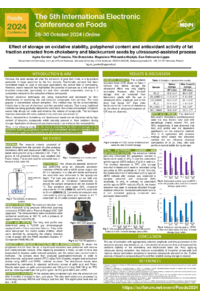
Pomace—a by-product of the fruit industry—is a potential source of bioactive compounds, such as oils. It is important to conduct research on their effective extraction from this material. The aim of this study was to investigate the effect of storage on the oxidative stability, polyphenol content and antioxidant activity of chokeberry and blackcurrant seed oils extracted by an ultrasound-assisted process. The analyses included determination of the total polyphenols, antioxidant activity, oxidative stability and fatty acid profile. The results showed that the use of ultrasonic extraction made it possible to shorten the extraction time and had a positive effect on the oxidative stability of the oils during storage. The highest efficiency was achieved when oil was extracted from blackcurrant seeds according to a process of 12-minute sonication with an amplitude of 60%. The extraction method used had a positive effect on the polyphenol content in the blackcurrant seed oil and the antioxidant activity against ABTS radicals of both oils. The lowest reduction in the polyphenol content after storage was recorded in the case of the blackcurrant seed oil extracted using the sonication process with an amplitude of 60% for 12 minutes. The lowest reduction in antioxidant activity against ABTS radicals after storage was found for the samples obtained by ultrasonic-assisted extraction (amplitude: 60%; time: 12 minutes), and in terms of their activity against DPPH radicals, the lowest reduction was found for the samples obtained by classical extraction. To maintain a higher oxidative stability of the oils during storage, a higher amplitude (90%) and a shorter extraction time (6 min) were preferred. There was no effect of the ultrasound-assisted extraction process on the fatty acid profile. The use of sonication with appropriately selected amplitude and time parameters in the extraction process was beneficial, as it shortened the extraction time and improved the oxidative stability of the chokeberry and blackcurrant seed oils.
Keywords
chokeberry seed oil
blackcurrant seed oil
ultrasound
oxidative stability
polyphenols
antioxidant activity
Poster
A.Gorska_poster.pdf
Phenolic compounds of olive mill wastewater (OMW) samples from Spain and evaluation of their antioxidant potential
Exploring the Commercial Viability of Coffee Pulp Infusion as a Functional Beverage: A Physicochemical and Sensory Evaluation