Event submissions
Published
This submission belongs to the session S2. Food Nutrition and Functional Foods of the event The 5th International Electronic Conference on Foods
Published date
25 Oct, 2024
Academic Editor
'%3e%3cpath%20d='M12.6657%2010.9104C12.4185%2010.325%2012.0599%209.79327%2011.6097%209.34482C11.1609%208.89508%2010.6293%208.5365%2010.0442%208.28888C10.0389%208.28626%2010.0337%208.28495%2010.0285%208.28233C10.8446%207.69279%2011.3752%206.73249%2011.3752%205.64904C11.3752%203.8542%209.92103%202.39999%208.1262%202.39999C6.33136%202.39999%204.87715%203.8542%204.87715%205.64904C4.87715%206.73249%205.40774%207.69279%206.22393%208.28364C6.21869%208.28626%206.21345%208.28757%206.20821%208.29019C5.62129%208.5378%205.09463%208.89284%204.64265%209.34613C4.1929%209.79493%203.83432%2010.3266%203.58671%2010.9117C3.34345%2011.4845%203.21226%2012.0987%203.20023%2012.7209C3.19988%2012.7349%203.20233%2012.7488%203.20744%2012.7619C3.21255%2012.7749%203.22022%2012.7867%203.22998%2012.7968C3.23975%2012.8068%203.25142%2012.8147%203.26431%2012.8202C3.2772%2012.8256%203.29105%2012.8284%203.30504%2012.8284H4.09109C4.14874%2012.8284%204.19459%2012.7825%204.1959%2012.7262C4.2221%2011.7148%204.62823%2010.7676%205.34617%2010.0497C6.08899%209.30683%207.0755%208.89808%208.1262%208.89808C9.17689%208.89808%2010.1634%209.30683%2010.9062%2010.0497C11.6242%2010.7676%2012.0303%2011.7148%2012.0565%2012.7262C12.0578%2012.7838%2012.1037%2012.8284%2012.1613%2012.8284H12.9474C12.9613%2012.8284%2012.9752%2012.8256%2012.9881%2012.8202C13.001%2012.8147%2013.0126%2012.8068%2013.0224%2012.7968C13.0322%2012.7867%2013.0398%2012.7749%2013.0449%2012.7619C13.0501%2012.7488%2013.0525%2012.7349%2013.0522%2012.7209C13.0391%2012.0947%2012.9094%2011.4855%2012.6657%2010.9104ZM8.1262%207.9024C7.52486%207.9024%206.9589%207.6679%206.53312%207.24211C6.10733%206.81633%205.87283%206.25037%205.87283%205.64904C5.87283%205.0477%206.10733%204.48174%206.53312%204.05596C6.9589%203.63018%207.52486%203.39567%208.1262%203.39567C8.72753%203.39567%209.29349%203.63018%209.71927%204.05596C10.1451%204.48174%2010.3796%205.0477%2010.3796%205.64904C10.3796%206.25037%2010.1451%206.81633%209.71927%207.24211C9.29349%207.6679%208.72753%207.9024%208.1262%207.9024Z'%20fill='%235D1EE1'/%3e%3c/g%3e%3c/svg%3e) Manuel Viuda-Martos
Manuel Viuda-MartosCitation
María Martín-Trueba, Shuai Hu, Silvia Cañas, Miguel Rebollo-Hernanz, Alicia Gil-Ramírez, María Ángeles Martín-Cabrejas, Vanesa Benítez, Yolanda Aguilera, Exploring the Commercial Viability of Coffee Pulp Infusion as a Functional Beverage: A Physicochemical and Sensory Evaluation, in Proceedings of The 5th International Electronic Conference on Foods, 28 October–30 October 2024, MDPI: Basel, Switzerland
Share
Email
Facebook
Twitter
LinkedIn
Exploring the Commercial Viability of Coffee Pulp Infusion as a Functional Beverage: A Physicochemical and Sensory Evaluation

María Martín-Trueba 1,2
'%3e%3cpath%20d='M12.6647%2010.9104C12.4176%2010.325%2012.0589%209.7933%2011.6088%209.34485C11.16%208.89511%2010.6283%208.53653%2010.0432%208.28891C10.038%208.28629%2010.0327%208.28498%2010.0275%208.28236C10.8437%207.69282%2011.3743%206.73252%2011.3743%205.64907C11.3743%203.85423%209.92005%202.40002%208.12522%202.40002C6.33038%202.40002%204.87618%203.85423%204.87618%205.64907C4.87618%206.73252%205.40677%207.69282%206.22296%208.28367C6.21772%208.28629%206.21248%208.2876%206.20724%208.29022C5.62031%208.53783%205.09365%208.89287%204.64167%209.34616C4.19192%209.79496%203.83334%2010.3266%203.58573%2010.9117C3.34247%2011.4846%203.21128%2012.0987%203.19925%2012.721C3.1989%2012.735%203.20135%2012.7489%203.20646%2012.7619C3.21157%2012.7749%203.21924%2012.7868%203.22901%2012.7968C3.23877%2012.8068%203.25045%2012.8148%203.26334%2012.8202C3.27623%2012.8256%203.29007%2012.8284%203.30406%2012.8284H4.09012C4.14776%2012.8284%204.19362%2012.7825%204.19493%2012.7262C4.22113%2011.7148%204.62726%2010.7676%205.34519%2010.0497C6.08802%209.30686%207.07452%208.89811%208.12522%208.89811C9.17592%208.89811%2010.1624%209.30686%2010.9052%2010.0497C11.6232%2010.7676%2012.0293%2011.7148%2012.0555%2012.7262C12.0568%2012.7839%2012.1027%2012.8284%2012.1603%2012.8284H12.9464C12.9604%2012.8284%2012.9742%2012.8256%2012.9871%2012.8202C13%2012.8148%2013.0117%2012.8068%2013.0214%2012.7968C13.0312%2012.7868%2013.0389%2012.7749%2013.044%2012.7619C13.0491%2012.7489%2013.0515%2012.735%2013.0512%2012.721C13.0381%2012.0947%2012.9084%2011.4856%2012.6647%2010.9104ZM8.12522%207.90243C7.52388%207.90243%206.95792%207.66793%206.53214%207.24215C6.10636%206.81636%205.87185%206.2504%205.87185%205.64907C5.87185%205.04773%206.10636%204.48177%206.53214%204.05599C6.95792%203.63021%207.52388%203.3957%208.12522%203.3957C8.72655%203.3957%209.29252%203.63021%209.7183%204.05599C10.1441%204.48177%2010.3786%205.04773%2010.3786%205.64907C10.3786%206.2504%2010.1441%206.81636%209.7183%207.24215C9.29252%207.66793%208.72655%207.90243%208.12522%207.90243Z'%20fill='%235D1EE1'/%3e%3c/g%3e%3c/svg%3e)
Shuai Hu 1,2

Silvia Cañas 1,2

Miguel Rebollo-Hernanz 1,2

Alicia Gil-Ramírez 1,2

María Ángeles Martín-Cabrejas 1,2

Vanesa Benítez 1,2

Yolanda Aguilera 1,2
1. 1 Department of Agricultural Chemistry and Food Science, Faculty of Science, C/ Francisco Tomás y Valiente, 7. Universidad Autónoma de Madrid, 28049, Madrid, Spain.
2. 2 Department of Production and Characterization of Novel Foods, Institute of Food Science Research, CIAL (UAM-CSIC), 28049 Madrid, Spain
Abstract
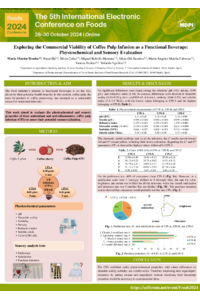
The food industry’s interest in functional beverages is on the rise, driven by their potential health benefits. In this context, coffee pulp, the main by-product of coffee processing, has emerged as a sustainable source for functional infusions. This work aimed to evaluate the physicochemical and sensory properties of three antioxidant and anti-inflammatory coffee pulp infusions (CPI) to assess their potential commercialization. CPI (250 mL) was prepared with a solid–liquid ratio of 0.08 g/mL for 6 min (CPI-A) and 9 min (CPI-B) as the infusion times and with 0.05 g/mL at 9 min (CPI-C). Physicochemical parameters such as pH, titratable acidity, turbidity, density, refractive index, soluble solids, and color (CIELAB) were measured. Additionally, sensory analysis, including preference, satisfaction, and purchase intention tests were carried out. No significant differences were found among the pH (3.8), density (0.99 g/L), and refractive index (1.34) of the infusions. In contrast, differences were detected in titratable acidity (0.19–0.29 g citric acid/100 mL infusion), turbidity (0.64–1.07), and soluble solids (3.1–3.9 ºBrix), distinguishing CPI-A, which had the lowest values, and CPI-B, which had the highest. The chromatic model exhibited that, in all the infusions, the a* results moved toward red and b* toward yellow, reflecting their brown coloration. Regarding the L* and C* parameters, CPI-A showed the highest values, followed by CPI-C. For the preference test, 40% of consumers chose CPI-A. However, on a satisfaction scale from 1 (strongly dislike) to 9 (strongly like), the rate for color, brightness, and aroma was 6 (like) for all the infusions, while the overall satisfaction and bitterness rate was 5 (neither like nor dislike). The purchase intention results showed that consumers probably would not buy any CPI. Therefore, improving its organoleptic properties by adding aromas and ingredients without modifying its functional properties would be necessary to commercialize it.
Keywords
Coffee pulp infusions
Physicochemical parameters
Sensory analysis
Preference test
Satisfaction test
Purchase intention test
Poster
poster Foods_María Martín Trueba.pdf
Effect of storage on oxidative stability, polyphenol content and antioxidant activity of fat fraction extracted from chokeberry and blackcurrant seeds by ultrasound-assisted process
Physicochemical, antioxidant, and in vitro cell viability properties of commonly consumed yams in Australia