Event submissions
Published
This submission belongs to the session S7. Novel Preservation and Packaging Technologies of the event The 5th International Electronic Conference on Foods
Published date
25 Oct, 2024
Academic Editor
'%3e%3cpath%20d='M12.6657%2010.9104C12.4185%2010.325%2012.0599%209.79327%2011.6097%209.34482C11.1609%208.89508%2010.6293%208.5365%2010.0442%208.28888C10.0389%208.28626%2010.0337%208.28495%2010.0285%208.28233C10.8446%207.69279%2011.3752%206.73249%2011.3752%205.64904C11.3752%203.8542%209.92103%202.39999%208.1262%202.39999C6.33136%202.39999%204.87715%203.8542%204.87715%205.64904C4.87715%206.73249%205.40774%207.69279%206.22393%208.28364C6.21869%208.28626%206.21345%208.28757%206.20821%208.29019C5.62129%208.5378%205.09463%208.89284%204.64265%209.34613C4.1929%209.79493%203.83432%2010.3266%203.58671%2010.9117C3.34345%2011.4845%203.21226%2012.0987%203.20023%2012.7209C3.19988%2012.7349%203.20233%2012.7488%203.20744%2012.7619C3.21255%2012.7749%203.22022%2012.7867%203.22998%2012.7968C3.23975%2012.8068%203.25142%2012.8147%203.26431%2012.8202C3.2772%2012.8256%203.29105%2012.8284%203.30504%2012.8284H4.09109C4.14874%2012.8284%204.19459%2012.7825%204.1959%2012.7262C4.2221%2011.7148%204.62823%2010.7676%205.34617%2010.0497C6.08899%209.30683%207.0755%208.89808%208.1262%208.89808C9.17689%208.89808%2010.1634%209.30683%2010.9062%2010.0497C11.6242%2010.7676%2012.0303%2011.7148%2012.0565%2012.7262C12.0578%2012.7838%2012.1037%2012.8284%2012.1613%2012.8284H12.9474C12.9613%2012.8284%2012.9752%2012.8256%2012.9881%2012.8202C13.001%2012.8147%2013.0126%2012.8068%2013.0224%2012.7968C13.0322%2012.7867%2013.0398%2012.7749%2013.0449%2012.7619C13.0501%2012.7488%2013.0525%2012.7349%2013.0522%2012.7209C13.0391%2012.0947%2012.9094%2011.4855%2012.6657%2010.9104ZM8.1262%207.9024C7.52486%207.9024%206.9589%207.6679%206.53312%207.24211C6.10733%206.81633%205.87283%206.25037%205.87283%205.64904C5.87283%205.0477%206.10733%204.48174%206.53312%204.05596C6.9589%203.63018%207.52486%203.39567%208.1262%203.39567C8.72753%203.39567%209.29349%203.63018%209.71927%204.05596C10.1451%204.48174%2010.3796%205.0477%2010.3796%205.64904C10.3796%206.25037%2010.1451%206.81633%209.71927%207.24211C9.29349%207.6679%208.72753%207.9024%208.1262%207.9024Z'%20fill='%235D1EE1'/%3e%3c/g%3e%3c/svg%3e) Saji George
Saji GeorgeCitation
Catarina D. Freire, Filipa R. Pinto, Sónia Barroso, Maria Manuel Gil, Advancing Circular Economy: Assessing Compound Migration in Recycled PE for Food Packaging, in Proceedings of The 5th International Electronic Conference on Foods, 28 October–30 October 2024, MDPI: Basel, Switzerland
Share
Email
Facebook
Twitter
LinkedIn
Advancing Circular Economy: Assessing Compound Migration in Recycled PE for Food Packaging

Catarina D. Freire 1

Filipa R. Pinto 1

Sónia Barroso 1

Maria Manuel Gil 2
1. MARE - Centro de Ciências do Mar e do Ambiente / ARNET - Aquatic Research Network, ESTM, Politécnico de Leiria
2. Colab+Atlantic, Lisboa, Portugal
Abstract
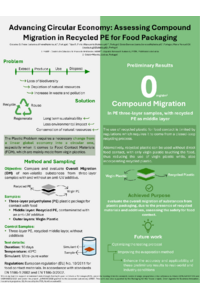
The problem of plastic requires a necessary change from a linear global economy into a circular one. The economic model that is currently in use relies on extraction, production, use, and disposal, leading to resource depletion, biodiversity loss, waste, and pollution, threatening the planet's ability to meet future needs. Poor end-of-life management and packaging design errors have led to low recycling rates. The use of recycled plastic for food contact is limited by regulations which require it to come from a closed-loop recycling process. Alternatively, recycled plastic can be used without direct food contact, with only virgin plastic touching the food, thus reducing the use of virgin plastic. Overall migration testing for food contact materials was conducted in a three-layer PE plastic package designed for contact with field crops and shelled nuts. The package combines a recycled middle layer, which was strategically contaminated with an anti-UV additive, and outer layers of virgin plastic. Contaminated samples were compared with control samples, which were also three-layered and also contained recycled plastic as the middle layer, presenting the same thickness. The tests occurred in a 10-day period; the samples were incubated at 40 °C, according to European regulation (UE) N. o 10/2011, in ultra-pure water. The results were promising and showed no compound migration. More tests need to be carried out, with different simulators, but preliminary results show that it may be possible to use recycled material within multilayered plastic packaging without jeopardising consumer health through contaminant migration onto food.
This study had the support of national funds through Fundação para a Ciência e Tecnologia (FCT), under the funding from the research centre strategic programme under reference numbers UIDB/04292/2020 and UIDP/04292/2020 and under the project LA/P/0069/2020 granted to the Associate Laboratory ARNET. This work was also supported by the Packaging for the Future project, Green Agenda for Business Innovation, investment project no. 59, financed by the PRR, NextGenerationEU.
Keywords
Overall migration
food packaging
circular economy
sustainability
Poster
Advancing Circular Economy Assessing Compound Migration in Recycled PE for Food Packaging.pdf
Physicochemical, antioxidant, and in vitro cell viability properties of commonly consumed yams in Australia
How blockchain can propel international trade and transform the food supply chain