Event submissions
Published
This submission belongs to the session S5. Chemistry and Physicochemical Properties of Foods of the event The 5th International Electronic Conference on Foods
Published date
25 Oct, 2024
Academic Editor
'%3e%3cpath%20d='M12.6657%2010.9104C12.4185%2010.325%2012.0599%209.79327%2011.6097%209.34482C11.1609%208.89508%2010.6293%208.5365%2010.0442%208.28888C10.0389%208.28626%2010.0337%208.28495%2010.0285%208.28233C10.8446%207.69279%2011.3752%206.73249%2011.3752%205.64904C11.3752%203.8542%209.92103%202.39999%208.1262%202.39999C6.33136%202.39999%204.87715%203.8542%204.87715%205.64904C4.87715%206.73249%205.40774%207.69279%206.22393%208.28364C6.21869%208.28626%206.21345%208.28757%206.20821%208.29019C5.62129%208.5378%205.09463%208.89284%204.64265%209.34613C4.1929%209.79493%203.83432%2010.3266%203.58671%2010.9117C3.34345%2011.4845%203.21226%2012.0987%203.20023%2012.7209C3.19988%2012.7349%203.20233%2012.7488%203.20744%2012.7619C3.21255%2012.7749%203.22022%2012.7867%203.22998%2012.7968C3.23975%2012.8068%203.25142%2012.8147%203.26431%2012.8202C3.2772%2012.8256%203.29105%2012.8284%203.30504%2012.8284H4.09109C4.14874%2012.8284%204.19459%2012.7825%204.1959%2012.7262C4.2221%2011.7148%204.62823%2010.7676%205.34617%2010.0497C6.08899%209.30683%207.0755%208.89808%208.1262%208.89808C9.17689%208.89808%2010.1634%209.30683%2010.9062%2010.0497C11.6242%2010.7676%2012.0303%2011.7148%2012.0565%2012.7262C12.0578%2012.7838%2012.1037%2012.8284%2012.1613%2012.8284H12.9474C12.9613%2012.8284%2012.9752%2012.8256%2012.9881%2012.8202C13.001%2012.8147%2013.0126%2012.8068%2013.0224%2012.7968C13.0322%2012.7867%2013.0398%2012.7749%2013.0449%2012.7619C13.0501%2012.7488%2013.0525%2012.7349%2013.0522%2012.7209C13.0391%2012.0947%2012.9094%2011.4855%2012.6657%2010.9104ZM8.1262%207.9024C7.52486%207.9024%206.9589%207.6679%206.53312%207.24211C6.10733%206.81633%205.87283%206.25037%205.87283%205.64904C5.87283%205.0477%206.10733%204.48174%206.53312%204.05596C6.9589%203.63018%207.52486%203.39567%208.1262%203.39567C8.72753%203.39567%209.29349%203.63018%209.71927%204.05596C10.1451%204.48174%2010.3796%205.0477%2010.3796%205.64904C10.3796%206.25037%2010.1451%206.81633%209.71927%207.24211C9.29349%207.6679%208.72753%207.9024%208.1262%207.9024Z'%20fill='%235D1EE1'/%3e%3c/g%3e%3c/svg%3e) Joana Amaral
Joana AmaralCitation
Mariana Ferreira dos Santos, Beatriz Pereira de Freitas, Jaqueline Souza de Freitas, Luane Souza Silva Lage, Eliane Przytyk Jung, Leilson de Oliveira Ribeiro, PHENOLIC COMPOUNDS AND PHYSICAL–CHEMICAL PROPERTIES OF TROPICAL FRUIT WASTES, in Proceedings of The 5th International Electronic Conference on Foods, 28 October–30 October 2024, MDPI: Basel, Switzerland
Share
Email
Facebook
Twitter
LinkedIn
PHENOLIC COMPOUNDS AND PHYSICAL–CHEMICAL PROPERTIES OF TROPICAL FRUIT WASTES
'%3e%3cpath%20d='M12.6647%2010.9104C12.4176%2010.325%2012.0589%209.7933%2011.6088%209.34485C11.16%208.89511%2010.6283%208.53653%2010.0432%208.28891C10.038%208.28629%2010.0327%208.28498%2010.0275%208.28236C10.8437%207.69282%2011.3743%206.73252%2011.3743%205.64907C11.3743%203.85423%209.92005%202.40002%208.12522%202.40002C6.33038%202.40002%204.87618%203.85423%204.87618%205.64907C4.87618%206.73252%205.40677%207.69282%206.22296%208.28367C6.21772%208.28629%206.21248%208.2876%206.20724%208.29022C5.62031%208.53783%205.09365%208.89287%204.64167%209.34616C4.19192%209.79496%203.83334%2010.3266%203.58573%2010.9117C3.34247%2011.4846%203.21128%2012.0987%203.19925%2012.721C3.1989%2012.735%203.20135%2012.7489%203.20646%2012.7619C3.21157%2012.7749%203.21924%2012.7868%203.22901%2012.7968C3.23877%2012.8068%203.25045%2012.8148%203.26334%2012.8202C3.27623%2012.8256%203.29007%2012.8284%203.30406%2012.8284H4.09012C4.14776%2012.8284%204.19362%2012.7825%204.19493%2012.7262C4.22113%2011.7148%204.62726%2010.7676%205.34519%2010.0497C6.08802%209.30686%207.07452%208.89811%208.12522%208.89811C9.17592%208.89811%2010.1624%209.30686%2010.9052%2010.0497C11.6232%2010.7676%2012.0293%2011.7148%2012.0555%2012.7262C12.0568%2012.7839%2012.1027%2012.8284%2012.1603%2012.8284H12.9464C12.9604%2012.8284%2012.9742%2012.8256%2012.9871%2012.8202C13%2012.8148%2013.0117%2012.8068%2013.0214%2012.7968C13.0312%2012.7868%2013.0389%2012.7749%2013.044%2012.7619C13.0491%2012.7489%2013.0515%2012.735%2013.0512%2012.721C13.0381%2012.0947%2012.9084%2011.4856%2012.6647%2010.9104ZM8.12522%207.90243C7.52388%207.90243%206.95792%207.66793%206.53214%207.24215C6.10636%206.81636%205.87185%206.2504%205.87185%205.64907C5.87185%205.04773%206.10636%204.48177%206.53214%204.05599C6.95792%203.63021%207.52388%203.3957%208.12522%203.3957C8.72655%203.3957%209.29252%203.63021%209.7183%204.05599C10.1441%204.48177%2010.3786%205.04773%2010.3786%205.64907C10.3786%206.2504%2010.1441%206.81636%209.7183%207.24215C9.29252%207.66793%208.72655%207.90243%208.12522%207.90243Z'%20fill='%235D1EE1'/%3e%3c/g%3e%3c/svg%3e)
Mariana Ferreira dos Santos 1
Beatriz Pereira de Freitas 1
Jaqueline Souza de Freitas 1
Luane Souza Silva Lage 1
Eliane Przytyk Jung 1
Leilson de Oliveira Ribeiro 1
1. Laboratory of Organic and Inorganic Chemical Analysis, National Institute of Technology, Rio de Janeiro 20081-312, Brazil
Abstract
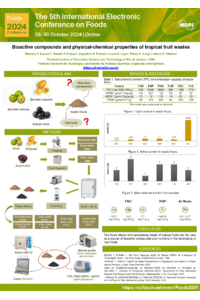
Waste resulting from the processing of tropical fruits such as umbu (Spondias tuberosa), siriguela (Spondias purpurea) and juçara (Euterpe edulis) can be used as a source of bioactive compounds and nutrients. Fruits acquired in a local market in Rio de Janeiro were depulped and their wastes were dried and crushed to obtain flours from siriguela seed (FSS), siriguela peel (FSP), umbu seed (FUS), umbu peel (FUP), umbu pulp refine cake (FUC) and juçara pulp refine cake (FJC). They were evaluated for total phenolic content (TPC); antioxidant capacity using the ABTS˙+, DPPH˙ and FRAP methods; physical–chemical properties; and mineral composition. The results were expressed in dry basis. For the TPC content, FSS, FSP, FUS, FUP, FUC and FJC presented values of 249, 1492, 369, 1850, 1058 and 774 mg GAE/100 g, respectively. The antioxidant capacity by ABTS•+, DPPH• and FRAP showed that FUP had the highest antioxidant potential and FSS had the lowest. The lipid content for FSP, FUS, FUP and FUC was approximately 1%, while for FJC it was 10% and for FSS it was negligible. Ash content varied from 1 to 4% with emphasis on FSP. Finally, the FSS presented the highest values for Ca (239.7 mg/100 g), Cu (27.1 mg/100 g) and Mg (183.3 mg/100 g) while for K, the FSP sample showed the highest value (1403.9 mg/100 g). The values for Mn ranged from 0.3 to 13.7 mg/100 g. Therefore, the flours obtained from processing the waste of tropical fruits can be used as a source of bioactive compounds and nutrients in developing new products or as total or partial replacements for conventional flours in bakery products.
Keywords
Umbu
Siriguela
Juçara
antioxidants
depulping residue
flours.
Poster
Poster FOODs Mariana Final.pdf
How blockchain can propel international trade and transform the food supply chain
Native carotenoid profile of banana inflorescence from Madeira Island