Event submissions
Published
This submission belongs to the session S2. Food Nutrition and Functional Foods of the event The 5th International Electronic Conference on Foods
Published date
25 Oct, 2024
Academic Editor
'%3e%3cpath%20d='M12.6657%2010.9104C12.4185%2010.325%2012.0599%209.79327%2011.6097%209.34482C11.1609%208.89508%2010.6293%208.5365%2010.0442%208.28888C10.0389%208.28626%2010.0337%208.28495%2010.0285%208.28233C10.8446%207.69279%2011.3752%206.73249%2011.3752%205.64904C11.3752%203.8542%209.92103%202.39999%208.1262%202.39999C6.33136%202.39999%204.87715%203.8542%204.87715%205.64904C4.87715%206.73249%205.40774%207.69279%206.22393%208.28364C6.21869%208.28626%206.21345%208.28757%206.20821%208.29019C5.62129%208.5378%205.09463%208.89284%204.64265%209.34613C4.1929%209.79493%203.83432%2010.3266%203.58671%2010.9117C3.34345%2011.4845%203.21226%2012.0987%203.20023%2012.7209C3.19988%2012.7349%203.20233%2012.7488%203.20744%2012.7619C3.21255%2012.7749%203.22022%2012.7867%203.22998%2012.7968C3.23975%2012.8068%203.25142%2012.8147%203.26431%2012.8202C3.2772%2012.8256%203.29105%2012.8284%203.30504%2012.8284H4.09109C4.14874%2012.8284%204.19459%2012.7825%204.1959%2012.7262C4.2221%2011.7148%204.62823%2010.7676%205.34617%2010.0497C6.08899%209.30683%207.0755%208.89808%208.1262%208.89808C9.17689%208.89808%2010.1634%209.30683%2010.9062%2010.0497C11.6242%2010.7676%2012.0303%2011.7148%2012.0565%2012.7262C12.0578%2012.7838%2012.1037%2012.8284%2012.1613%2012.8284H12.9474C12.9613%2012.8284%2012.9752%2012.8256%2012.9881%2012.8202C13.001%2012.8147%2013.0126%2012.8068%2013.0224%2012.7968C13.0322%2012.7867%2013.0398%2012.7749%2013.0449%2012.7619C13.0501%2012.7488%2013.0525%2012.7349%2013.0522%2012.7209C13.0391%2012.0947%2012.9094%2011.4855%2012.6657%2010.9104ZM8.1262%207.9024C7.52486%207.9024%206.9589%207.6679%206.53312%207.24211C6.10733%206.81633%205.87283%206.25037%205.87283%205.64904C5.87283%205.0477%206.10733%204.48174%206.53312%204.05596C6.9589%203.63018%207.52486%203.39567%208.1262%203.39567C8.72753%203.39567%209.29349%203.63018%209.71927%204.05596C10.1451%204.48174%2010.3796%205.0477%2010.3796%205.64904C10.3796%206.25037%2010.1451%206.81633%209.71927%207.24211C9.29349%207.6679%208.72753%207.9024%208.1262%207.9024Z'%20fill='%235D1EE1'/%3e%3c/g%3e%3c/svg%3e) Antonello Santini
Antonello SantiniCitation
Olaide Ruth Aderibigbe, Thikrat Ayodele, Oluwaseun Ariyo, Determination of ideal sweetness level and nutritional and sensory properties of Spondias mombin juice, in Proceedings of The 5th International Electronic Conference on Foods, 28 October–30 October 2024, MDPI: Basel, Switzerland
Share
Email
Facebook
Twitter
LinkedIn
Determination of ideal sweetness level and nutritional and sensory properties of Spondias mombin juice
'%3e%3cpath%20d='M12.6647%2010.9104C12.4176%2010.325%2012.0589%209.7933%2011.6088%209.34485C11.16%208.89511%2010.6283%208.53653%2010.0432%208.28891C10.038%208.28629%2010.0327%208.28498%2010.0275%208.28236C10.8437%207.69282%2011.3743%206.73252%2011.3743%205.64907C11.3743%203.85423%209.92005%202.40002%208.12522%202.40002C6.33038%202.40002%204.87618%203.85423%204.87618%205.64907C4.87618%206.73252%205.40677%207.69282%206.22296%208.28367C6.21772%208.28629%206.21248%208.2876%206.20724%208.29022C5.62031%208.53783%205.09365%208.89287%204.64167%209.34616C4.19192%209.79496%203.83334%2010.3266%203.58573%2010.9117C3.34247%2011.4846%203.21128%2012.0987%203.19925%2012.721C3.1989%2012.735%203.20135%2012.7489%203.20646%2012.7619C3.21157%2012.7749%203.21924%2012.7868%203.22901%2012.7968C3.23877%2012.8068%203.25045%2012.8148%203.26334%2012.8202C3.27623%2012.8256%203.29007%2012.8284%203.30406%2012.8284H4.09012C4.14776%2012.8284%204.19362%2012.7825%204.19493%2012.7262C4.22113%2011.7148%204.62726%2010.7676%205.34519%2010.0497C6.08802%209.30686%207.07452%208.89811%208.12522%208.89811C9.17592%208.89811%2010.1624%209.30686%2010.9052%2010.0497C11.6232%2010.7676%2012.0293%2011.7148%2012.0555%2012.7262C12.0568%2012.7839%2012.1027%2012.8284%2012.1603%2012.8284H12.9464C12.9604%2012.8284%2012.9742%2012.8256%2012.9871%2012.8202C13%2012.8148%2013.0117%2012.8068%2013.0214%2012.7968C13.0312%2012.7868%2013.0389%2012.7749%2013.044%2012.7619C13.0491%2012.7489%2013.0515%2012.735%2013.0512%2012.721C13.0381%2012.0947%2012.9084%2011.4856%2012.6647%2010.9104ZM8.12522%207.90243C7.52388%207.90243%206.95792%207.66793%206.53214%207.24215C6.10636%206.81636%205.87185%206.2504%205.87185%205.64907C5.87185%205.04773%206.10636%204.48177%206.53214%204.05599C6.95792%203.63021%207.52388%203.3957%208.12522%203.3957C8.72655%203.3957%209.29252%203.63021%209.7183%204.05599C10.1441%204.48177%2010.3786%205.04773%2010.3786%205.64907C10.3786%206.2504%2010.1441%206.81636%209.7183%207.24215C9.29252%207.66793%208.72655%207.90243%208.12522%207.90243Z'%20fill='%235D1EE1'/%3e%3c/g%3e%3c/svg%3e)
Olaide Ruth Aderibigbe 1
Thikrat Ayodele 2
Oluwaseun Ariyo 2
1. National Horticultural Research Institute, Nigeria
2. Department of Human Nutrition and Dietetics, University of Ibadan, Nigeria
Abstract
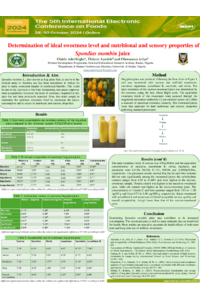
Introduction: Spondias mombin L., also known as hog plum fruit, is native to the tropical areas of America and has been naturalized in Africa. Its juice is rarely consumed despite its nutritional benefits. This could be due to the sour taste of the fruit. Sweetening sour juices improves their acceptability; however, the level of sweetness required for this juice has not been previously reported. Thus, this study sought to determine the optimum sweetness level to encourage the juice's consumption and to assess its nutritional and sensory properties.
Method: The juice was sweetened with sucrose and artificial sweeteners: sucralose, aspartame, acesulfame K, saccharin, and stevia. The ideal sweetness of the sucrose-sweetened juice was determined by 60 assessors using the Just About Right scale. The equivalent sweetness levels of the sweeteners were assessed through the magnitude estimation method by 12 pre-selected tasters; this offers a measure of perceived sweetness intensity. The sweetened juices were then analyzed for their nutritional and sensory properties following standard procedures.
Results: The ideal sweetness level of sucrose was 9.95g/100ml, and the equivalent concentrations of sucralose, acesulfame K, stevia, saccharin, and aspartame were 0.0186, 0.0316, 0.1157, 0.0316, and 0.0580g/100ml, respectively. The proximate results showed that the fat and fiber contents did not vary significantly among the sweetened juices; the carbohydrate contents ranged from 4.45 to 13.60% and were highest in the sucrose-sweetened sample. Protein content was highest in the sucralose-sweetened juice, while ash content was highest in the stevia-sweetened juice. The concentrations of vitamin C and beta carotene ranged from 7.63 to 11.88 mg/10 g and from 0.70 to 1.06 mg/100 g, respectively. Juices sweetened with acesulfame k and aspartame exhibited acceptable sensory quality and overall acceptability, though lower than that of the sucrose-sweetened juice.
Conclusion: Sweetening Spondias mombin juice may contribute to its increased consumption. The sweetened juice is rich in many nutrients that are beneficial for health.
Keywords
Spondias mombin
fruits
sweetness level
nutrients
Poster
Olaide Aderibigbe_Poster Presentation.pdf
THE EFFECTS OF GERMINATION PERIODS ON THE PROXIMATE, MINERAL, AND ANTINUTRIENT PROFILES OF PEARL MILLET (Pennisetum glacum) AND GRAIN AMARANTH (Amaranth cruentus) FLOURS
Development of probiotic containing soy-based functional foods with novel Weissella spp.