Event submissions
Published
This submission belongs to the session S1. Innovation in Food Technology and Engineering of the event The 5th International Electronic Conference on Foods
Published date
25 Oct, 2024
Academic Editor
'%3e%3cpath%20d='M12.6657%2010.9104C12.4185%2010.325%2012.0599%209.79327%2011.6097%209.34482C11.1609%208.89508%2010.6293%208.5365%2010.0442%208.28888C10.0389%208.28626%2010.0337%208.28495%2010.0285%208.28233C10.8446%207.69279%2011.3752%206.73249%2011.3752%205.64904C11.3752%203.8542%209.92103%202.39999%208.1262%202.39999C6.33136%202.39999%204.87715%203.8542%204.87715%205.64904C4.87715%206.73249%205.40774%207.69279%206.22393%208.28364C6.21869%208.28626%206.21345%208.28757%206.20821%208.29019C5.62129%208.5378%205.09463%208.89284%204.64265%209.34613C4.1929%209.79493%203.83432%2010.3266%203.58671%2010.9117C3.34345%2011.4845%203.21226%2012.0987%203.20023%2012.7209C3.19988%2012.7349%203.20233%2012.7488%203.20744%2012.7619C3.21255%2012.7749%203.22022%2012.7867%203.22998%2012.7968C3.23975%2012.8068%203.25142%2012.8147%203.26431%2012.8202C3.2772%2012.8256%203.29105%2012.8284%203.30504%2012.8284H4.09109C4.14874%2012.8284%204.19459%2012.7825%204.1959%2012.7262C4.2221%2011.7148%204.62823%2010.7676%205.34617%2010.0497C6.08899%209.30683%207.0755%208.89808%208.1262%208.89808C9.17689%208.89808%2010.1634%209.30683%2010.9062%2010.0497C11.6242%2010.7676%2012.0303%2011.7148%2012.0565%2012.7262C12.0578%2012.7838%2012.1037%2012.8284%2012.1613%2012.8284H12.9474C12.9613%2012.8284%2012.9752%2012.8256%2012.9881%2012.8202C13.001%2012.8147%2013.0126%2012.8068%2013.0224%2012.7968C13.0322%2012.7867%2013.0398%2012.7749%2013.0449%2012.7619C13.0501%2012.7488%2013.0525%2012.7349%2013.0522%2012.7209C13.0391%2012.0947%2012.9094%2011.4855%2012.6657%2010.9104ZM8.1262%207.9024C7.52486%207.9024%206.9589%207.6679%206.53312%207.24211C6.10733%206.81633%205.87283%206.25037%205.87283%205.64904C5.87283%205.0477%206.10733%204.48174%206.53312%204.05596C6.9589%203.63018%207.52486%203.39567%208.1262%203.39567C8.72753%203.39567%209.29349%203.63018%209.71927%204.05596C10.1451%204.48174%2010.3796%205.0477%2010.3796%205.64904C10.3796%206.25037%2010.1451%206.81633%209.71927%207.24211C9.29349%207.6679%208.72753%207.9024%208.1262%207.9024Z'%20fill='%235D1EE1'/%3e%3c/g%3e%3c/svg%3e) Moktar Hamdi
Moktar HamdiCitation
Borja Ferrández-Gómez, Rocío Asencio-Vicedo, Antonio Sánchez-Sánchez, Juana D. Jordá, Mar Cerdán, Effect of post-harvest UV-C radiation application on resveratrol and tannin concentrations in table grapes, in Proceedings of The 5th International Electronic Conference on Foods, 28 October–30 October 2024, MDPI: Basel, Switzerland
Share
Email
Facebook
Twitter
LinkedIn
Effect of post-harvest UV-C radiation application on resveratrol and tannin concentrations in table grapes
'%3e%3cpath%20d='M12.6647%2010.9104C12.4176%2010.325%2012.0589%209.7933%2011.6088%209.34485C11.16%208.89511%2010.6283%208.53653%2010.0432%208.28891C10.038%208.28629%2010.0327%208.28498%2010.0275%208.28236C10.8437%207.69282%2011.3743%206.73252%2011.3743%205.64907C11.3743%203.85423%209.92005%202.40002%208.12522%202.40002C6.33038%202.40002%204.87618%203.85423%204.87618%205.64907C4.87618%206.73252%205.40677%207.69282%206.22296%208.28367C6.21772%208.28629%206.21248%208.2876%206.20724%208.29022C5.62031%208.53783%205.09365%208.89287%204.64167%209.34616C4.19192%209.79496%203.83334%2010.3266%203.58573%2010.9117C3.34247%2011.4846%203.21128%2012.0987%203.19925%2012.721C3.1989%2012.735%203.20135%2012.7489%203.20646%2012.7619C3.21157%2012.7749%203.21924%2012.7868%203.22901%2012.7968C3.23877%2012.8068%203.25045%2012.8148%203.26334%2012.8202C3.27623%2012.8256%203.29007%2012.8284%203.30406%2012.8284H4.09012C4.14776%2012.8284%204.19362%2012.7825%204.19493%2012.7262C4.22113%2011.7148%204.62726%2010.7676%205.34519%2010.0497C6.08802%209.30686%207.07452%208.89811%208.12522%208.89811C9.17592%208.89811%2010.1624%209.30686%2010.9052%2010.0497C11.6232%2010.7676%2012.0293%2011.7148%2012.0555%2012.7262C12.0568%2012.7839%2012.1027%2012.8284%2012.1603%2012.8284H12.9464C12.9604%2012.8284%2012.9742%2012.8256%2012.9871%2012.8202C13%2012.8148%2013.0117%2012.8068%2013.0214%2012.7968C13.0312%2012.7868%2013.0389%2012.7749%2013.044%2012.7619C13.0491%2012.7489%2013.0515%2012.735%2013.0512%2012.721C13.0381%2012.0947%2012.9084%2011.4856%2012.6647%2010.9104ZM8.12522%207.90243C7.52388%207.90243%206.95792%207.66793%206.53214%207.24215C6.10636%206.81636%205.87185%206.2504%205.87185%205.64907C5.87185%205.04773%206.10636%204.48177%206.53214%204.05599C6.95792%203.63021%207.52388%203.3957%208.12522%203.3957C8.72655%203.3957%209.29252%203.63021%209.7183%204.05599C10.1441%204.48177%2010.3786%205.04773%2010.3786%205.64907C10.3786%206.2504%2010.1441%206.81636%209.7183%207.24215C9.29252%207.66793%208.72655%207.90243%208.12522%207.90243Z'%20fill='%235D1EE1'/%3e%3c/g%3e%3c/svg%3e)
Borja Ferrández-Gómez 1
Rocío Asencio-Vicedo 1
Antonio Sánchez-Sánchez 1

Juana D. Jordá 1
Mar Cerdán 1
1. Department of Biochemistry, Molecular Biology, Edaphology and Agricultural Chemistry, University of Alicante, 03080, Alicante, Spain
Abstract
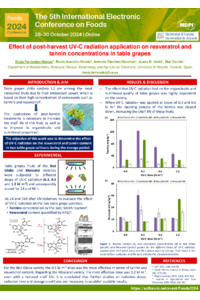
Table grapes (Vitis vinifera L.) are among the most consumed fruits due to their antioxidant power, which is based on their high concentration of compounds such as tannins and resveratrol. However, the application of post-harvest treatments is necessary to increase the shelf life of this fruit, as well as to improve its organoleptic and nutritional properties. The objective of this work was to determine the effect of UV-C radiation on the resveratrol and tannin content of different table grape cultivars during the storage period. For this purpose, table grape fruits of the Red Globe and Muscatel varieties were subjected to different doses of UV-C radiation (0.3, 0.6, and 1.2 kJ/m2) and subsequently stored for 24 h. To evaluate the effect of UV-C radiation on the two grape varieties, the Bate--Smith reaction was used to determine the tannin content, while the resveratrol concentration was quantified by HPLC after extraction (80:20 v/v), maintained at 60ºC for 30 min. The effect that UV-C radiation had on the organoleptic and nutritional quality of table grapes was highly dependent on the variety. When UV-C radiation was applied at doses of 0.3 and 0.6 kJ/m2, the ripening process of the berries was slowed down, increasing the shelf life of these fruits. For the Red Globe variety, the 0.3 kJ/m2 dose was the most effective in terms of tannin and resveratrol content, increasing from 92.50 to 122.83 mg/kg and from 11.94 to 30.34 mg/kg, respectively. Regarding the Muscatel variety, the most effective dose was 1.2 kJ/m2, even with a reduced shelf life, with an increase of 257.5% in tannins and 238.2% in resveratrol compared to the control (0 kJ/m2). It was concluded that further studies on radiation doses, times, and storage conditions are necessary to establish scalable results.
Keywords
table grapes
UV-C radiation
Red Globe
Muscatel
resveratrol
tannin
Poster
Template poster Foods2024-BFG.pdf
EFFECT OF THE ADDITION OF NORI (Porphyra yezoensis) ON THE DEVELOPMENT AND CHARACTERIZATION OF MULTI-MILLET IDLY BATTER
Risk Assessment of xenobiotic--gut microbiota exposure: an in vitro approach to study food-derived microplastics.