Event submissions
Published
This submission belongs to the session S4. Food Microbiology of the event The 5th International Electronic Conference on Foods
Published date
25 Oct, 2024
Academic Editor
'%3e%3cpath%20d='M12.6657%2010.9104C12.4185%2010.325%2012.0599%209.79327%2011.6097%209.34482C11.1609%208.89508%2010.6293%208.5365%2010.0442%208.28888C10.0389%208.28626%2010.0337%208.28495%2010.0285%208.28233C10.8446%207.69279%2011.3752%206.73249%2011.3752%205.64904C11.3752%203.8542%209.92103%202.39999%208.1262%202.39999C6.33136%202.39999%204.87715%203.8542%204.87715%205.64904C4.87715%206.73249%205.40774%207.69279%206.22393%208.28364C6.21869%208.28626%206.21345%208.28757%206.20821%208.29019C5.62129%208.5378%205.09463%208.89284%204.64265%209.34613C4.1929%209.79493%203.83432%2010.3266%203.58671%2010.9117C3.34345%2011.4845%203.21226%2012.0987%203.20023%2012.7209C3.19988%2012.7349%203.20233%2012.7488%203.20744%2012.7619C3.21255%2012.7749%203.22022%2012.7867%203.22998%2012.7968C3.23975%2012.8068%203.25142%2012.8147%203.26431%2012.8202C3.2772%2012.8256%203.29105%2012.8284%203.30504%2012.8284H4.09109C4.14874%2012.8284%204.19459%2012.7825%204.1959%2012.7262C4.2221%2011.7148%204.62823%2010.7676%205.34617%2010.0497C6.08899%209.30683%207.0755%208.89808%208.1262%208.89808C9.17689%208.89808%2010.1634%209.30683%2010.9062%2010.0497C11.6242%2010.7676%2012.0303%2011.7148%2012.0565%2012.7262C12.0578%2012.7838%2012.1037%2012.8284%2012.1613%2012.8284H12.9474C12.9613%2012.8284%2012.9752%2012.8256%2012.9881%2012.8202C13.001%2012.8147%2013.0126%2012.8068%2013.0224%2012.7968C13.0322%2012.7867%2013.0398%2012.7749%2013.0449%2012.7619C13.0501%2012.7488%2013.0525%2012.7349%2013.0522%2012.7209C13.0391%2012.0947%2012.9094%2011.4855%2012.6657%2010.9104ZM8.1262%207.9024C7.52486%207.9024%206.9589%207.6679%206.53312%207.24211C6.10733%206.81633%205.87283%206.25037%205.87283%205.64904C5.87283%205.0477%206.10733%204.48174%206.53312%204.05596C6.9589%203.63018%207.52486%203.39567%208.1262%203.39567C8.72753%203.39567%209.29349%203.63018%209.71927%204.05596C10.1451%204.48174%2010.3796%205.0477%2010.3796%205.64904C10.3796%206.25037%2010.1451%206.81633%209.71927%207.24211C9.29349%207.6679%208.72753%207.9024%208.1262%207.9024Z'%20fill='%235D1EE1'/%3e%3c/g%3e%3c/svg%3e) Antonio Bevilacqua
Antonio BevilacquaCitation
Roberta Battistini, Chiara Masotti, Valeria Listorti, Elisabetta Razzuoli, Sara Antonia Chiarlone, Nicola Pussini, Laura Serracca, Lisa Guardone, HEPATITIS E VIRUS IN WILD UNGULATES INTENDED FOR HUMAN CONSUMPTION: A SURVEY IN THE REGION OF LIGURIA (NW ITALY), in Proceedings of The 5th International Electronic Conference on Foods, 28 October–30 October 2024, MDPI: Basel, Switzerland
Share
Email
Facebook
Twitter
LinkedIn
HEPATITIS E VIRUS IN WILD UNGULATES INTENDED FOR HUMAN CONSUMPTION: A SURVEY IN THE REGION OF LIGURIA (NW ITALY)
'%3e%3cpath%20d='M12.6647%2010.9104C12.4176%2010.325%2012.0589%209.7933%2011.6088%209.34485C11.16%208.89511%2010.6283%208.53653%2010.0432%208.28891C10.038%208.28629%2010.0327%208.28498%2010.0275%208.28236C10.8437%207.69282%2011.3743%206.73252%2011.3743%205.64907C11.3743%203.85423%209.92005%202.40002%208.12522%202.40002C6.33038%202.40002%204.87618%203.85423%204.87618%205.64907C4.87618%206.73252%205.40677%207.69282%206.22296%208.28367C6.21772%208.28629%206.21248%208.2876%206.20724%208.29022C5.62031%208.53783%205.09365%208.89287%204.64167%209.34616C4.19192%209.79496%203.83334%2010.3266%203.58573%2010.9117C3.34247%2011.4846%203.21128%2012.0987%203.19925%2012.721C3.1989%2012.735%203.20135%2012.7489%203.20646%2012.7619C3.21157%2012.7749%203.21924%2012.7868%203.22901%2012.7968C3.23877%2012.8068%203.25045%2012.8148%203.26334%2012.8202C3.27623%2012.8256%203.29007%2012.8284%203.30406%2012.8284H4.09012C4.14776%2012.8284%204.19362%2012.7825%204.19493%2012.7262C4.22113%2011.7148%204.62726%2010.7676%205.34519%2010.0497C6.08802%209.30686%207.07452%208.89811%208.12522%208.89811C9.17592%208.89811%2010.1624%209.30686%2010.9052%2010.0497C11.6232%2010.7676%2012.0293%2011.7148%2012.0555%2012.7262C12.0568%2012.7839%2012.1027%2012.8284%2012.1603%2012.8284H12.9464C12.9604%2012.8284%2012.9742%2012.8256%2012.9871%2012.8202C13%2012.8148%2013.0117%2012.8068%2013.0214%2012.7968C13.0312%2012.7868%2013.0389%2012.7749%2013.044%2012.7619C13.0491%2012.7489%2013.0515%2012.735%2013.0512%2012.721C13.0381%2012.0947%2012.9084%2011.4856%2012.6647%2010.9104ZM8.12522%207.90243C7.52388%207.90243%206.95792%207.66793%206.53214%207.24215C6.10636%206.81636%205.87185%206.2504%205.87185%205.64907C5.87185%205.04773%206.10636%204.48177%206.53214%204.05599C6.95792%203.63021%207.52388%203.3957%208.12522%203.3957C8.72655%203.3957%209.29252%203.63021%209.7183%204.05599C10.1441%204.48177%2010.3786%205.04773%2010.3786%205.64907C10.3786%206.2504%2010.1441%206.81636%209.7183%207.24215C9.29252%207.66793%208.72655%207.90243%208.12522%207.90243Z'%20fill='%235D1EE1'/%3e%3c/g%3e%3c/svg%3e)
Roberta Battistini 1
Chiara Masotti 1
Valeria Listorti 2
Elisabetta Razzuoli 2
Sara Antonia Chiarlone 3
Nicola Pussini 3
Laura Serracca 1
Lisa Guardone 4
1. Istituto Zooprofilattico Sperimentale del Piemonte, Liguria e Valle d’Aosta, S.S. Levante Ligure, Italy
2. Istituto Zooprofilattico Sperimentale del Piemonte, Liguria e Valle d’Aosta, S.S. Genova e Portualità Marittima, Italy
3. Istituto Zooprofilattico Sperimentale del Piemonte, Liguria e Valle d’Aosta, S.S. Ponente Ligure, Italy
4. Istituto Zooprofilattico Sperimentale del Piemonte, Liguria e Valle d’Aosta, S.S. Genova e Portualità Marittima, Italy; Department of Veterinary Sciences, University of Pisa, Italy
Abstract
Hepatitis E virus (HEV) is an enteric virus belonging to the Hepeviridae family. It is responsible for acute hepatitis in humans, through the consumption of contaminated water, and undercooked meat or through being in contact with infected animals. HEV has eight genotypes; of these, HEV-3 and HEV-4 are zoonotic and are responsible for sporadic cases of food-borne diseases in developed countries. Swine and wild boars are the principal sources of infection for humans. Among the wild species that act as reservoirs of the virus, wild boar is the most investigated in Italy, while limited data on HEV prevalence are present in other ungulates. In this study, we investigated the circulation of HEV in the three most hunted ungulates species in the Region of Liguria (northwestern Italy) (Sus scrofa, Dama dama, and Capreolus capreolus) to assess the potential risk of HEV transmission through the consumption of game meat. During the 2023-2024 hunting seasons, 303 liver samples from 66 wild boars, 155 roe deer, and 82 European fallow deer were collected and tested for HEV RNA using real-time RT-PCR. The HEV genome was found in the livers of 8/66 (12.1%) wild boars analyzed; however, it was not found in the roe deer and European fallow deer samples. The results obtained in this study showed that in the Liguria Region, HEV is present only in wild boars. Therefore, the consumption of uncooked meat, liver products, or direct contact with these species represent a potential risk for consumers and hunters.
Keywords
Hepatitis E virus
wild animals
zoonoses
Poster
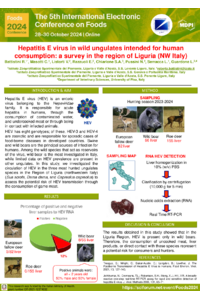
poster HEV foods 24.pdf
Assessment of Bioactive Compound Changes and Antioxidant Activity in Processed Georgian Cherry Plum Products Using UPLC-PDA-MS
Antioxidant and Antihypertensive Activities of Giant Grouper (Epinephelus lanceolatus) Egg Protein Hydrolysates