Event submissions
Published
This submission belongs to the session S2. Food Nutrition and Functional Foods of the event The 5th International Electronic Conference on Foods
Published date
25 Oct, 2024
Academic Editor
'%3e%3cpath%20d='M12.6657%2010.9104C12.4185%2010.325%2012.0599%209.79327%2011.6097%209.34482C11.1609%208.89508%2010.6293%208.5365%2010.0442%208.28888C10.0389%208.28626%2010.0337%208.28495%2010.0285%208.28233C10.8446%207.69279%2011.3752%206.73249%2011.3752%205.64904C11.3752%203.8542%209.92103%202.39999%208.1262%202.39999C6.33136%202.39999%204.87715%203.8542%204.87715%205.64904C4.87715%206.73249%205.40774%207.69279%206.22393%208.28364C6.21869%208.28626%206.21345%208.28757%206.20821%208.29019C5.62129%208.5378%205.09463%208.89284%204.64265%209.34613C4.1929%209.79493%203.83432%2010.3266%203.58671%2010.9117C3.34345%2011.4845%203.21226%2012.0987%203.20023%2012.7209C3.19988%2012.7349%203.20233%2012.7488%203.20744%2012.7619C3.21255%2012.7749%203.22022%2012.7867%203.22998%2012.7968C3.23975%2012.8068%203.25142%2012.8147%203.26431%2012.8202C3.2772%2012.8256%203.29105%2012.8284%203.30504%2012.8284H4.09109C4.14874%2012.8284%204.19459%2012.7825%204.1959%2012.7262C4.2221%2011.7148%204.62823%2010.7676%205.34617%2010.0497C6.08899%209.30683%207.0755%208.89808%208.1262%208.89808C9.17689%208.89808%2010.1634%209.30683%2010.9062%2010.0497C11.6242%2010.7676%2012.0303%2011.7148%2012.0565%2012.7262C12.0578%2012.7838%2012.1037%2012.8284%2012.1613%2012.8284H12.9474C12.9613%2012.8284%2012.9752%2012.8256%2012.9881%2012.8202C13.001%2012.8147%2013.0126%2012.8068%2013.0224%2012.7968C13.0322%2012.7867%2013.0398%2012.7749%2013.0449%2012.7619C13.0501%2012.7488%2013.0525%2012.7349%2013.0522%2012.7209C13.0391%2012.0947%2012.9094%2011.4855%2012.6657%2010.9104ZM8.1262%207.9024C7.52486%207.9024%206.9589%207.6679%206.53312%207.24211C6.10733%206.81633%205.87283%206.25037%205.87283%205.64904C5.87283%205.0477%206.10733%204.48174%206.53312%204.05596C6.9589%203.63018%207.52486%203.39567%208.1262%203.39567C8.72753%203.39567%209.29349%203.63018%209.71927%204.05596C10.1451%204.48174%2010.3796%205.0477%2010.3796%205.64904C10.3796%206.25037%2010.1451%206.81633%209.71927%207.24211C9.29349%207.6679%208.72753%207.9024%208.1262%207.9024Z'%20fill='%235D1EE1'/%3e%3c/g%3e%3c/svg%3e) Antonello Santini
Antonello SantiniCitation
Fenny Crista Anastasia Panjaitan, Chang Yu Wei, Antioxidant and Antihypertensive Activities of Giant Grouper (Epinephelus lanceolatus) Egg Protein Hydrolysates, in Proceedings of The 5th International Electronic Conference on Foods, 28 October–30 October 2024, MDPI: Basel, Switzerland
Share
Email
Facebook
Twitter
LinkedIn
Antioxidant and Antihypertensive Activities of Giant Grouper (Epinephelus lanceolatus) Egg Protein Hydrolysates
'%3e%3cpath%20d='M12.6647%2010.9104C12.4176%2010.325%2012.0589%209.7933%2011.6088%209.34485C11.16%208.89511%2010.6283%208.53653%2010.0432%208.28891C10.038%208.28629%2010.0327%208.28498%2010.0275%208.28236C10.8437%207.69282%2011.3743%206.73252%2011.3743%205.64907C11.3743%203.85423%209.92005%202.40002%208.12522%202.40002C6.33038%202.40002%204.87618%203.85423%204.87618%205.64907C4.87618%206.73252%205.40677%207.69282%206.22296%208.28367C6.21772%208.28629%206.21248%208.2876%206.20724%208.29022C5.62031%208.53783%205.09365%208.89287%204.64167%209.34616C4.19192%209.79496%203.83334%2010.3266%203.58573%2010.9117C3.34247%2011.4846%203.21128%2012.0987%203.19925%2012.721C3.1989%2012.735%203.20135%2012.7489%203.20646%2012.7619C3.21157%2012.7749%203.21924%2012.7868%203.22901%2012.7968C3.23877%2012.8068%203.25045%2012.8148%203.26334%2012.8202C3.27623%2012.8256%203.29007%2012.8284%203.30406%2012.8284H4.09012C4.14776%2012.8284%204.19362%2012.7825%204.19493%2012.7262C4.22113%2011.7148%204.62726%2010.7676%205.34519%2010.0497C6.08802%209.30686%207.07452%208.89811%208.12522%208.89811C9.17592%208.89811%2010.1624%209.30686%2010.9052%2010.0497C11.6232%2010.7676%2012.0293%2011.7148%2012.0555%2012.7262C12.0568%2012.7839%2012.1027%2012.8284%2012.1603%2012.8284H12.9464C12.9604%2012.8284%2012.9742%2012.8256%2012.9871%2012.8202C13%2012.8148%2013.0117%2012.8068%2013.0214%2012.7968C13.0312%2012.7868%2013.0389%2012.7749%2013.044%2012.7619C13.0491%2012.7489%2013.0515%2012.735%2013.0512%2012.721C13.0381%2012.0947%2012.9084%2011.4856%2012.6647%2010.9104ZM8.12522%207.90243C7.52388%207.90243%206.95792%207.66793%206.53214%207.24215C6.10636%206.81636%205.87185%206.2504%205.87185%205.64907C5.87185%205.04773%206.10636%204.48177%206.53214%204.05599C6.95792%203.63021%207.52388%203.3957%208.12522%203.3957C8.72655%203.3957%209.29252%203.63021%209.7183%204.05599C10.1441%204.48177%2010.3786%205.04773%2010.3786%205.64907C10.3786%206.2504%2010.1441%206.81636%209.7183%207.24215C9.29252%207.66793%208.72655%207.90243%208.12522%207.90243Z'%20fill='%235D1EE1'/%3e%3c/g%3e%3c/svg%3e)
Fenny Crista Anastasia Panjaitan 1

Chang Yu Wei 2
1. Marine Products Processing Study Program, Marine and Fisheries Polytechnic of Jembrana, Bali 82218, Indonesia
2. Department of Food Science, National Taiwan Ocean University, Keelung 20224, Taiwan
Abstract
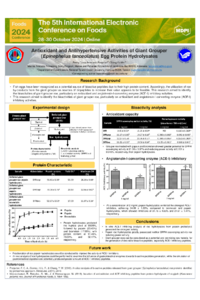
Fish eggs have been recognized as a potential source of bioactive peptides due to their high protein content. Accordingly, the utilization of roe by-products from the giant grouper as sources of biopeptides to increase their value appears to be feasible. This research aimed to identify the bioactivities of giant grouper roe, particularly on antioxidant and angiotensin-I-converting enzyme (ACE-I) inhibitory activities. Unutilized grouper roe was first defatted and subsequently hydrolyzed using pepsin (DFRpep), papain (DFRpap), and bromelain (DFRbro). The protein hydrolysates were then analyzed for their ACE-I inhibitory and antioxidantactivities. The results showed that the degree of hydrolysis after four hours was 26.25% for DFRpep, 12.66% for DFRpap, and 11.07% for DFRbro. Pepsin hydrolysates produced the highest yield at 59.99%, followed by papain (23.43%) and bromelain (17.09%), with protein contents of 91.46%, 73.03%, and 52.17%, respectively. At a concentration of 2 mg/ml, pepsin hydrolysates exhibited the strongest ACE-I inhibition, achieving 34.09 ± 1.83%, compared to bromelain and papain hydrolysates, which showed inhibitions of 31.15 ± 4.65% and 21.51 ± 1.41%, respectively. Additionally, grouper roe treated with papain and bromelain showed greater potential for DPPH scavenging activity at 21.36 ± 0.37% and a reducing power activity of 0.151 ± 0.040%, respectively, than pepsin hydrolysates. Based on these findings, giant grouper roe can be effectively utilized as a valuable raw material for producing specific bioactive peptides, such as ACE-I inhibitory and antioxidant peptides. These bioactive peptides can be formulated into pharmaceutical products to boost their market value and improve human health.
Keywords
bioactivity
by-products
hypertension
oxidative stress
peptides
Poster
Poster presentation.pdf
HEPATITIS E VIRUS IN WILD UNGULATES INTENDED FOR HUMAN CONSUMPTION: A SURVEY IN THE REGION OF LIGURIA (NW ITALY)
Optimization of the transformation process of Agaricus bisporus and Pleurotus ostreatus co-products into flours with potential food uses