Event submissions
Published
This submission belongs to the session S1. Innovation in Food Technology and Engineering of the event The 5th International Electronic Conference on Foods
Published date
25 Oct, 2024
Academic Editor
'%3e%3cpath%20d='M12.6657%2010.9104C12.4185%2010.325%2012.0599%209.79327%2011.6097%209.34482C11.1609%208.89508%2010.6293%208.5365%2010.0442%208.28888C10.0389%208.28626%2010.0337%208.28495%2010.0285%208.28233C10.8446%207.69279%2011.3752%206.73249%2011.3752%205.64904C11.3752%203.8542%209.92103%202.39999%208.1262%202.39999C6.33136%202.39999%204.87715%203.8542%204.87715%205.64904C4.87715%206.73249%205.40774%207.69279%206.22393%208.28364C6.21869%208.28626%206.21345%208.28757%206.20821%208.29019C5.62129%208.5378%205.09463%208.89284%204.64265%209.34613C4.1929%209.79493%203.83432%2010.3266%203.58671%2010.9117C3.34345%2011.4845%203.21226%2012.0987%203.20023%2012.7209C3.19988%2012.7349%203.20233%2012.7488%203.20744%2012.7619C3.21255%2012.7749%203.22022%2012.7867%203.22998%2012.7968C3.23975%2012.8068%203.25142%2012.8147%203.26431%2012.8202C3.2772%2012.8256%203.29105%2012.8284%203.30504%2012.8284H4.09109C4.14874%2012.8284%204.19459%2012.7825%204.1959%2012.7262C4.2221%2011.7148%204.62823%2010.7676%205.34617%2010.0497C6.08899%209.30683%207.0755%208.89808%208.1262%208.89808C9.17689%208.89808%2010.1634%209.30683%2010.9062%2010.0497C11.6242%2010.7676%2012.0303%2011.7148%2012.0565%2012.7262C12.0578%2012.7838%2012.1037%2012.8284%2012.1613%2012.8284H12.9474C12.9613%2012.8284%2012.9752%2012.8256%2012.9881%2012.8202C13.001%2012.8147%2013.0126%2012.8068%2013.0224%2012.7968C13.0322%2012.7867%2013.0398%2012.7749%2013.0449%2012.7619C13.0501%2012.7488%2013.0525%2012.7349%2013.0522%2012.7209C13.0391%2012.0947%2012.9094%2011.4855%2012.6657%2010.9104ZM8.1262%207.9024C7.52486%207.9024%206.9589%207.6679%206.53312%207.24211C6.10733%206.81633%205.87283%206.25037%205.87283%205.64904C5.87283%205.0477%206.10733%204.48174%206.53312%204.05596C6.9589%203.63018%207.52486%203.39567%208.1262%203.39567C8.72753%203.39567%209.29349%203.63018%209.71927%204.05596C10.1451%204.48174%2010.3796%205.0477%2010.3796%205.64904C10.3796%206.25037%2010.1451%206.81633%209.71927%207.24211C9.29349%207.6679%208.72753%207.9024%208.1262%207.9024Z'%20fill='%235D1EE1'/%3e%3c/g%3e%3c/svg%3e) Moktar Hamdi
Moktar HamdiCitation
Michelle Morales Noboa, Leidy Burgos Pereira, Cristina dos Santos Ferreira, Maria Florencia Mazzobre, Pilar Buera, Andrea Nieto, Encapsulation of lemon essential oil and physicochemical characterization of encapsulated powders, in Proceedings of The 5th International Electronic Conference on Foods, 28 October–30 October 2024, MDPI: Basel, Switzerland
Share
Email
Facebook
Twitter
LinkedIn
Encapsulation of lemon essential oil and physicochemical characterization of encapsulated powders
'%3e%3cpath%20d='M12.6647%2010.9104C12.4176%2010.325%2012.0589%209.7933%2011.6088%209.34485C11.16%208.89511%2010.6283%208.53653%2010.0432%208.28891C10.038%208.28629%2010.0327%208.28498%2010.0275%208.28236C10.8437%207.69282%2011.3743%206.73252%2011.3743%205.64907C11.3743%203.85423%209.92005%202.40002%208.12522%202.40002C6.33038%202.40002%204.87618%203.85423%204.87618%205.64907C4.87618%206.73252%205.40677%207.69282%206.22296%208.28367C6.21772%208.28629%206.21248%208.2876%206.20724%208.29022C5.62031%208.53783%205.09365%208.89287%204.64167%209.34616C4.19192%209.79496%203.83334%2010.3266%203.58573%2010.9117C3.34247%2011.4846%203.21128%2012.0987%203.19925%2012.721C3.1989%2012.735%203.20135%2012.7489%203.20646%2012.7619C3.21157%2012.7749%203.21924%2012.7868%203.22901%2012.7968C3.23877%2012.8068%203.25045%2012.8148%203.26334%2012.8202C3.27623%2012.8256%203.29007%2012.8284%203.30406%2012.8284H4.09012C4.14776%2012.8284%204.19362%2012.7825%204.19493%2012.7262C4.22113%2011.7148%204.62726%2010.7676%205.34519%2010.0497C6.08802%209.30686%207.07452%208.89811%208.12522%208.89811C9.17592%208.89811%2010.1624%209.30686%2010.9052%2010.0497C11.6232%2010.7676%2012.0293%2011.7148%2012.0555%2012.7262C12.0568%2012.7839%2012.1027%2012.8284%2012.1603%2012.8284H12.9464C12.9604%2012.8284%2012.9742%2012.8256%2012.9871%2012.8202C13%2012.8148%2013.0117%2012.8068%2013.0214%2012.7968C13.0312%2012.7868%2013.0389%2012.7749%2013.044%2012.7619C13.0491%2012.7489%2013.0515%2012.735%2013.0512%2012.721C13.0381%2012.0947%2012.9084%2011.4856%2012.6647%2010.9104ZM8.12522%207.90243C7.52388%207.90243%206.95792%207.66793%206.53214%207.24215C6.10636%206.81636%205.87185%206.2504%205.87185%205.64907C5.87185%205.04773%206.10636%204.48177%206.53214%204.05599C6.95792%203.63021%207.52388%203.3957%208.12522%203.3957C8.72655%203.3957%209.29252%203.63021%209.7183%204.05599C10.1441%204.48177%2010.3786%205.04773%2010.3786%205.64907C10.3786%206.2504%2010.1441%206.81636%209.7183%207.24215C9.29252%207.66793%208.72655%207.90243%208.12522%207.90243Z'%20fill='%235D1EE1'/%3e%3c/g%3e%3c/svg%3e)
Michelle Morales Noboa 1
Leidy Burgos Pereira 2
Cristina dos Santos Ferreira 3
Maria Florencia Mazzobre 4
Pilar Buera 5
Andrea Nieto 4
1. Universidad de Buenos Aires. Facultad de Ciencias Exactas y Naturales. Departamento de Industrias. CABA, Argentina
2. Universidad de Buenos Aires. Facultad de Ciencias Exactas y Naturales. Departamento de Industrias. CABA, Argentina.
3. Universidad de Buenos Aires (UBA), Facultad de Ciencias. Exactas y Naturales, Departamento de Orgánica, Intendente Güiraldes 2160, CABA, Argentina.
4. Universidad de Buenos Aires. Facultad de Ciencias Exactas y Naturales. Departamento de Industrias. CABA, Argentina. Instituto de Tecnología de Alimentos y Procesos Químicos, ITAPROQ UBA
5. Universidad de Buenos Aires (UBA), Facultad de Ciencias. Exactas y Naturales, Departamento de Orgánica, Intendente Güiraldes 2160, CABA, Argentina. Instituto de Tecnología de Alimentos y Procesos Químicos, ITAPROQ UBA
Abstract
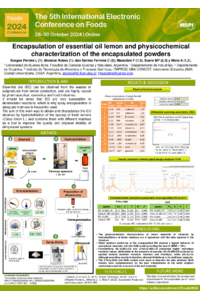
Essential oils (EOs) can be obtained from the waste products of lemon production, and are highly valued by the pharmaceutical and food industries. It should be noted that they are very susceptible to deterioration reactions, which is why spray encapsulation is frequently used.
The objective of this work was to obtain and characterize the EOs obtained by the hydrodistillation of the epicarp of fresh lemons (Citrus limon L.) and to combine them with different matrices as a tool to improve the quality and physical stability of dehydrated systems. Maltodextrin, commercial saccharose and starch were used to prepare two emulsions containing EOs. The powders were obtained by spray drying. The constant operational conditions were as follows: inlet and outlet air temperature at 98 and 68 °C, respectively, flow rate 8 mL/min, air pressure 3.2 bar, and nozzle diameter 1.5 mm.
The physicochemical characterization of each EO was carried out by pycnometry (20ºC) and using the refractive index (20ºC).
The aroma composition of each EO was determined by GC–MS and FT-IR. The inclusion complexes were characterized by differential scanning calorimetry (DSC) and by their sorption properties.
The D’Arcy–Watt and GAB models were used to describe the data obtained. Both models were complementary for the best interpretation of the water sorption mechanisms and the structure of the wall material.
These data are necessary for the sustainable use of subproducts.
Keywords
Inclusion complex
essential oil
lemon
Poster
Burgos Pereira y col.pdf
Bioactive influence of Cell-Free Supernatant from Lactobacillus plantarum strains towards probiotic Bifidobacteria: a preliminary study on growth and survival kinetic parameters
Antioxidant Activity of Various Bee Products