Event submissions
Published
This submission belongs to the session S2. Food Nutrition and Functional Foods of the event The 5th International Electronic Conference on Foods
Published date
25 Oct, 2024
Academic Editor
'%3e%3cpath%20d='M12.6657%2010.9104C12.4185%2010.325%2012.0599%209.79327%2011.6097%209.34482C11.1609%208.89508%2010.6293%208.5365%2010.0442%208.28888C10.0389%208.28626%2010.0337%208.28495%2010.0285%208.28233C10.8446%207.69279%2011.3752%206.73249%2011.3752%205.64904C11.3752%203.8542%209.92103%202.39999%208.1262%202.39999C6.33136%202.39999%204.87715%203.8542%204.87715%205.64904C4.87715%206.73249%205.40774%207.69279%206.22393%208.28364C6.21869%208.28626%206.21345%208.28757%206.20821%208.29019C5.62129%208.5378%205.09463%208.89284%204.64265%209.34613C4.1929%209.79493%203.83432%2010.3266%203.58671%2010.9117C3.34345%2011.4845%203.21226%2012.0987%203.20023%2012.7209C3.19988%2012.7349%203.20233%2012.7488%203.20744%2012.7619C3.21255%2012.7749%203.22022%2012.7867%203.22998%2012.7968C3.23975%2012.8068%203.25142%2012.8147%203.26431%2012.8202C3.2772%2012.8256%203.29105%2012.8284%203.30504%2012.8284H4.09109C4.14874%2012.8284%204.19459%2012.7825%204.1959%2012.7262C4.2221%2011.7148%204.62823%2010.7676%205.34617%2010.0497C6.08899%209.30683%207.0755%208.89808%208.1262%208.89808C9.17689%208.89808%2010.1634%209.30683%2010.9062%2010.0497C11.6242%2010.7676%2012.0303%2011.7148%2012.0565%2012.7262C12.0578%2012.7838%2012.1037%2012.8284%2012.1613%2012.8284H12.9474C12.9613%2012.8284%2012.9752%2012.8256%2012.9881%2012.8202C13.001%2012.8147%2013.0126%2012.8068%2013.0224%2012.7968C13.0322%2012.7867%2013.0398%2012.7749%2013.0449%2012.7619C13.0501%2012.7488%2013.0525%2012.7349%2013.0522%2012.7209C13.0391%2012.0947%2012.9094%2011.4855%2012.6657%2010.9104ZM8.1262%207.9024C7.52486%207.9024%206.9589%207.6679%206.53312%207.24211C6.10733%206.81633%205.87283%206.25037%205.87283%205.64904C5.87283%205.0477%206.10733%204.48174%206.53312%204.05596C6.9589%203.63018%207.52486%203.39567%208.1262%203.39567C8.72753%203.39567%209.29349%203.63018%209.71927%204.05596C10.1451%204.48174%2010.3796%205.0477%2010.3796%205.64904C10.3796%206.25037%2010.1451%206.81633%209.71927%207.24211C9.29349%207.6679%208.72753%207.9024%208.1262%207.9024Z'%20fill='%235D1EE1'/%3e%3c/g%3e%3c/svg%3e) Antonello Santini
Antonello SantiniCitation
Modupeola A. Oguntoye, Oreoluwa P. Adeleye, Ultrasound-Assisted Extraction and Alginate Encapsulation of Polyphenols from Hogplum Peels: Impact on Sensory Properties and Functional Groups of Maize Gruel (Ogi), in Proceedings of The 5th International Electronic Conference on Foods, 28 October–30 October 2024, MDPI: Basel, Switzerland
Share
Email
Facebook
Twitter
LinkedIn
Ultrasound-Assisted Extraction and Alginate Encapsulation of Polyphenols from Hogplum Peels: Impact on Sensory Properties and Functional Groups of Maize Gruel (Ogi)
'%3e%3cpath%20d='M12.6647%2010.9104C12.4176%2010.325%2012.0589%209.7933%2011.6088%209.34485C11.16%208.89511%2010.6283%208.53653%2010.0432%208.28891C10.038%208.28629%2010.0327%208.28498%2010.0275%208.28236C10.8437%207.69282%2011.3743%206.73252%2011.3743%205.64907C11.3743%203.85423%209.92005%202.40002%208.12522%202.40002C6.33038%202.40002%204.87618%203.85423%204.87618%205.64907C4.87618%206.73252%205.40677%207.69282%206.22296%208.28367C6.21772%208.28629%206.21248%208.2876%206.20724%208.29022C5.62031%208.53783%205.09365%208.89287%204.64167%209.34616C4.19192%209.79496%203.83334%2010.3266%203.58573%2010.9117C3.34247%2011.4846%203.21128%2012.0987%203.19925%2012.721C3.1989%2012.735%203.20135%2012.7489%203.20646%2012.7619C3.21157%2012.7749%203.21924%2012.7868%203.22901%2012.7968C3.23877%2012.8068%203.25045%2012.8148%203.26334%2012.8202C3.27623%2012.8256%203.29007%2012.8284%203.30406%2012.8284H4.09012C4.14776%2012.8284%204.19362%2012.7825%204.19493%2012.7262C4.22113%2011.7148%204.62726%2010.7676%205.34519%2010.0497C6.08802%209.30686%207.07452%208.89811%208.12522%208.89811C9.17592%208.89811%2010.1624%209.30686%2010.9052%2010.0497C11.6232%2010.7676%2012.0293%2011.7148%2012.0555%2012.7262C12.0568%2012.7839%2012.1027%2012.8284%2012.1603%2012.8284H12.9464C12.9604%2012.8284%2012.9742%2012.8256%2012.9871%2012.8202C13%2012.8148%2013.0117%2012.8068%2013.0214%2012.7968C13.0312%2012.7868%2013.0389%2012.7749%2013.044%2012.7619C13.0491%2012.7489%2013.0515%2012.735%2013.0512%2012.721C13.0381%2012.0947%2012.9084%2011.4856%2012.6647%2010.9104ZM8.12522%207.90243C7.52388%207.90243%206.95792%207.66793%206.53214%207.24215C6.10636%206.81636%205.87185%206.2504%205.87185%205.64907C5.87185%205.04773%206.10636%204.48177%206.53214%204.05599C6.95792%203.63021%207.52388%203.3957%208.12522%203.3957C8.72655%203.3957%209.29252%203.63021%209.7183%204.05599C10.1441%204.48177%2010.3786%205.04773%2010.3786%205.64907C10.3786%206.2504%2010.1441%206.81636%209.7183%207.24215C9.29252%207.66793%208.72655%207.90243%208.12522%207.90243Z'%20fill='%235D1EE1'/%3e%3c/g%3e%3c/svg%3e)
Modupeola A. Oguntoye 1
Oreoluwa P. Adeleye 1
1. Department of Food Technology, Faculty of Technology, University of Ibadan, Nigeria.
Abstract
Introduction:
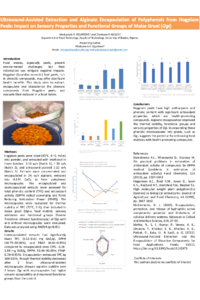
Food waste, especially peels, presents environmental challenges, but its valorisation can mitigate its negative impacts. Hogplum (Spondias mombin) fruit peels, rich in phenolic compounds, may offer significant health benefits. This study aims to extract, encapsulate and characterise the phenolic compounds from Hogplum peels and evaluate their inclusion in a food matrix.
Methods:
Hogplum peels were dried (45℃, 4 h), milled into powder, and extracted with methanol in three batches: 1:10 w/v (Batch 1), 1:20 w/v (Batch 2), and ultrasound-assisted 1:20 w/v (Batch 3). Extracts were concentrated and encapsulated in 3% w/v alginate and extruded into 0.1 M CaCl₂ to form polyphenol microcapsules. The encapsulated and unencapsulated extracts were assessed for total phenolic content (TPC) and antioxidant activity [(DPPH radical scavenging and Ferric Reducing Antioxidant Power (FRAP)]. The microcapsules were evaluated for thermal stability by measuring TPC after heating in water (70℃, 3 h) and were then included in maize gruel (Ogi, a food matrix). The sensory attributes and functional groups (Fourier Transform Infrared Spectroscopy) of Ogi with and without the microcapsules were evaluated. Data were analysed using ANOVA (p<0.05).
Results:
Unencapsulated extracts had significantly lower TPC (0.32–0.41 mg GAE/g), DPPH (18.75–20.06%), and FRAP (0.64–0.95%) compared to encapsulated ones (TPC: 0.98–1.89 mg GAE/g; DPPH: 52.44–92.05%; FRAP: 0.70–0.95%). Encapsulation enhanced TPC by 188-331%, though thermal stability decreased after 1 hour; ultrasound-assisted microcapsules showed superior stability over 2 hours. Ogi with microcapsules had higher sensory acceptability and improved functional groups compared to the control.
Conclusions:
Hogplum peels have high anthocyanin and phenolic content with significant antioxidant properties, and contain health-promoting compounds. Alginate encapsulation improved the thermal stability, functional groups, and sensory properties of Ogi. Incorporating these phenolic microcapsules into gruels such as Ogi suggests the potential for enhancing food matrices with health-promoting compounds.
Keywords
Hogplum peels
encapsulated polyphenols
fruit wastes
bioactive compounds
polyphenol extraction
Poster
Sciforum_Modupeola Oguntoye.pdf
Characterization and Stability Evaluation of Whey-, Soy-, and Pea Protein-Based Emulsions Enriched with Mentha Essential Oil
Sunflower (Helianthus annuus L.) bioresidues: a source of phenolic compounds and bioactive potential