Event submissions
Published
This submission belongs to the session S2. Food Nutrition and Functional Foods of the event The 5th International Electronic Conference on Foods
Published date
25 Oct, 2024
Academic Editor
'%3e%3cpath%20d='M12.6657%2010.9104C12.4185%2010.325%2012.0599%209.79327%2011.6097%209.34482C11.1609%208.89508%2010.6293%208.5365%2010.0442%208.28888C10.0389%208.28626%2010.0337%208.28495%2010.0285%208.28233C10.8446%207.69279%2011.3752%206.73249%2011.3752%205.64904C11.3752%203.8542%209.92103%202.39999%208.1262%202.39999C6.33136%202.39999%204.87715%203.8542%204.87715%205.64904C4.87715%206.73249%205.40774%207.69279%206.22393%208.28364C6.21869%208.28626%206.21345%208.28757%206.20821%208.29019C5.62129%208.5378%205.09463%208.89284%204.64265%209.34613C4.1929%209.79493%203.83432%2010.3266%203.58671%2010.9117C3.34345%2011.4845%203.21226%2012.0987%203.20023%2012.7209C3.19988%2012.7349%203.20233%2012.7488%203.20744%2012.7619C3.21255%2012.7749%203.22022%2012.7867%203.22998%2012.7968C3.23975%2012.8068%203.25142%2012.8147%203.26431%2012.8202C3.2772%2012.8256%203.29105%2012.8284%203.30504%2012.8284H4.09109C4.14874%2012.8284%204.19459%2012.7825%204.1959%2012.7262C4.2221%2011.7148%204.62823%2010.7676%205.34617%2010.0497C6.08899%209.30683%207.0755%208.89808%208.1262%208.89808C9.17689%208.89808%2010.1634%209.30683%2010.9062%2010.0497C11.6242%2010.7676%2012.0303%2011.7148%2012.0565%2012.7262C12.0578%2012.7838%2012.1037%2012.8284%2012.1613%2012.8284H12.9474C12.9613%2012.8284%2012.9752%2012.8256%2012.9881%2012.8202C13.001%2012.8147%2013.0126%2012.8068%2013.0224%2012.7968C13.0322%2012.7867%2013.0398%2012.7749%2013.0449%2012.7619C13.0501%2012.7488%2013.0525%2012.7349%2013.0522%2012.7209C13.0391%2012.0947%2012.9094%2011.4855%2012.6657%2010.9104ZM8.1262%207.9024C7.52486%207.9024%206.9589%207.6679%206.53312%207.24211C6.10733%206.81633%205.87283%206.25037%205.87283%205.64904C5.87283%205.0477%206.10733%204.48174%206.53312%204.05596C6.9589%203.63018%207.52486%203.39567%208.1262%203.39567C8.72753%203.39567%209.29349%203.63018%209.71927%204.05596C10.1451%204.48174%2010.3796%205.0477%2010.3796%205.64904C10.3796%206.25037%2010.1451%206.81633%209.71927%207.24211C9.29349%207.6679%208.72753%207.9024%208.1262%207.9024Z'%20fill='%235D1EE1'/%3e%3c/g%3e%3c/svg%3e) Manuel Viuda-Martos
Manuel Viuda-MartosCitation
Bárbara Menezes, Cristina Caleja, Sandrina Heleno, Tiane Cristine Finimundy, Lillian Barros, Manuel Goméz, Alexandre Gonçalves, Eliana Pereira, Sunflower (Helianthus annuus L.) bioresidues: a source of phenolic compounds and bioactive potential, in Proceedings of The 5th International Electronic Conference on Foods, 28 October–30 October 2024, MDPI: Basel, Switzerland
Share
Email
Facebook
Twitter
LinkedIn
Sunflower (Helianthus annuus L.) bioresidues: a source of phenolic compounds and bioactive potential
'%3e%3cpath%20d='M12.6647%2010.9104C12.4176%2010.325%2012.0589%209.7933%2011.6088%209.34485C11.16%208.89511%2010.6283%208.53653%2010.0432%208.28891C10.038%208.28629%2010.0327%208.28498%2010.0275%208.28236C10.8437%207.69282%2011.3743%206.73252%2011.3743%205.64907C11.3743%203.85423%209.92005%202.40002%208.12522%202.40002C6.33038%202.40002%204.87618%203.85423%204.87618%205.64907C4.87618%206.73252%205.40677%207.69282%206.22296%208.28367C6.21772%208.28629%206.21248%208.2876%206.20724%208.29022C5.62031%208.53783%205.09365%208.89287%204.64167%209.34616C4.19192%209.79496%203.83334%2010.3266%203.58573%2010.9117C3.34247%2011.4846%203.21128%2012.0987%203.19925%2012.721C3.1989%2012.735%203.20135%2012.7489%203.20646%2012.7619C3.21157%2012.7749%203.21924%2012.7868%203.22901%2012.7968C3.23877%2012.8068%203.25045%2012.8148%203.26334%2012.8202C3.27623%2012.8256%203.29007%2012.8284%203.30406%2012.8284H4.09012C4.14776%2012.8284%204.19362%2012.7825%204.19493%2012.7262C4.22113%2011.7148%204.62726%2010.7676%205.34519%2010.0497C6.08802%209.30686%207.07452%208.89811%208.12522%208.89811C9.17592%208.89811%2010.1624%209.30686%2010.9052%2010.0497C11.6232%2010.7676%2012.0293%2011.7148%2012.0555%2012.7262C12.0568%2012.7839%2012.1027%2012.8284%2012.1603%2012.8284H12.9464C12.9604%2012.8284%2012.9742%2012.8256%2012.9871%2012.8202C13%2012.8148%2013.0117%2012.8068%2013.0214%2012.7968C13.0312%2012.7868%2013.0389%2012.7749%2013.044%2012.7619C13.0491%2012.7489%2013.0515%2012.735%2013.0512%2012.721C13.0381%2012.0947%2012.9084%2011.4856%2012.6647%2010.9104ZM8.12522%207.90243C7.52388%207.90243%206.95792%207.66793%206.53214%207.24215C6.10636%206.81636%205.87185%206.2504%205.87185%205.64907C5.87185%205.04773%206.10636%204.48177%206.53214%204.05599C6.95792%203.63021%207.52388%203.3957%208.12522%203.3957C8.72655%203.3957%209.29252%203.63021%209.7183%204.05599C10.1441%204.48177%2010.3786%205.04773%2010.3786%205.64907C10.3786%206.2504%2010.1441%206.81636%209.7183%207.24215C9.29252%207.66793%208.72655%207.90243%208.12522%207.90243Z'%20fill='%235D1EE1'/%3e%3c/g%3e%3c/svg%3e)
Bárbara Menezes 1,2

Cristina Caleja 2,3

Sandrina Heleno 2,3

Tiane Cristine Finimundy 2,3

Lillian Barros 2,3

Manuel Goméz 4
Alexandre Gonçalves 5

Eliana Pereira 2,3
1. Centro de Investigação de Montanha (CIMO), Instituto Politécnico de Bragança (IPB)
2. Laboratório Associado para a Sustentabilidade e Tecnologia em Regiões de Montanha (SusTEC), Instituto Politécnico de Bragança, Portugal
3. Centro de Investigação de Montanha (CIMO), Instituto Politécnico de Bragança, Portugal
4. UVa, University of Valladolid, Department of Agricultural and Forestry Engineering, Higher Technical School of Agricultural Engineering, Palencia, Spain
5. MORE – Mountains of Research Colaborative Laboratory – Association, Bragança, Portugal
Abstract
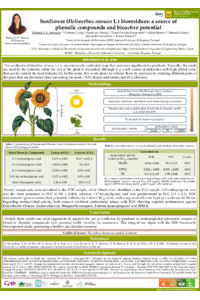
The sunflower (Helianthus annuus L.) is an extensively cultivated plant and, consequently, produces a significant amount of residues. However, these residues are discarded, although they are rich sources of high-value-added molecules that can be used in the food industry. In this sense, this work intended to valorize these residues through the study of different parts of the plant that are discarded after harvesting the seeds—FOG (leaves and stems) and FLG (flowers). The phenolic composition was determined by LC-DAD-ESI-MSn, and the bioactive action was evaluated regarding its antioxidant (TBARS, RP, DPPH) and antimicrobial action. Twenty compounds were identified in the FOG sample, while fifteen compounds were identified in the FLG sample. The quantitative analyses revealed that 3-O-caffeoylquinic acid was found in higher amounts in FOG (0.191 ± 0.003 mg/g of extract), while the 5-O-feruloylquinic acid was more abundant in FLG (3.5 ± 0.1 mg/g of extract). Regarding the bioactive potential, FOG presents more promising antioxidant activity, reflected through a lower EC50 value, indicating greater efficacy in inhibiting lipid peroxidation. In terms of antimicrobial activity, tested on several strains of bacteria selected according to their relevance at the public-health level, it was visible that both extracts showed antibacterial action. The FOG extract showed a slightly better performance, particularly against Enterobacter Cloacae and Escherichia coli. Otherwise, the FOG extract showed better results against the strains Morganella morganii, Listeria monocytogenes and against MRSA.
Overall, these results are valid arguments to support the use of sunflower by-products as underexploited alternative sources of bioactive phenolic compounds with potential health benefits for consumers. This integral use is in line with the 2030 Sustainable Development Goals, promoting a healthy and circular economy.
Keywords
Sunflower residues
Phenolic compounds
Antioxidant activity
Antimicrobial activity
Sustainability.
Poster
Poster FOODS 2024.pdf
Ultrasound-Assisted Extraction and Alginate Encapsulation of Polyphenols from Hogplum Peels: Impact on Sensory Properties and Functional Groups of Maize Gruel (Ogi)
The Development of a method for disintegrating the yeast cell wall aimed at obtaining microbial proteins