Event submissions
Published
This submission belongs to the session S1. Innovation in Food Technology and Engineering of the event The 5th International Electronic Conference on Foods
Published date
25 Oct, 2024
Academic Editor
'%3e%3cpath%20d='M12.6657%2010.9104C12.4185%2010.325%2012.0599%209.79327%2011.6097%209.34482C11.1609%208.89508%2010.6293%208.5365%2010.0442%208.28888C10.0389%208.28626%2010.0337%208.28495%2010.0285%208.28233C10.8446%207.69279%2011.3752%206.73249%2011.3752%205.64904C11.3752%203.8542%209.92103%202.39999%208.1262%202.39999C6.33136%202.39999%204.87715%203.8542%204.87715%205.64904C4.87715%206.73249%205.40774%207.69279%206.22393%208.28364C6.21869%208.28626%206.21345%208.28757%206.20821%208.29019C5.62129%208.5378%205.09463%208.89284%204.64265%209.34613C4.1929%209.79493%203.83432%2010.3266%203.58671%2010.9117C3.34345%2011.4845%203.21226%2012.0987%203.20023%2012.7209C3.19988%2012.7349%203.20233%2012.7488%203.20744%2012.7619C3.21255%2012.7749%203.22022%2012.7867%203.22998%2012.7968C3.23975%2012.8068%203.25142%2012.8147%203.26431%2012.8202C3.2772%2012.8256%203.29105%2012.8284%203.30504%2012.8284H4.09109C4.14874%2012.8284%204.19459%2012.7825%204.1959%2012.7262C4.2221%2011.7148%204.62823%2010.7676%205.34617%2010.0497C6.08899%209.30683%207.0755%208.89808%208.1262%208.89808C9.17689%208.89808%2010.1634%209.30683%2010.9062%2010.0497C11.6242%2010.7676%2012.0303%2011.7148%2012.0565%2012.7262C12.0578%2012.7838%2012.1037%2012.8284%2012.1613%2012.8284H12.9474C12.9613%2012.8284%2012.9752%2012.8256%2012.9881%2012.8202C13.001%2012.8147%2013.0126%2012.8068%2013.0224%2012.7968C13.0322%2012.7867%2013.0398%2012.7749%2013.0449%2012.7619C13.0501%2012.7488%2013.0525%2012.7349%2013.0522%2012.7209C13.0391%2012.0947%2012.9094%2011.4855%2012.6657%2010.9104ZM8.1262%207.9024C7.52486%207.9024%206.9589%207.6679%206.53312%207.24211C6.10733%206.81633%205.87283%206.25037%205.87283%205.64904C5.87283%205.0477%206.10733%204.48174%206.53312%204.05596C6.9589%203.63018%207.52486%203.39567%208.1262%203.39567C8.72753%203.39567%209.29349%203.63018%209.71927%204.05596C10.1451%204.48174%2010.3796%205.0477%2010.3796%205.64904C10.3796%206.25037%2010.1451%206.81633%209.71927%207.24211C9.29349%207.6679%208.72753%207.9024%208.1262%207.9024Z'%20fill='%235D1EE1'/%3e%3c/g%3e%3c/svg%3e) Moktar Hamdi
Moktar HamdiCitation
Joanna Sękul, Magdalena Trusińska, Anna Kot, Katarzyna Rybak, Małgorzata Nowacka, Katarzyna Pobiega, Michał Pląder, The Development of a method for disintegrating the yeast cell wall aimed at obtaining microbial proteins, in Proceedings of The 5th International Electronic Conference on Foods, 28 October–30 October 2024, MDPI: Basel, Switzerland
Share
Email
Facebook
Twitter
LinkedIn
The Development of a method for disintegrating the yeast cell wall aimed at obtaining microbial proteins
'%3e%3cpath%20d='M12.6647%2010.9104C12.4176%2010.325%2012.0589%209.7933%2011.6088%209.34485C11.16%208.89511%2010.6283%208.53653%2010.0432%208.28891C10.038%208.28629%2010.0327%208.28498%2010.0275%208.28236C10.8437%207.69282%2011.3743%206.73252%2011.3743%205.64907C11.3743%203.85423%209.92005%202.40002%208.12522%202.40002C6.33038%202.40002%204.87618%203.85423%204.87618%205.64907C4.87618%206.73252%205.40677%207.69282%206.22296%208.28367C6.21772%208.28629%206.21248%208.2876%206.20724%208.29022C5.62031%208.53783%205.09365%208.89287%204.64167%209.34616C4.19192%209.79496%203.83334%2010.3266%203.58573%2010.9117C3.34247%2011.4846%203.21128%2012.0987%203.19925%2012.721C3.1989%2012.735%203.20135%2012.7489%203.20646%2012.7619C3.21157%2012.7749%203.21924%2012.7868%203.22901%2012.7968C3.23877%2012.8068%203.25045%2012.8148%203.26334%2012.8202C3.27623%2012.8256%203.29007%2012.8284%203.30406%2012.8284H4.09012C4.14776%2012.8284%204.19362%2012.7825%204.19493%2012.7262C4.22113%2011.7148%204.62726%2010.7676%205.34519%2010.0497C6.08802%209.30686%207.07452%208.89811%208.12522%208.89811C9.17592%208.89811%2010.1624%209.30686%2010.9052%2010.0497C11.6232%2010.7676%2012.0293%2011.7148%2012.0555%2012.7262C12.0568%2012.7839%2012.1027%2012.8284%2012.1603%2012.8284H12.9464C12.9604%2012.8284%2012.9742%2012.8256%2012.9871%2012.8202C13%2012.8148%2013.0117%2012.8068%2013.0214%2012.7968C13.0312%2012.7868%2013.0389%2012.7749%2013.044%2012.7619C13.0491%2012.7489%2013.0515%2012.735%2013.0512%2012.721C13.0381%2012.0947%2012.9084%2011.4856%2012.6647%2010.9104ZM8.12522%207.90243C7.52388%207.90243%206.95792%207.66793%206.53214%207.24215C6.10636%206.81636%205.87185%206.2504%205.87185%205.64907C5.87185%205.04773%206.10636%204.48177%206.53214%204.05599C6.95792%203.63021%207.52388%203.3957%208.12522%203.3957C8.72655%203.3957%209.29252%203.63021%209.7183%204.05599C10.1441%204.48177%2010.3786%205.04773%2010.3786%205.64907C10.3786%206.2504%2010.1441%206.81636%209.7183%207.24215C9.29252%207.66793%208.72655%207.90243%208.12522%207.90243Z'%20fill='%235D1EE1'/%3e%3c/g%3e%3c/svg%3e)
Joanna Sękul 1

Magdalena Trusińska 2

Anna Kot 1
Katarzyna Rybak 2

Małgorzata Nowacka 2

Katarzyna Pobiega 1
Michał Pląder 1
1. Department of Food Biotechnology and Microbiology, Institute of Food Sciences, Warsaw University of Life Sciences
2. Department of Food Engineering and Process Management, Institute of Food Sciences, Warsaw University of Life Sciences
Abstract
In recent decades, the global production of ruminant meat has doubled. Animal production has significant environmental consequences, mainly due to significant greenhouse gas emissions, arable land use, and freshwater withdrawal. It is estimated that the production of feed for farm animals accounts for 41% of total water consumption in agriculture. On account of the increasing popularity of vegetarian and vegan diets, as well as the significant increase in protein deficit in the world, attempts are being made to develop unconventional methods of nutrition. In recent years, there has been increasing interest in the production of microbial proteins (single-cell proteins), mainly as feed for domestic and farm animals. SCP biosynthesis is approximately 500 times faster than the production of beef protein and is more efficient than that of animal protein. Microbial proteins, also known as single-cell proteins, are proteins that have been extracted from cultivated microbial biomass. Microorganisms commonly used for microbial protein synthesis include Saccharomyces cerevisiae, Fusarium venenatum and Candida sp., according to EU Commission Implementing Regulation 2023/938, and Yarrowia lipolytica yeast biomass is considered a novel food.
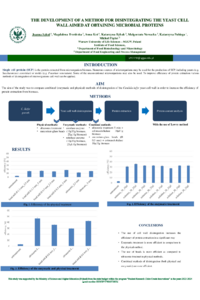
The aim of this study was to compare combined (enzymatic and physical) methods of disintegration of the Candida kefyr yeast cell wall in order to increase the efficiency of protein extraction from biomass.
Enzymatic methods were used in combination with ultrasonic treatment and mechanical grinding with zurconium--glass beads. Combined methods proved to be more effective for the disintegration of the C. kefyr yeast cell wall than the enzymatic or physical method only. An increase in the efficiency of single-cell protein extraction was demonstrated, which can be used on an industrial scale to obtain microbial proteins.
This study was supported by the Ministry of Education and Science (Poland) from the state within the program "Student Research Clubs Create Innovations" in the years 2023-2024 (grant number SKN/SP/570267/2023).
Keywords
SCP
Candida kefyr
cell wall
Poster
J.Sękul_poster.pdf
Sunflower (Helianthus annuus L.) bioresidues: a source of phenolic compounds and bioactive potential
Virtual Flavour Prototyping: Harnessing Machine Learning to Revolutionize Flavour Development and Innovation in Food Science