Event submissions
Published
This submission belongs to the session S4. Food Microbiology of the event The 5th International Electronic Conference on Foods
Published date
25 Oct, 2024
Academic Editor
'%3e%3cpath%20d='M12.6657%2010.9104C12.4185%2010.325%2012.0599%209.79327%2011.6097%209.34482C11.1609%208.89508%2010.6293%208.5365%2010.0442%208.28888C10.0389%208.28626%2010.0337%208.28495%2010.0285%208.28233C10.8446%207.69279%2011.3752%206.73249%2011.3752%205.64904C11.3752%203.8542%209.92103%202.39999%208.1262%202.39999C6.33136%202.39999%204.87715%203.8542%204.87715%205.64904C4.87715%206.73249%205.40774%207.69279%206.22393%208.28364C6.21869%208.28626%206.21345%208.28757%206.20821%208.29019C5.62129%208.5378%205.09463%208.89284%204.64265%209.34613C4.1929%209.79493%203.83432%2010.3266%203.58671%2010.9117C3.34345%2011.4845%203.21226%2012.0987%203.20023%2012.7209C3.19988%2012.7349%203.20233%2012.7488%203.20744%2012.7619C3.21255%2012.7749%203.22022%2012.7867%203.22998%2012.7968C3.23975%2012.8068%203.25142%2012.8147%203.26431%2012.8202C3.2772%2012.8256%203.29105%2012.8284%203.30504%2012.8284H4.09109C4.14874%2012.8284%204.19459%2012.7825%204.1959%2012.7262C4.2221%2011.7148%204.62823%2010.7676%205.34617%2010.0497C6.08899%209.30683%207.0755%208.89808%208.1262%208.89808C9.17689%208.89808%2010.1634%209.30683%2010.9062%2010.0497C11.6242%2010.7676%2012.0303%2011.7148%2012.0565%2012.7262C12.0578%2012.7838%2012.1037%2012.8284%2012.1613%2012.8284H12.9474C12.9613%2012.8284%2012.9752%2012.8256%2012.9881%2012.8202C13.001%2012.8147%2013.0126%2012.8068%2013.0224%2012.7968C13.0322%2012.7867%2013.0398%2012.7749%2013.0449%2012.7619C13.0501%2012.7488%2013.0525%2012.7349%2013.0522%2012.7209C13.0391%2012.0947%2012.9094%2011.4855%2012.6657%2010.9104ZM8.1262%207.9024C7.52486%207.9024%206.9589%207.6679%206.53312%207.24211C6.10733%206.81633%205.87283%206.25037%205.87283%205.64904C5.87283%205.0477%206.10733%204.48174%206.53312%204.05596C6.9589%203.63018%207.52486%203.39567%208.1262%203.39567C8.72753%203.39567%209.29349%203.63018%209.71927%204.05596C10.1451%204.48174%2010.3796%205.0477%2010.3796%205.64904C10.3796%206.25037%2010.1451%206.81633%209.71927%207.24211C9.29349%207.6679%208.72753%207.9024%208.1262%207.9024Z'%20fill='%235D1EE1'/%3e%3c/g%3e%3c/svg%3e) Antonio Bevilacqua
Antonio BevilacquaCitation
Iglė Vepštaitė-Monstavičė, Juliana Lukša, Živilė Strazdaitė-Žielienė, Saulius Serva, Elena Servienė, The epiphytic microorganisms inhabiting rosehip and rowanberry, in Proceedings of The 5th International Electronic Conference on Foods, 28 October–30 October 2024, MDPI: Basel, Switzerland
Share
Email
Facebook
Twitter
LinkedIn
The epiphytic microorganisms inhabiting rosehip and rowanberry
'%3e%3cpath%20d='M12.6647%2010.9104C12.4176%2010.325%2012.0589%209.7933%2011.6088%209.34485C11.16%208.89511%2010.6283%208.53653%2010.0432%208.28891C10.038%208.28629%2010.0327%208.28498%2010.0275%208.28236C10.8437%207.69282%2011.3743%206.73252%2011.3743%205.64907C11.3743%203.85423%209.92005%202.40002%208.12522%202.40002C6.33038%202.40002%204.87618%203.85423%204.87618%205.64907C4.87618%206.73252%205.40677%207.69282%206.22296%208.28367C6.21772%208.28629%206.21248%208.2876%206.20724%208.29022C5.62031%208.53783%205.09365%208.89287%204.64167%209.34616C4.19192%209.79496%203.83334%2010.3266%203.58573%2010.9117C3.34247%2011.4846%203.21128%2012.0987%203.19925%2012.721C3.1989%2012.735%203.20135%2012.7489%203.20646%2012.7619C3.21157%2012.7749%203.21924%2012.7868%203.22901%2012.7968C3.23877%2012.8068%203.25045%2012.8148%203.26334%2012.8202C3.27623%2012.8256%203.29007%2012.8284%203.30406%2012.8284H4.09012C4.14776%2012.8284%204.19362%2012.7825%204.19493%2012.7262C4.22113%2011.7148%204.62726%2010.7676%205.34519%2010.0497C6.08802%209.30686%207.07452%208.89811%208.12522%208.89811C9.17592%208.89811%2010.1624%209.30686%2010.9052%2010.0497C11.6232%2010.7676%2012.0293%2011.7148%2012.0555%2012.7262C12.0568%2012.7839%2012.1027%2012.8284%2012.1603%2012.8284H12.9464C12.9604%2012.8284%2012.9742%2012.8256%2012.9871%2012.8202C13%2012.8148%2013.0117%2012.8068%2013.0214%2012.7968C13.0312%2012.7868%2013.0389%2012.7749%2013.044%2012.7619C13.0491%2012.7489%2013.0515%2012.735%2013.0512%2012.721C13.0381%2012.0947%2012.9084%2011.4856%2012.6647%2010.9104ZM8.12522%207.90243C7.52388%207.90243%206.95792%207.66793%206.53214%207.24215C6.10636%206.81636%205.87185%206.2504%205.87185%205.64907C5.87185%205.04773%206.10636%204.48177%206.53214%204.05599C6.95792%203.63021%207.52388%203.3957%208.12522%203.3957C8.72655%203.3957%209.29252%203.63021%209.7183%204.05599C10.1441%204.48177%2010.3786%205.04773%2010.3786%205.64907C10.3786%206.2504%2010.1441%206.81636%209.7183%207.24215C9.29252%207.66793%208.72655%207.90243%208.12522%207.90243Z'%20fill='%235D1EE1'/%3e%3c/g%3e%3c/svg%3e)
Iglė Vepštaitė-Monstavičė 1,2
Juliana Lukša 2

Živilė Strazdaitė-Žielienė 2
Saulius Serva 1
Elena Servienė 2,3
1. Life Science Center, Vilnius University, Saulėtekio av. 7, 10257 Vilnius, Lithuania
2. Laboratory of Genetics, Nature Research Centre, Akademijos str. 2, 08412 Vilnius, Lithuania
3. Department of Chemistry and Bioengineering, Vilnius Gediminas Technical University, Saulėtekio av. 11, 10223 Vilnius, Lithuania
Abstract
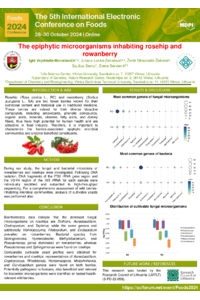
Rosehip (Rosa canina L.) and rowanberry (Sorbus aucuparia L.) are two forest berries known for their nutritional content and historical use in traditional medicine. These berries are valued for their diverse bioactive compounds, including antioxidants, phenolic compounds, organic acids, minerals, vitamins, fatty acids, and dietary fiber; thus, they have high potential for human health and are attractive in the food industry. Therefore, it is important to characterize the berry-associated epiphytic microbial communities and uncover their beneficial constituents.
During our study, the fungal and bacterial microbiota of rowanberries and rosehips were investigated. Following DNA isolation, DNA fragments of the ITS2 rRNA gene region and the V3-V4 region of the 16S rRNA for each sample were individually amplified and subjected to high-throughput next-generation sequencing. The bioinformatics data indicated that the dominant fungal microorganisms on the rosehips were Dothiora, Aureobasidium, Cladosporium, and Taphrina, while the same genera and additionally Vishniacozyma, Filobasidium, and Exobasidium prevailed on the rowanberries. Bacterial species from the Sphingomonas, Hymenobacter, Methylobacterium, and Pseudomonas genera dominated on the rowanberries, whereas Pseudomonas and Sphingomonas were found on the rosehips.
For a comprehensive assessment of the wild berry-inhabiting microbial communities, analysis of the cultivable yeasts was performed. Comparable cultivable yeast profiles were obtained for the rowanberries and rosehips: representatives of the Aureobasidium, Cryptoccocus, Rhodotorula, Hanseniaspora, Metschnikowia, and Curvibasidium genera were found on both berries. Although potentially pathogenic to humans, beneficial microorganisms relevant as biocontrol microorganisms were also identified on the tested berries.
This research was funded by the Research Council of Lithuania (S-PD-22-058).
Keywords
Microbiota
rowanberry
rosehip
yeast.
Poster
Vepstaite_Monstavice_Foods_online conference_2024.pdf
Consumer attitudes and acceptability towards innovative functional foods: A retroprospective epidimiological study in Greece and Cyprus
Development of chewy snack bars from mechanically dehulled toasted African breadfruit (Treculia africana) grits.