Event submissions
Published
This submission belongs to the session S2. Food Nutrition and Functional Foods of the event The 5th International Electronic Conference on Foods
Published date
25 Oct, 2024
Academic Editor
'%3e%3cpath%20d='M12.6657%2010.9104C12.4185%2010.325%2012.0599%209.79327%2011.6097%209.34482C11.1609%208.89508%2010.6293%208.5365%2010.0442%208.28888C10.0389%208.28626%2010.0337%208.28495%2010.0285%208.28233C10.8446%207.69279%2011.3752%206.73249%2011.3752%205.64904C11.3752%203.8542%209.92103%202.39999%208.1262%202.39999C6.33136%202.39999%204.87715%203.8542%204.87715%205.64904C4.87715%206.73249%205.40774%207.69279%206.22393%208.28364C6.21869%208.28626%206.21345%208.28757%206.20821%208.29019C5.62129%208.5378%205.09463%208.89284%204.64265%209.34613C4.1929%209.79493%203.83432%2010.3266%203.58671%2010.9117C3.34345%2011.4845%203.21226%2012.0987%203.20023%2012.7209C3.19988%2012.7349%203.20233%2012.7488%203.20744%2012.7619C3.21255%2012.7749%203.22022%2012.7867%203.22998%2012.7968C3.23975%2012.8068%203.25142%2012.8147%203.26431%2012.8202C3.2772%2012.8256%203.29105%2012.8284%203.30504%2012.8284H4.09109C4.14874%2012.8284%204.19459%2012.7825%204.1959%2012.7262C4.2221%2011.7148%204.62823%2010.7676%205.34617%2010.0497C6.08899%209.30683%207.0755%208.89808%208.1262%208.89808C9.17689%208.89808%2010.1634%209.30683%2010.9062%2010.0497C11.6242%2010.7676%2012.0303%2011.7148%2012.0565%2012.7262C12.0578%2012.7838%2012.1037%2012.8284%2012.1613%2012.8284H12.9474C12.9613%2012.8284%2012.9752%2012.8256%2012.9881%2012.8202C13.001%2012.8147%2013.0126%2012.8068%2013.0224%2012.7968C13.0322%2012.7867%2013.0398%2012.7749%2013.0449%2012.7619C13.0501%2012.7488%2013.0525%2012.7349%2013.0522%2012.7209C13.0391%2012.0947%2012.9094%2011.4855%2012.6657%2010.9104ZM8.1262%207.9024C7.52486%207.9024%206.9589%207.6679%206.53312%207.24211C6.10733%206.81633%205.87283%206.25037%205.87283%205.64904C5.87283%205.0477%206.10733%204.48174%206.53312%204.05596C6.9589%203.63018%207.52486%203.39567%208.1262%203.39567C8.72753%203.39567%209.29349%203.63018%209.71927%204.05596C10.1451%204.48174%2010.3796%205.0477%2010.3796%205.64904C10.3796%206.25037%2010.1451%206.81633%209.71927%207.24211C9.29349%207.6679%208.72753%207.9024%208.1262%207.9024Z'%20fill='%235D1EE1'/%3e%3c/g%3e%3c/svg%3e) Manuel Viuda-Martos
Manuel Viuda-MartosCitation
Valentina Baranda, Lara del Cerro, Valentina Izquierdo, Florencia Paz, Agustina Rodríguez, Victoria Martínez, Victoria Olt, Jessica Báez, Alejandra Medrano-Fernandez, Adriana Maite Fernández-Fernández, Development of muffins with Tannat grape pomace as potential functional foods, in Proceedings of The 5th International Electronic Conference on Foods, 28 October–30 October 2024, MDPI: Basel, Switzerland
Share
Email
Facebook
Twitter
LinkedIn
Development of muffins with Tannat grape pomace as potential functional foods
'%3e%3cpath%20d='M12.6647%2010.9104C12.4176%2010.325%2012.0589%209.7933%2011.6088%209.34485C11.16%208.89511%2010.6283%208.53653%2010.0432%208.28891C10.038%208.28629%2010.0327%208.28498%2010.0275%208.28236C10.8437%207.69282%2011.3743%206.73252%2011.3743%205.64907C11.3743%203.85423%209.92005%202.40002%208.12522%202.40002C6.33038%202.40002%204.87618%203.85423%204.87618%205.64907C4.87618%206.73252%205.40677%207.69282%206.22296%208.28367C6.21772%208.28629%206.21248%208.2876%206.20724%208.29022C5.62031%208.53783%205.09365%208.89287%204.64167%209.34616C4.19192%209.79496%203.83334%2010.3266%203.58573%2010.9117C3.34247%2011.4846%203.21128%2012.0987%203.19925%2012.721C3.1989%2012.735%203.20135%2012.7489%203.20646%2012.7619C3.21157%2012.7749%203.21924%2012.7868%203.22901%2012.7968C3.23877%2012.8068%203.25045%2012.8148%203.26334%2012.8202C3.27623%2012.8256%203.29007%2012.8284%203.30406%2012.8284H4.09012C4.14776%2012.8284%204.19362%2012.7825%204.19493%2012.7262C4.22113%2011.7148%204.62726%2010.7676%205.34519%2010.0497C6.08802%209.30686%207.07452%208.89811%208.12522%208.89811C9.17592%208.89811%2010.1624%209.30686%2010.9052%2010.0497C11.6232%2010.7676%2012.0293%2011.7148%2012.0555%2012.7262C12.0568%2012.7839%2012.1027%2012.8284%2012.1603%2012.8284H12.9464C12.9604%2012.8284%2012.9742%2012.8256%2012.9871%2012.8202C13%2012.8148%2013.0117%2012.8068%2013.0214%2012.7968C13.0312%2012.7868%2013.0389%2012.7749%2013.044%2012.7619C13.0491%2012.7489%2013.0515%2012.735%2013.0512%2012.721C13.0381%2012.0947%2012.9084%2011.4856%2012.6647%2010.9104ZM8.12522%207.90243C7.52388%207.90243%206.95792%207.66793%206.53214%207.24215C6.10636%206.81636%205.87185%206.2504%205.87185%205.64907C5.87185%205.04773%206.10636%204.48177%206.53214%204.05599C6.95792%203.63021%207.52388%203.3957%208.12522%203.3957C8.72655%203.3957%209.29252%203.63021%209.7183%204.05599C10.1441%204.48177%2010.3786%205.04773%2010.3786%205.64907C10.3786%206.2504%2010.1441%206.81636%209.7183%207.24215C9.29252%207.66793%208.72655%207.90243%208.12522%207.90243Z'%20fill='%235D1EE1'/%3e%3c/g%3e%3c/svg%3e)
Valentina Baranda 1
Lara del Cerro 1
Valentina Izquierdo 1
Florencia Paz 1
Agustina Rodríguez 1
Victoria Martínez 1
Victoria Olt 1

Jessica Báez 1

Alejandra Medrano-Fernandez 1

Adriana Maite Fernández-Fernández 1
1. Departamento de Ciencia y Tecnología de Alimentos, Facultad de Química, Universidad de la República, General Flores 2124, Montevideo 11800, Uruguay
Abstract
An abundant byproduct of the Uruguayan winemaking industry, Tannat grape pomace (TGP) has a unique profile of phenolic compounds, making it a great candidate as an ingredient in the formulation of healthy and sustainable foods. The addition of TGP and sweetener to a muffin formulation may represent a challenge regarding technological properties. In this work, the objective was to develop potential functional muffins with the nutritional claims of “source of/high in fibre” and “no added sugars”, by incorporating TGP as a source of fibre and bioactive compounds and stevia as a sweetener. For this purpose, a factorial experimental design with central points was assessed by varying TGP and sweetener contents. Colour was measured in the muffins by a CieLab system, and texture parameters (hardness, elasticity, cohesiveness, gumminess, and chewiness) were obtained by a texture analyser. The antioxidant capacity was also assessed by total phenol content (TPC by Folin reaction), ABTS, and ORAC-FL methods. Regarding colour parameters, the main results showed lower L values for the muffins with higher TGP content (34.4-35.9, p<0.05). As for texture parameters, lower hardness values (3170-3655 N) were displayed by muffins with higher TGP content (p<0.05). Elasticity showed no significant differences between the samples (0.773-0.873), with the exception of one of the formulations with higher TGP content. Cohesiveness values ranged between 0.210 and 0.374. Gumminess and chewiness values were lower for the muffin formulation with higher TGP and stevia contents (694±202 N and 538±182 N). Moreover, antioxidant capacity showed increased TPC values for muffins with higher TGP content when compared to the control muffin (without TGP). Similarly, ABTS and ORAC-FL values were higher for the muffins with higher TGP content (15.26-15.59 and 23.92-25.56 µmol Trolox equivalent (TE)/g samples, respectively). In conclusion, TGP muffins represent a sustainable food with adequate technological properties and enhanced nutritional properties, presenting potential to promote health.
Keywords
antioxidants
functional foods
health-promoting potential
sustainable muffins
Tannat grape pomace
wine industry byproduct
Poster
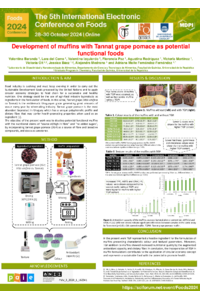
Poster TGP Muffins 2024.pdf
Innovative confectionery product with nutritionally improved status
Assessment of Bioactive Compound Changes and Antioxidant Activity in Processed Georgian Cherry Plum Products Using UPLC-PDA-MS