Event submissions
Published
This submission belongs to the session S4. Food Microbiology of the event The 5th International Electronic Conference on Foods
Published date
25 Oct, 2024
Academic Editor
'%3e%3cpath%20d='M12.6657%2010.9104C12.4185%2010.325%2012.0599%209.79327%2011.6097%209.34482C11.1609%208.89508%2010.6293%208.5365%2010.0442%208.28888C10.0389%208.28626%2010.0337%208.28495%2010.0285%208.28233C10.8446%207.69279%2011.3752%206.73249%2011.3752%205.64904C11.3752%203.8542%209.92103%202.39999%208.1262%202.39999C6.33136%202.39999%204.87715%203.8542%204.87715%205.64904C4.87715%206.73249%205.40774%207.69279%206.22393%208.28364C6.21869%208.28626%206.21345%208.28757%206.20821%208.29019C5.62129%208.5378%205.09463%208.89284%204.64265%209.34613C4.1929%209.79493%203.83432%2010.3266%203.58671%2010.9117C3.34345%2011.4845%203.21226%2012.0987%203.20023%2012.7209C3.19988%2012.7349%203.20233%2012.7488%203.20744%2012.7619C3.21255%2012.7749%203.22022%2012.7867%203.22998%2012.7968C3.23975%2012.8068%203.25142%2012.8147%203.26431%2012.8202C3.2772%2012.8256%203.29105%2012.8284%203.30504%2012.8284H4.09109C4.14874%2012.8284%204.19459%2012.7825%204.1959%2012.7262C4.2221%2011.7148%204.62823%2010.7676%205.34617%2010.0497C6.08899%209.30683%207.0755%208.89808%208.1262%208.89808C9.17689%208.89808%2010.1634%209.30683%2010.9062%2010.0497C11.6242%2010.7676%2012.0303%2011.7148%2012.0565%2012.7262C12.0578%2012.7838%2012.1037%2012.8284%2012.1613%2012.8284H12.9474C12.9613%2012.8284%2012.9752%2012.8256%2012.9881%2012.8202C13.001%2012.8147%2013.0126%2012.8068%2013.0224%2012.7968C13.0322%2012.7867%2013.0398%2012.7749%2013.0449%2012.7619C13.0501%2012.7488%2013.0525%2012.7349%2013.0522%2012.7209C13.0391%2012.0947%2012.9094%2011.4855%2012.6657%2010.9104ZM8.1262%207.9024C7.52486%207.9024%206.9589%207.6679%206.53312%207.24211C6.10733%206.81633%205.87283%206.25037%205.87283%205.64904C5.87283%205.0477%206.10733%204.48174%206.53312%204.05596C6.9589%203.63018%207.52486%203.39567%208.1262%203.39567C8.72753%203.39567%209.29349%203.63018%209.71927%204.05596C10.1451%204.48174%2010.3796%205.0477%2010.3796%205.64904C10.3796%206.25037%2010.1451%206.81633%209.71927%207.24211C9.29349%207.6679%208.72753%207.9024%208.1262%207.9024Z'%20fill='%235D1EE1'/%3e%3c/g%3e%3c/svg%3e) Antonio Bevilacqua
Antonio BevilacquaCitation
Elisavet Vakouli, Aikaterini Psarafti, Maria Kazou, Efstathios Zacharias Panagou, Monitoring the Fermentation of cv. Kalamata Natural Black Olives Using Raman Spectroscopy, in Proceedings of The 5th International Electronic Conference on Foods, 28 October–30 October 2024, MDPI: Basel, Switzerland
Share
Email
Facebook
Twitter
LinkedIn
Monitoring the Fermentation of cv. Kalamata Natural Black Olives Using Raman Spectroscopy
'%3e%3cpath%20d='M12.6647%2010.9104C12.4176%2010.325%2012.0589%209.7933%2011.6088%209.34485C11.16%208.89511%2010.6283%208.53653%2010.0432%208.28891C10.038%208.28629%2010.0327%208.28498%2010.0275%208.28236C10.8437%207.69282%2011.3743%206.73252%2011.3743%205.64907C11.3743%203.85423%209.92005%202.40002%208.12522%202.40002C6.33038%202.40002%204.87618%203.85423%204.87618%205.64907C4.87618%206.73252%205.40677%207.69282%206.22296%208.28367C6.21772%208.28629%206.21248%208.2876%206.20724%208.29022C5.62031%208.53783%205.09365%208.89287%204.64167%209.34616C4.19192%209.79496%203.83334%2010.3266%203.58573%2010.9117C3.34247%2011.4846%203.21128%2012.0987%203.19925%2012.721C3.1989%2012.735%203.20135%2012.7489%203.20646%2012.7619C3.21157%2012.7749%203.21924%2012.7868%203.22901%2012.7968C3.23877%2012.8068%203.25045%2012.8148%203.26334%2012.8202C3.27623%2012.8256%203.29007%2012.8284%203.30406%2012.8284H4.09012C4.14776%2012.8284%204.19362%2012.7825%204.19493%2012.7262C4.22113%2011.7148%204.62726%2010.7676%205.34519%2010.0497C6.08802%209.30686%207.07452%208.89811%208.12522%208.89811C9.17592%208.89811%2010.1624%209.30686%2010.9052%2010.0497C11.6232%2010.7676%2012.0293%2011.7148%2012.0555%2012.7262C12.0568%2012.7839%2012.1027%2012.8284%2012.1603%2012.8284H12.9464C12.9604%2012.8284%2012.9742%2012.8256%2012.9871%2012.8202C13%2012.8148%2013.0117%2012.8068%2013.0214%2012.7968C13.0312%2012.7868%2013.0389%2012.7749%2013.044%2012.7619C13.0491%2012.7489%2013.0515%2012.735%2013.0512%2012.721C13.0381%2012.0947%2012.9084%2011.4856%2012.6647%2010.9104ZM8.12522%207.90243C7.52388%207.90243%206.95792%207.66793%206.53214%207.24215C6.10636%206.81636%205.87185%206.2504%205.87185%205.64907C5.87185%205.04773%206.10636%204.48177%206.53214%204.05599C6.95792%203.63021%207.52388%203.3957%208.12522%203.3957C8.72655%203.3957%209.29252%203.63021%209.7183%204.05599C10.1441%204.48177%2010.3786%205.04773%2010.3786%205.64907C10.3786%206.2504%2010.1441%206.81636%209.7183%207.24215C9.29252%207.66793%208.72655%207.90243%208.12522%207.90243Z'%20fill='%235D1EE1'/%3e%3c/g%3e%3c/svg%3e)
Elisavet Vakouli 1
Aikaterini Psarafti 1
Maria Kazou 1

Efstathios Zacharias Panagou 1
1. Laboratory of Microbiology and Biotechnology of Foods, Department of Food Science and Human Nutrition, School of Food and Nutritional Sciences, Agricultural University of Athens, Iera Odos 75, 11855 Athens, Greece
Abstract
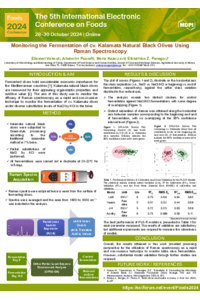
Kalamata table olives are of great significance for the economy of the table olive industry in Greece. Consequently, it is crucial to monitor the fermentation process of cv. Kalamata table olives to ensure product quality and safety. This study aims to evaluate the efficiency of Raman spectroscopy, as a rapid and non-destructive analytical technique, in monitoring the table olive fermentation process. For this purpose, natural cv. Kalamata black olives were fermented according to industrial practice in 7% (w/v) NaCl salt for 145 days. Four substitution levels of NaCl by KCl were performed: namely 0, 25, 50, and 75% (w/v). Raman spectra were acquired from the surface of olives from four spots of three different olive fruits sampled from each fermentation vessel. The spectra were analyzed using Partial Least Squares Regression (PLS-R) in order to correlate spectral information with the population of lactic acid bacteria (LAB) and yeasts, pH changes, and lactic acid concentration in terms of titratable acidity measurements. Orthogonal Partial Least Squares Discriminant Analysis (Ortho PLS-DA) was also employed to discriminate among the olive fruits fermented exclusively in NaCl against those fermented in different NaCl substitution levels. The most efficient PLS-R models provided R2 and RMSE scores for Cross Validation of 0.65 and 0.81, 0.44 and 0.58, 0.63 and 0.39,and 0.56 and 0.11 for LAB, yeasts, pH, and % lactic acid, respectively. Ortho PLS-DA successfully discriminated olive samples fermented in NaCl from olive samples fermented in various levels of NaCl substitution by KCl. Overall, the results obtained in this work provided promising perspectives for the use of Raman spectroscopy as a rapid and non-invasive technique to monitor table olive fermentation.
Acknowledgements: This work was funded by the Greek Ministry for Rural Development and Food, General Secretariat of Union Resources and Infrastructure, Special Agricultural Development Program (RAP) 2014-2022 (contract number Μ16ΣΥΝ-01086).
Keywords
Raman
table olives
Kalamata cultivar
fermentation
Poster
poster salt reduction.pdf
OPTIMIZATION OF POLYMER CONCENTRATION AND ELECTROSPINNING PARAMETERS TO DEVELOP A NANOFIBROUS MEMBRANE
A systematic review of the factors influencing the co-occurrence of wasting, stunting, and underweight in children under five who suffer from severe acute malnutrition in low- and middle-income countries