Event submissions
Published
This submission belongs to the session S1. Innovation in Food Technology and Engineering of the event The 5th International Electronic Conference on Foods
Published date
25 Oct, 2024
Academic Editor
'%3e%3cpath%20d='M12.6657%2010.9104C12.4185%2010.325%2012.0599%209.79327%2011.6097%209.34482C11.1609%208.89508%2010.6293%208.5365%2010.0442%208.28888C10.0389%208.28626%2010.0337%208.28495%2010.0285%208.28233C10.8446%207.69279%2011.3752%206.73249%2011.3752%205.64904C11.3752%203.8542%209.92103%202.39999%208.1262%202.39999C6.33136%202.39999%204.87715%203.8542%204.87715%205.64904C4.87715%206.73249%205.40774%207.69279%206.22393%208.28364C6.21869%208.28626%206.21345%208.28757%206.20821%208.29019C5.62129%208.5378%205.09463%208.89284%204.64265%209.34613C4.1929%209.79493%203.83432%2010.3266%203.58671%2010.9117C3.34345%2011.4845%203.21226%2012.0987%203.20023%2012.7209C3.19988%2012.7349%203.20233%2012.7488%203.20744%2012.7619C3.21255%2012.7749%203.22022%2012.7867%203.22998%2012.7968C3.23975%2012.8068%203.25142%2012.8147%203.26431%2012.8202C3.2772%2012.8256%203.29105%2012.8284%203.30504%2012.8284H4.09109C4.14874%2012.8284%204.19459%2012.7825%204.1959%2012.7262C4.2221%2011.7148%204.62823%2010.7676%205.34617%2010.0497C6.08899%209.30683%207.0755%208.89808%208.1262%208.89808C9.17689%208.89808%2010.1634%209.30683%2010.9062%2010.0497C11.6242%2010.7676%2012.0303%2011.7148%2012.0565%2012.7262C12.0578%2012.7838%2012.1037%2012.8284%2012.1613%2012.8284H12.9474C12.9613%2012.8284%2012.9752%2012.8256%2012.9881%2012.8202C13.001%2012.8147%2013.0126%2012.8068%2013.0224%2012.7968C13.0322%2012.7867%2013.0398%2012.7749%2013.0449%2012.7619C13.0501%2012.7488%2013.0525%2012.7349%2013.0522%2012.7209C13.0391%2012.0947%2012.9094%2011.4855%2012.6657%2010.9104ZM8.1262%207.9024C7.52486%207.9024%206.9589%207.6679%206.53312%207.24211C6.10733%206.81633%205.87283%206.25037%205.87283%205.64904C5.87283%205.0477%206.10733%204.48174%206.53312%204.05596C6.9589%203.63018%207.52486%203.39567%208.1262%203.39567C8.72753%203.39567%209.29349%203.63018%209.71927%204.05596C10.1451%204.48174%2010.3796%205.0477%2010.3796%205.64904C10.3796%206.25037%2010.1451%206.81633%209.71927%207.24211C9.29349%207.6679%208.72753%207.9024%208.1262%207.9024Z'%20fill='%235D1EE1'/%3e%3c/g%3e%3c/svg%3e) Moktar Hamdi
Moktar HamdiCitation
Kiranbeer kaur, Barinderjeet Singh, Ankita Kataria, Advancements in Legume Processing: A Comprehensive Review of Non-Conventional and Emerging Technologies, in Proceedings of The 5th International Electronic Conference on Foods, 28 October–30 October 2024, MDPI: Basel, Switzerland
Share
Email
Facebook
Twitter
LinkedIn
Advancements in Legume Processing: A Comprehensive Review of Non-Conventional and Emerging Technologies

Kiranbeer kaur 1,2
'%3e%3cpath%20d='M12.6647%2010.9104C12.4176%2010.325%2012.0589%209.7933%2011.6088%209.34485C11.16%208.89511%2010.6283%208.53653%2010.0432%208.28891C10.038%208.28629%2010.0327%208.28498%2010.0275%208.28236C10.8437%207.69282%2011.3743%206.73252%2011.3743%205.64907C11.3743%203.85423%209.92005%202.40002%208.12522%202.40002C6.33038%202.40002%204.87618%203.85423%204.87618%205.64907C4.87618%206.73252%205.40677%207.69282%206.22296%208.28367C6.21772%208.28629%206.21248%208.2876%206.20724%208.29022C5.62031%208.53783%205.09365%208.89287%204.64167%209.34616C4.19192%209.79496%203.83334%2010.3266%203.58573%2010.9117C3.34247%2011.4846%203.21128%2012.0987%203.19925%2012.721C3.1989%2012.735%203.20135%2012.7489%203.20646%2012.7619C3.21157%2012.7749%203.21924%2012.7868%203.22901%2012.7968C3.23877%2012.8068%203.25045%2012.8148%203.26334%2012.8202C3.27623%2012.8256%203.29007%2012.8284%203.30406%2012.8284H4.09012C4.14776%2012.8284%204.19362%2012.7825%204.19493%2012.7262C4.22113%2011.7148%204.62726%2010.7676%205.34519%2010.0497C6.08802%209.30686%207.07452%208.89811%208.12522%208.89811C9.17592%208.89811%2010.1624%209.30686%2010.9052%2010.0497C11.6232%2010.7676%2012.0293%2011.7148%2012.0555%2012.7262C12.0568%2012.7839%2012.1027%2012.8284%2012.1603%2012.8284H12.9464C12.9604%2012.8284%2012.9742%2012.8256%2012.9871%2012.8202C13%2012.8148%2013.0117%2012.8068%2013.0214%2012.7968C13.0312%2012.7868%2013.0389%2012.7749%2013.044%2012.7619C13.0491%2012.7489%2013.0515%2012.735%2013.0512%2012.721C13.0381%2012.0947%2012.9084%2011.4856%2012.6647%2010.9104ZM8.12522%207.90243C7.52388%207.90243%206.95792%207.66793%206.53214%207.24215C6.10636%206.81636%205.87185%206.2504%205.87185%205.64907C5.87185%205.04773%206.10636%204.48177%206.53214%204.05599C6.95792%203.63021%207.52388%203.3957%208.12522%203.3957C8.72655%203.3957%209.29252%203.63021%209.7183%204.05599C10.1441%204.48177%2010.3786%205.04773%2010.3786%205.64907C10.3786%206.2504%2010.1441%206.81636%209.7183%207.24215C9.29252%207.66793%208.72655%207.90243%208.12522%207.90243Z'%20fill='%235D1EE1'/%3e%3c/g%3e%3c/svg%3e)
Barinderjeet Singh 3
Ankita Kataria 3
1. Department of Food Science and Technology ,
Maharaja Ranjit Singh Punjab Technical University
Bathinda, Punjab
2. Ph.D Scholar
3. Department of Food Science and Technology,
Maharaja Ranjit Singh Punjab Technical University
Bathinda, Punjab
Abstract
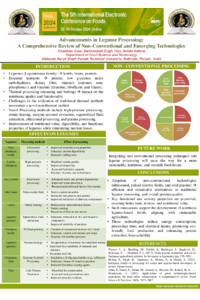
Legumes are widely grown and consumed all over the world. Legumes are crucial in global agriculture and nutrition due to their high protein, fiber, and micronutrient content. Beyond these nutritional factors, legumes are rich in plant bioactive compounds like phenolic and flavonoid content, which have very beneficial impacts on human health. However, traditional processing methods often result in nutrient loss and suboptimal product quality. Novel food processing technologies have arisen as a result of consumers’ desire for safe, tasty, fresh, and mildly processed food products with long shelf lives and maintained quality. Ultrasound technology involves the use of ultrasound waves to disrupt cell walls and enhance the extraction of bioactive compounds, such as proteins, from legumes. High-pressure processing can alter protein structures, improving digestibility and functional properties such as emulsification and gelation. This process also helps in reducing anti-nutritional factors, enhancing the bioavailability of nutrients, and extending the shelf life of legume-based products. Ohmic heating is a direct heating method that minimizes energy loss compared to that observed in traditional methods. Supercritical fluid extraction utilizes CO2 at a high pressures to extract compounds from legumes, yielding high-quality extracts without leaving solvent residues. It is valued for its selectivity, efficiency, and environmental friendliness in extracting bioactive components from legumes. Enzyme-assisted extraction harnesses the function of enzymes to enhance the extraction of bioactive compounds from legumes, improving yield and purity while reducing processing time and energy consumption. Plasma processing modifies legume surfaces to enhance functional properties and microbial safety, leading to promising food packaging and preservation applications. Emerging technologies like 3D food printing, vacuum frying, and nanotechnology offer innovative ways to create novel legume-based products with precise structures, enhanced flavours, and improved nutritional profiles, catering to diverse consumer preferences for sustainability. These novel techniques prolong the shelf life, enhancing or maintaining the quality, and regulating the freshness of legume products.
Keywords
Legumes
non-conventional
processing
Processing technologies
emerging technologies
Poster
Mdpi poster.pdf
Effect of a nutritional intervention using a combination of perspective theories and expected utility on the use of orange-fleshed sweet potato among women of childbearing age of the commune of Zè in Benin
Antimicrobial Resistance Genes in Vegetables Fertilized with Pig Manure: A Bibliographic Review on Food Safety