Event submissions
Published
This submission belongs to the session S5. Chemistry and Physicochemical Properties of Foods of the event The 5th International Electronic Conference on Foods
Published date
25 Oct, 2024
Academic Editor
'%3e%3cpath%20d='M12.6657%2010.9104C12.4185%2010.325%2012.0599%209.79327%2011.6097%209.34482C11.1609%208.89508%2010.6293%208.5365%2010.0442%208.28888C10.0389%208.28626%2010.0337%208.28495%2010.0285%208.28233C10.8446%207.69279%2011.3752%206.73249%2011.3752%205.64904C11.3752%203.8542%209.92103%202.39999%208.1262%202.39999C6.33136%202.39999%204.87715%203.8542%204.87715%205.64904C4.87715%206.73249%205.40774%207.69279%206.22393%208.28364C6.21869%208.28626%206.21345%208.28757%206.20821%208.29019C5.62129%208.5378%205.09463%208.89284%204.64265%209.34613C4.1929%209.79493%203.83432%2010.3266%203.58671%2010.9117C3.34345%2011.4845%203.21226%2012.0987%203.20023%2012.7209C3.19988%2012.7349%203.20233%2012.7488%203.20744%2012.7619C3.21255%2012.7749%203.22022%2012.7867%203.22998%2012.7968C3.23975%2012.8068%203.25142%2012.8147%203.26431%2012.8202C3.2772%2012.8256%203.29105%2012.8284%203.30504%2012.8284H4.09109C4.14874%2012.8284%204.19459%2012.7825%204.1959%2012.7262C4.2221%2011.7148%204.62823%2010.7676%205.34617%2010.0497C6.08899%209.30683%207.0755%208.89808%208.1262%208.89808C9.17689%208.89808%2010.1634%209.30683%2010.9062%2010.0497C11.6242%2010.7676%2012.0303%2011.7148%2012.0565%2012.7262C12.0578%2012.7838%2012.1037%2012.8284%2012.1613%2012.8284H12.9474C12.9613%2012.8284%2012.9752%2012.8256%2012.9881%2012.8202C13.001%2012.8147%2013.0126%2012.8068%2013.0224%2012.7968C13.0322%2012.7867%2013.0398%2012.7749%2013.0449%2012.7619C13.0501%2012.7488%2013.0525%2012.7349%2013.0522%2012.7209C13.0391%2012.0947%2012.9094%2011.4855%2012.6657%2010.9104ZM8.1262%207.9024C7.52486%207.9024%206.9589%207.6679%206.53312%207.24211C6.10733%206.81633%205.87283%206.25037%205.87283%205.64904C5.87283%205.0477%206.10733%204.48174%206.53312%204.05596C6.9589%203.63018%207.52486%203.39567%208.1262%203.39567C8.72753%203.39567%209.29349%203.63018%209.71927%204.05596C10.1451%204.48174%2010.3796%205.0477%2010.3796%205.64904C10.3796%206.25037%2010.1451%206.81633%209.71927%207.24211C9.29349%207.6679%208.72753%207.9024%208.1262%207.9024Z'%20fill='%235D1EE1'/%3e%3c/g%3e%3c/svg%3e) Joana Amaral
Joana AmaralCitation
Anna Ferrandis Rosell, Emanuela Marchese, Jesús Blesa, Daniel Lopez-Malo, Ana Frígola, María José Esteve, PREDICTION AND VALIDATION OF THE SOLUBILITY OF DATE SEED PHYTOSTEROLS USING HYDROPHOBIC NATURAL DEEP EUTECTIC SOLVENTS, in Proceedings of The 5th International Electronic Conference on Foods, 28 October–30 October 2024, MDPI: Basel, Switzerland
Share
Email
Facebook
Twitter
LinkedIn
PREDICTION AND VALIDATION OF THE SOLUBILITY OF DATE SEED PHYTOSTEROLS USING HYDROPHOBIC NATURAL DEEP EUTECTIC SOLVENTS
'%3e%3cpath%20d='M12.6647%2010.9104C12.4176%2010.325%2012.0589%209.7933%2011.6088%209.34485C11.16%208.89511%2010.6283%208.53653%2010.0432%208.28891C10.038%208.28629%2010.0327%208.28498%2010.0275%208.28236C10.8437%207.69282%2011.3743%206.73252%2011.3743%205.64907C11.3743%203.85423%209.92005%202.40002%208.12522%202.40002C6.33038%202.40002%204.87618%203.85423%204.87618%205.64907C4.87618%206.73252%205.40677%207.69282%206.22296%208.28367C6.21772%208.28629%206.21248%208.2876%206.20724%208.29022C5.62031%208.53783%205.09365%208.89287%204.64167%209.34616C4.19192%209.79496%203.83334%2010.3266%203.58573%2010.9117C3.34247%2011.4846%203.21128%2012.0987%203.19925%2012.721C3.1989%2012.735%203.20135%2012.7489%203.20646%2012.7619C3.21157%2012.7749%203.21924%2012.7868%203.22901%2012.7968C3.23877%2012.8068%203.25045%2012.8148%203.26334%2012.8202C3.27623%2012.8256%203.29007%2012.8284%203.30406%2012.8284H4.09012C4.14776%2012.8284%204.19362%2012.7825%204.19493%2012.7262C4.22113%2011.7148%204.62726%2010.7676%205.34519%2010.0497C6.08802%209.30686%207.07452%208.89811%208.12522%208.89811C9.17592%208.89811%2010.1624%209.30686%2010.9052%2010.0497C11.6232%2010.7676%2012.0293%2011.7148%2012.0555%2012.7262C12.0568%2012.7839%2012.1027%2012.8284%2012.1603%2012.8284H12.9464C12.9604%2012.8284%2012.9742%2012.8256%2012.9871%2012.8202C13%2012.8148%2013.0117%2012.8068%2013.0214%2012.7968C13.0312%2012.7868%2013.0389%2012.7749%2013.044%2012.7619C13.0491%2012.7489%2013.0515%2012.735%2013.0512%2012.721C13.0381%2012.0947%2012.9084%2011.4856%2012.6647%2010.9104ZM8.12522%207.90243C7.52388%207.90243%206.95792%207.66793%206.53214%207.24215C6.10636%206.81636%205.87185%206.2504%205.87185%205.64907C5.87185%205.04773%206.10636%204.48177%206.53214%204.05599C6.95792%203.63021%207.52388%203.3957%208.12522%203.3957C8.72655%203.3957%209.29252%203.63021%209.7183%204.05599C10.1441%204.48177%2010.3786%205.04773%2010.3786%205.64907C10.3786%206.2504%2010.1441%206.81636%209.7183%207.24215C9.29252%207.66793%208.72655%207.90243%208.12522%207.90243Z'%20fill='%235D1EE1'/%3e%3c/g%3e%3c/svg%3e)
Anna Ferrandis Rosell 1

Emanuela Marchese 2

Jesús Blesa 1

Daniel Lopez-Malo 3
Ana Frígola 1

María José Esteve 1
1. Nutrition and Food Chemistry, University of Valencia. Avda. Vicent Andrés Estellés, S/n, 46100, Burjassot (Valencia), Spain
2. Department of health sciences, University “Magna Graecia”, Catanzaro, Italy
3. Faculty of Health Sciences, Universidad Europea de Valencia, Paseo de La Alameda, 7, 46010, Valencia (Valencia), Spain
Abstract
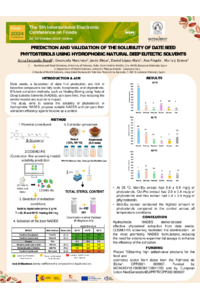
Introduction: Date seeds, a by-product of date fruit production, are rich in bioactive compounds like fatty acids, tocopherols, and phytosterols. Efficient extraction methods, such as Heating--Stirring (HS) using Natural Deep Eutectic Solvents (NADES), can save time, thus reducing the environmental and economic impact. This study aims to assess the solubility of phytosterols in hydrophobic NADES, propose suitable NADES and compare their extraction efficiency against hexane as a control.
Methods: The solubility prediction was performed using the conductor-like screening model for the real solvent (COSMO-RS). For the extraction of phytosterols, HS was used under optimal extraction conditions previously determined by the Response Surface Methodology: a 1/3 (w/v) solid to liquid ratio and 45 minutes duration. Different temperatures (25, 45, and 65 ºC) were tested to analyse differences in sterol content. The Total Sterol Content (TSC) in the extracts was measured using the colorimetric method Farbtest (R-Biopharm-AG) expressed in mg/g of dry date seed powder.
Results: After screening several NADES in COSMO-RS, five NADES with different molar ratios were selected: Menthol/Eucalyptol (Men:Eu, 1:1), Menthol/Lauric acid (Men:LA, 4:1), Menthol/Lactic acid (Men:Lact, 1:2), Octanoic acid/L-Proline (4:1), and Octanoic acid/Lauric acid (3:1). Hexane (Hex) was used as a control. Analysing both the in silico and experimental models, the Men:Eu extract contained the highest amount of phytosterols compared to the control in all temperature conditions. At 25 ºC, Men:Eu (8.6 ± 0.9 mg/g) and Oct:Pro (2.0 ± 0.4 mg/g) showed significant differences with Hex (0.4 ± 0.0 mg/g). In recent studies on date seed oil, TSCs were found to be between 5.4 and 7.9 mg/g.
Conclusions: Hydrophobic NADES demonstrated effective phytosterol extraction from date seeds. COSMO-RS screening facilitated the identification of the most promising NADES formulations, reducing the need for extensive experimental assays to enhance the efficiency of the extraction.
Keywords
Green extraction
NADES
sterols
date seed
COSMO-RS prediction
Poster
FOODS 2024. FERRANDIS ROSELL, ANNA.pdf
Antimicrobial Resistance Genes in Vegetables Fertilized with Pig Manure: A Bibliographic Review on Food Safety
Up-to-date and comprehensive data on the evolving consumption patterns of energy drinks: in search of a nutrigenomics approach