Event submissions
Published
This submission belongs to the session S2. Food Nutrition and Functional Foods of the event The 5th International Electronic Conference on Foods
Published date
25 Oct, 2024
Academic Editor
'%3e%3cpath%20d='M12.6657%2010.9104C12.4185%2010.325%2012.0599%209.79327%2011.6097%209.34482C11.1609%208.89508%2010.6293%208.5365%2010.0442%208.28888C10.0389%208.28626%2010.0337%208.28495%2010.0285%208.28233C10.8446%207.69279%2011.3752%206.73249%2011.3752%205.64904C11.3752%203.8542%209.92103%202.39999%208.1262%202.39999C6.33136%202.39999%204.87715%203.8542%204.87715%205.64904C4.87715%206.73249%205.40774%207.69279%206.22393%208.28364C6.21869%208.28626%206.21345%208.28757%206.20821%208.29019C5.62129%208.5378%205.09463%208.89284%204.64265%209.34613C4.1929%209.79493%203.83432%2010.3266%203.58671%2010.9117C3.34345%2011.4845%203.21226%2012.0987%203.20023%2012.7209C3.19988%2012.7349%203.20233%2012.7488%203.20744%2012.7619C3.21255%2012.7749%203.22022%2012.7867%203.22998%2012.7968C3.23975%2012.8068%203.25142%2012.8147%203.26431%2012.8202C3.2772%2012.8256%203.29105%2012.8284%203.30504%2012.8284H4.09109C4.14874%2012.8284%204.19459%2012.7825%204.1959%2012.7262C4.2221%2011.7148%204.62823%2010.7676%205.34617%2010.0497C6.08899%209.30683%207.0755%208.89808%208.1262%208.89808C9.17689%208.89808%2010.1634%209.30683%2010.9062%2010.0497C11.6242%2010.7676%2012.0303%2011.7148%2012.0565%2012.7262C12.0578%2012.7838%2012.1037%2012.8284%2012.1613%2012.8284H12.9474C12.9613%2012.8284%2012.9752%2012.8256%2012.9881%2012.8202C13.001%2012.8147%2013.0126%2012.8068%2013.0224%2012.7968C13.0322%2012.7867%2013.0398%2012.7749%2013.0449%2012.7619C13.0501%2012.7488%2013.0525%2012.7349%2013.0522%2012.7209C13.0391%2012.0947%2012.9094%2011.4855%2012.6657%2010.9104ZM8.1262%207.9024C7.52486%207.9024%206.9589%207.6679%206.53312%207.24211C6.10733%206.81633%205.87283%206.25037%205.87283%205.64904C5.87283%205.0477%206.10733%204.48174%206.53312%204.05596C6.9589%203.63018%207.52486%203.39567%208.1262%203.39567C8.72753%203.39567%209.29349%203.63018%209.71927%204.05596C10.1451%204.48174%2010.3796%205.0477%2010.3796%205.64904C10.3796%206.25037%2010.1451%206.81633%209.71927%207.24211C9.29349%207.6679%208.72753%207.9024%208.1262%207.9024Z'%20fill='%235D1EE1'/%3e%3c/g%3e%3c/svg%3e) Antonello Santini
Antonello SantiniCitation
Aida Zapico, Patricia López-Suárez, Silvia Arboleya, Nuria Salazar, Sergio Ruiz-Saavedra, Clara G. de los Reyes-Gavilán, Ana Suárez, Miguel Gueimonde, Sonia González, A 4-week Mediterranean type diet intervention ameliorated the immunological profile of vulnerable individuals., in Proceedings of The 5th International Electronic Conference on Foods, 28 October–30 October 2024, MDPI: Basel, Switzerland
Share
Email
Facebook
Twitter
LinkedIn
A 4-week Mediterranean type diet intervention ameliorated the immunological profile of vulnerable individuals.
'%3e%3cpath%20d='M12.6647%2010.9104C12.4176%2010.325%2012.0589%209.7933%2011.6088%209.34485C11.16%208.89511%2010.6283%208.53653%2010.0432%208.28891C10.038%208.28629%2010.0327%208.28498%2010.0275%208.28236C10.8437%207.69282%2011.3743%206.73252%2011.3743%205.64907C11.3743%203.85423%209.92005%202.40002%208.12522%202.40002C6.33038%202.40002%204.87618%203.85423%204.87618%205.64907C4.87618%206.73252%205.40677%207.69282%206.22296%208.28367C6.21772%208.28629%206.21248%208.2876%206.20724%208.29022C5.62031%208.53783%205.09365%208.89287%204.64167%209.34616C4.19192%209.79496%203.83334%2010.3266%203.58573%2010.9117C3.34247%2011.4846%203.21128%2012.0987%203.19925%2012.721C3.1989%2012.735%203.20135%2012.7489%203.20646%2012.7619C3.21157%2012.7749%203.21924%2012.7868%203.22901%2012.7968C3.23877%2012.8068%203.25045%2012.8148%203.26334%2012.8202C3.27623%2012.8256%203.29007%2012.8284%203.30406%2012.8284H4.09012C4.14776%2012.8284%204.19362%2012.7825%204.19493%2012.7262C4.22113%2011.7148%204.62726%2010.7676%205.34519%2010.0497C6.08802%209.30686%207.07452%208.89811%208.12522%208.89811C9.17592%208.89811%2010.1624%209.30686%2010.9052%2010.0497C11.6232%2010.7676%2012.0293%2011.7148%2012.0555%2012.7262C12.0568%2012.7839%2012.1027%2012.8284%2012.1603%2012.8284H12.9464C12.9604%2012.8284%2012.9742%2012.8256%2012.9871%2012.8202C13%2012.8148%2013.0117%2012.8068%2013.0214%2012.7968C13.0312%2012.7868%2013.0389%2012.7749%2013.044%2012.7619C13.0491%2012.7489%2013.0515%2012.735%2013.0512%2012.721C13.0381%2012.0947%2012.9084%2011.4856%2012.6647%2010.9104ZM8.12522%207.90243C7.52388%207.90243%206.95792%207.66793%206.53214%207.24215C6.10636%206.81636%205.87185%206.2504%205.87185%205.64907C5.87185%205.04773%206.10636%204.48177%206.53214%204.05599C6.95792%203.63021%207.52388%203.3957%208.12522%203.3957C8.72655%203.3957%209.29252%203.63021%209.7183%204.05599C10.1441%204.48177%2010.3786%205.04773%2010.3786%205.64907C10.3786%206.2504%2010.1441%206.81636%209.7183%207.24215C9.29252%207.66793%208.72655%207.90243%208.12522%207.90243Z'%20fill='%235D1EE1'/%3e%3c/g%3e%3c/svg%3e)
Aida Zapico 1,2
Patricia López-Suárez 1
Silvia Arboleya 2,3
Nuria Salazar 2,3
Sergio Ruiz-Saavedra 2,3
Clara G. de los Reyes-Gavilán 2,3
Ana Suárez 1
Miguel Gueimonde 2,3
Sonia González 1,2
1. Department of Functional Biology, University of Oviedo, 33006 Oviedo, Spain
2. Diet, Microbiota and Health Group, Instituto de Investigación Sanitaria del Principado de Asturias (ISPA),33011 Oviedo, Spain
3. Department of Microbiology and Biochemistry of Dairy Products, Instituto de Productos Lácteos de Asturias (IPLA-CSIC), 33300 Villaviciosa, Spain
Abstract
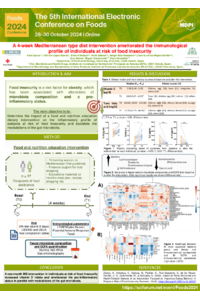
Introduction: Due to the increasing cost of nutrient-dense foods, food-insecure populations present a limited access to these products and a greater risk of obesity, which has been associated with alterations of microbiota composition and a pro-inflammatory status. Objective: Determine the impact of a food and nutrition education dietary intervention on the inflammatory profile of materially vulnerable individuals and elucidate the modulations of the gut microbiota. Methods: Seventeen adults regularly receiving food assistance from Red Cross were recruited (Ethical committee: CEImPA2021.307). A one-month dietary intervention was conducted consisting of the provision to each volunteer of 1-hour educational training on MD recommendations based on the PREDIMED criteria along with educational materials (a monthly meal plan, a shopping list and recipes) and financial support for fresh foods purchasing. Nutritional assessment, blood and stool analysis were performed at baseline and after intervention. Dietary intake was recorded through 3 non-consecutive 24-hour food diaries and analysed using food composition tables (CESNID and USDA). Plasma cytokines were assessed with the Human Essential Immune Response Panel. Faecal microbiota and short chain fatty acids were determined by 16S rRNA gene sequencing and gas chromatography. Results: After the intervention, a higher concentration of the interleukin (IL)-10 (by 12%) was detected, along with lower levels of IL-2 and IL-12 (by 34 and 35%). In addition, the intake of vitamin D was increased after the intervention and displayed direct associations with the relative abundance of Roseburia and Ruminoccocus torques group, which were also increased at the end of the study. Finally, the faecal levels of caproic acid were reduced (by 22%) at the end of this work and positive associations were found between its excretion levels and IL-2 and IL-12. Conclusion: One-month intervention based on MD guidelines in vulnerable individuals ameliorated the pro-inflammatory status in parallel to modulations of the gut microbiota.
Keywords
food insecurity
sustainable diet
mediterranean diet
food and nutrition intervention
inflammation
gut microbiota
Poster
Foods_AZL_.pdf
Nano-Fortification of Flour for The Effective Management of Nutritional Deficiencies
The Bioactivity of byproducts from the blackberry juice industry