Event submissions
Published
This submission belongs to the session S2. Food Nutrition and Functional Foods of the event The 5th International Electronic Conference on Foods
Published date
25 Oct, 2024
Academic Editor
'%3e%3cpath%20d='M12.6657%2010.9104C12.4185%2010.325%2012.0599%209.79327%2011.6097%209.34482C11.1609%208.89508%2010.6293%208.5365%2010.0442%208.28888C10.0389%208.28626%2010.0337%208.28495%2010.0285%208.28233C10.8446%207.69279%2011.3752%206.73249%2011.3752%205.64904C11.3752%203.8542%209.92103%202.39999%208.1262%202.39999C6.33136%202.39999%204.87715%203.8542%204.87715%205.64904C4.87715%206.73249%205.40774%207.69279%206.22393%208.28364C6.21869%208.28626%206.21345%208.28757%206.20821%208.29019C5.62129%208.5378%205.09463%208.89284%204.64265%209.34613C4.1929%209.79493%203.83432%2010.3266%203.58671%2010.9117C3.34345%2011.4845%203.21226%2012.0987%203.20023%2012.7209C3.19988%2012.7349%203.20233%2012.7488%203.20744%2012.7619C3.21255%2012.7749%203.22022%2012.7867%203.22998%2012.7968C3.23975%2012.8068%203.25142%2012.8147%203.26431%2012.8202C3.2772%2012.8256%203.29105%2012.8284%203.30504%2012.8284H4.09109C4.14874%2012.8284%204.19459%2012.7825%204.1959%2012.7262C4.2221%2011.7148%204.62823%2010.7676%205.34617%2010.0497C6.08899%209.30683%207.0755%208.89808%208.1262%208.89808C9.17689%208.89808%2010.1634%209.30683%2010.9062%2010.0497C11.6242%2010.7676%2012.0303%2011.7148%2012.0565%2012.7262C12.0578%2012.7838%2012.1037%2012.8284%2012.1613%2012.8284H12.9474C12.9613%2012.8284%2012.9752%2012.8256%2012.9881%2012.8202C13.001%2012.8147%2013.0126%2012.8068%2013.0224%2012.7968C13.0322%2012.7867%2013.0398%2012.7749%2013.0449%2012.7619C13.0501%2012.7488%2013.0525%2012.7349%2013.0522%2012.7209C13.0391%2012.0947%2012.9094%2011.4855%2012.6657%2010.9104ZM8.1262%207.9024C7.52486%207.9024%206.9589%207.6679%206.53312%207.24211C6.10733%206.81633%205.87283%206.25037%205.87283%205.64904C5.87283%205.0477%206.10733%204.48174%206.53312%204.05596C6.9589%203.63018%207.52486%203.39567%208.1262%203.39567C8.72753%203.39567%209.29349%203.63018%209.71927%204.05596C10.1451%204.48174%2010.3796%205.0477%2010.3796%205.64904C10.3796%206.25037%2010.1451%206.81633%209.71927%207.24211C9.29349%207.6679%208.72753%207.9024%208.1262%207.9024Z'%20fill='%235D1EE1'/%3e%3c/g%3e%3c/svg%3e) Manuel Viuda-Martos
Manuel Viuda-MartosCitation
Daniela Moreno, Mariela Ana Pontin, Leonardo Bolcato, Patricia Piccoli, Ruben Bottini, Amino acids profile and nutritional value of processed tomato by-products, in Proceedings of The 5th International Electronic Conference on Foods, 28 October–30 October 2024, MDPI: Basel, Switzerland
Share
Email
Facebook
Twitter
LinkedIn
Amino acids profile and nutritional value of processed tomato by-products
'%3e%3cpath%20d='M12.6647%2010.9104C12.4176%2010.325%2012.0589%209.7933%2011.6088%209.34485C11.16%208.89511%2010.6283%208.53653%2010.0432%208.28891C10.038%208.28629%2010.0327%208.28498%2010.0275%208.28236C10.8437%207.69282%2011.3743%206.73252%2011.3743%205.64907C11.3743%203.85423%209.92005%202.40002%208.12522%202.40002C6.33038%202.40002%204.87618%203.85423%204.87618%205.64907C4.87618%206.73252%205.40677%207.69282%206.22296%208.28367C6.21772%208.28629%206.21248%208.2876%206.20724%208.29022C5.62031%208.53783%205.09365%208.89287%204.64167%209.34616C4.19192%209.79496%203.83334%2010.3266%203.58573%2010.9117C3.34247%2011.4846%203.21128%2012.0987%203.19925%2012.721C3.1989%2012.735%203.20135%2012.7489%203.20646%2012.7619C3.21157%2012.7749%203.21924%2012.7868%203.22901%2012.7968C3.23877%2012.8068%203.25045%2012.8148%203.26334%2012.8202C3.27623%2012.8256%203.29007%2012.8284%203.30406%2012.8284H4.09012C4.14776%2012.8284%204.19362%2012.7825%204.19493%2012.7262C4.22113%2011.7148%204.62726%2010.7676%205.34519%2010.0497C6.08802%209.30686%207.07452%208.89811%208.12522%208.89811C9.17592%208.89811%2010.1624%209.30686%2010.9052%2010.0497C11.6232%2010.7676%2012.0293%2011.7148%2012.0555%2012.7262C12.0568%2012.7839%2012.1027%2012.8284%2012.1603%2012.8284H12.9464C12.9604%2012.8284%2012.9742%2012.8256%2012.9871%2012.8202C13%2012.8148%2013.0117%2012.8068%2013.0214%2012.7968C13.0312%2012.7868%2013.0389%2012.7749%2013.044%2012.7619C13.0491%2012.7489%2013.0515%2012.735%2013.0512%2012.721C13.0381%2012.0947%2012.9084%2011.4856%2012.6647%2010.9104ZM8.12522%207.90243C7.52388%207.90243%206.95792%207.66793%206.53214%207.24215C6.10636%206.81636%205.87185%206.2504%205.87185%205.64907C5.87185%205.04773%206.10636%204.48177%206.53214%204.05599C6.95792%203.63021%207.52388%203.3957%208.12522%203.3957C8.72655%203.3957%209.29252%203.63021%209.7183%204.05599C10.1441%204.48177%2010.3786%205.04773%2010.3786%205.64907C10.3786%206.2504%2010.1441%206.81636%209.7183%207.24215C9.29252%207.66793%208.72655%207.90243%208.12522%207.90243Z'%20fill='%235D1EE1'/%3e%3c/g%3e%3c/svg%3e)
Daniela Moreno 1,2
Mariela Ana Pontin 3,4
Leonardo Bolcato 5
Patricia Piccoli 2
Ruben Bottini 6,7
1. Facultad de Ciencias Agrarias, Instituto de Biología Agrícola de Mendoza, Consejo Nacional de Investigaciones Científicas y Tecnológicas-Universidad Nacional de Cuyo, Almirante Brown 500, M5528AHB, Chacras de Coria, Argentina
2. Laboratorio de Bioquímica Vegetal, Instituto de Biología Agrícola de Mendoza (IBAM), Consejo Nacional de Investigaciones Científicas y Técnicas (CONICET)–Universidad Nacional de Cuyo, M5528AHB Chacras de Coria, Mendoza, Argentina
3. Estación Experimental Agropecuaria La Consulta INTA, cc8 (5567) La Consulta, San Carlos, Mendoza, Argentina
4. Universidad Nacional de Cuyo, Almirante Brown 500, M5528AHB, Chacras de Coria, Argentina
5. Instituto de Biología Agrícola de Mendoza, Consejo Nacional de Investigaciones Científicas y Tecnológicas-Universidad Nacional de Cuyo, Almirante Brown 500, M5528AHB, Chacras de Coria, Argentina
6. Laboratorio de Bioquímica Vegetal, Instituto de Biología Agrícola de Mendoza (IBAM), Facultad de Ciencias Agrarias, Consejo Nacional de Investigaciones Científicas y Técnicas (CONICET)–UNCuyo, M5528AHB Chacras de Coria, Mendoza, Argentina
7. Universidad Juan A. Maza, Área de Ciencia y Técnica, 5519 Guaymallén, Mendoza, Argentina
Abstract
Tomato by-products, such as its fresh fruit, contain bioactive compounds with beneficial properties for human health. The analysis of these bioactive compounds provides relevant information that promotes the valorization of these by-products. Amino acids are considered to be compounds with a high nutritional value.
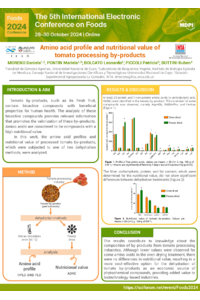
In this work, the amino acid (aa) profiles and nutritional values of processed tomato by-products, which were subjected to one of two dehydration methods—at 60 °C in a hot air circulation oven (OD) or freeze-drying (FD)—were analyzed using HPLC-DAD-FLD and AOAC, respectively. In total, 20 protein and 1 non-protein amino acids (γ-aminobutyric acid, GABA) were identified in the tomato by-products.
The co-elution of some compounds was observed, namely Asp+Glu, GABA+Pro, and Ile+Leu. Asp+Glu was the most abundant, followed by Gln, Arg, Tyr, and GABA+Pro. The OD treatment reduced the percentage of Gln (14.68%), Gly (10.88%), GABA+Pro (14.40%), Met (10.00%), Val (8.80%), Phe (13.07%), Trp (10.43%), Ile+Leu (11.05%), His (10.64%), and Lys (17.91%), while it increased that of Tyr (9.08%) compared to the FD method, in which no significant differences were observed in the other amino acids. Nevertheless, the OD treatment showed a higher percentage of essential amino acids (21.8%) compared to the FD treatment (20.5%). The decreased aa content in the OD treatment may be attributed to the temperature effect on the drying process. The fiber, carbohydrate, protein, and fat content, which were determined for the nutritional value, did not show significant differences between dehydration treatments.
The results contribute to knowledge about the composition of by-products from tomato processing industries. Although lower values were observed for some amino acids in the oven drying treatment, there were no differences in nutritional value, resulting in a more cost-effective option for the dehydration of tomato by-products as an economic source of phytochemical compounds, providing added value to biotechnology-based industries.
Keywords
tomato by-products
bioactive compounds
amino acids
Poster
Moreno D et al.pdf
Modeling and simulation of ion channels and action potentials in taste receptor cells
Inventory of neglected traditional recipes with high nutritional potential for improving vitamin A status in Benin