Event submissions
Published
This submission belongs to the session S6. Emerging Methods of Food Analysis of the event The 5th International Electronic Conference on Foods
Published date
25 Oct, 2024
Academic Editor
'%3e%3cpath%20d='M12.6657%2010.9104C12.4185%2010.325%2012.0599%209.79327%2011.6097%209.34482C11.1609%208.89508%2010.6293%208.5365%2010.0442%208.28888C10.0389%208.28626%2010.0337%208.28495%2010.0285%208.28233C10.8446%207.69279%2011.3752%206.73249%2011.3752%205.64904C11.3752%203.8542%209.92103%202.39999%208.1262%202.39999C6.33136%202.39999%204.87715%203.8542%204.87715%205.64904C4.87715%206.73249%205.40774%207.69279%206.22393%208.28364C6.21869%208.28626%206.21345%208.28757%206.20821%208.29019C5.62129%208.5378%205.09463%208.89284%204.64265%209.34613C4.1929%209.79493%203.83432%2010.3266%203.58671%2010.9117C3.34345%2011.4845%203.21226%2012.0987%203.20023%2012.7209C3.19988%2012.7349%203.20233%2012.7488%203.20744%2012.7619C3.21255%2012.7749%203.22022%2012.7867%203.22998%2012.7968C3.23975%2012.8068%203.25142%2012.8147%203.26431%2012.8202C3.2772%2012.8256%203.29105%2012.8284%203.30504%2012.8284H4.09109C4.14874%2012.8284%204.19459%2012.7825%204.1959%2012.7262C4.2221%2011.7148%204.62823%2010.7676%205.34617%2010.0497C6.08899%209.30683%207.0755%208.89808%208.1262%208.89808C9.17689%208.89808%2010.1634%209.30683%2010.9062%2010.0497C11.6242%2010.7676%2012.0303%2011.7148%2012.0565%2012.7262C12.0578%2012.7838%2012.1037%2012.8284%2012.1613%2012.8284H12.9474C12.9613%2012.8284%2012.9752%2012.8256%2012.9881%2012.8202C13.001%2012.8147%2013.0126%2012.8068%2013.0224%2012.7968C13.0322%2012.7867%2013.0398%2012.7749%2013.0449%2012.7619C13.0501%2012.7488%2013.0525%2012.7349%2013.0522%2012.7209C13.0391%2012.0947%2012.9094%2011.4855%2012.6657%2010.9104ZM8.1262%207.9024C7.52486%207.9024%206.9589%207.6679%206.53312%207.24211C6.10733%206.81633%205.87283%206.25037%205.87283%205.64904C5.87283%205.0477%206.10733%204.48174%206.53312%204.05596C6.9589%203.63018%207.52486%203.39567%208.1262%203.39567C8.72753%203.39567%209.29349%203.63018%209.71927%204.05596C10.1451%204.48174%2010.3796%205.0477%2010.3796%205.64904C10.3796%206.25037%2010.1451%206.81633%209.71927%207.24211C9.29349%207.6679%208.72753%207.9024%208.1262%207.9024Z'%20fill='%235D1EE1'/%3e%3c/g%3e%3c/svg%3e) Susana Casal
Susana CasalCitation
Richa Singh, Bhuwal Deshmukh, Rajan Sharma, Sumit Arora, Synthesis and characterization of magnetic molecular imprinted polymer (MMIP) for extraction of vitamin B12 from milk, in Proceedings of The 5th International Electronic Conference on Foods, 28 October–30 October 2024, MDPI: Basel, Switzerland
Share
Email
Facebook
Twitter
LinkedIn
Synthesis and characterization of magnetic molecular imprinted polymer (MMIP) for extraction of vitamin B12 from milk
'%3e%3cpath%20d='M12.6647%2010.9104C12.4176%2010.325%2012.0589%209.7933%2011.6088%209.34485C11.16%208.89511%2010.6283%208.53653%2010.0432%208.28891C10.038%208.28629%2010.0327%208.28498%2010.0275%208.28236C10.8437%207.69282%2011.3743%206.73252%2011.3743%205.64907C11.3743%203.85423%209.92005%202.40002%208.12522%202.40002C6.33038%202.40002%204.87618%203.85423%204.87618%205.64907C4.87618%206.73252%205.40677%207.69282%206.22296%208.28367C6.21772%208.28629%206.21248%208.2876%206.20724%208.29022C5.62031%208.53783%205.09365%208.89287%204.64167%209.34616C4.19192%209.79496%203.83334%2010.3266%203.58573%2010.9117C3.34247%2011.4846%203.21128%2012.0987%203.19925%2012.721C3.1989%2012.735%203.20135%2012.7489%203.20646%2012.7619C3.21157%2012.7749%203.21924%2012.7868%203.22901%2012.7968C3.23877%2012.8068%203.25045%2012.8148%203.26334%2012.8202C3.27623%2012.8256%203.29007%2012.8284%203.30406%2012.8284H4.09012C4.14776%2012.8284%204.19362%2012.7825%204.19493%2012.7262C4.22113%2011.7148%204.62726%2010.7676%205.34519%2010.0497C6.08802%209.30686%207.07452%208.89811%208.12522%208.89811C9.17592%208.89811%2010.1624%209.30686%2010.9052%2010.0497C11.6232%2010.7676%2012.0293%2011.7148%2012.0555%2012.7262C12.0568%2012.7839%2012.1027%2012.8284%2012.1603%2012.8284H12.9464C12.9604%2012.8284%2012.9742%2012.8256%2012.9871%2012.8202C13%2012.8148%2013.0117%2012.8068%2013.0214%2012.7968C13.0312%2012.7868%2013.0389%2012.7749%2013.044%2012.7619C13.0491%2012.7489%2013.0515%2012.735%2013.0512%2012.721C13.0381%2012.0947%2012.9084%2011.4856%2012.6647%2010.9104ZM8.12522%207.90243C7.52388%207.90243%206.95792%207.66793%206.53214%207.24215C6.10636%206.81636%205.87185%206.2504%205.87185%205.64907C5.87185%205.04773%206.10636%204.48177%206.53214%204.05599C6.95792%203.63021%207.52388%203.3957%208.12522%203.3957C8.72655%203.3957%209.29252%203.63021%209.7183%204.05599C10.1441%204.48177%2010.3786%205.04773%2010.3786%205.64907C10.3786%206.2504%2010.1441%206.81636%209.7183%207.24215C9.29252%207.66793%208.72655%207.90243%208.12522%207.90243Z'%20fill='%235D1EE1'/%3e%3c/g%3e%3c/svg%3e)
Richa Singh 1
Bhuwal Deshmukh 1
Rajan Sharma 1
Sumit Arora 1
1. Dairy Chemistry Division, ICAR-National Dairy Research Institute, Karnal-132001, Haryana
Abstract
Estimating vitamin B12 levels in milk is challenging due to its low concentration (0.5 μg per 100 mL). A selective method using magnetic molecularly imprinted polymers (MMIPs) was developed to extract vitamin B12 from milk. The synthesis process included the preparation of oleic acid-coated iron magnetite particles obtained through co-precipitation using FeCl2 and FeCl3 under alkaline conditions, which were further used for magnetic molecularly imprinted polymers (MMIPs) and non-imprinted polymers (MNIPs). In this study, five different MMIPs were prepared by varying ratios of template (T) and functional monomer (FM) as 2, 4, 6; FM and cross-linker (C) as 5, 10; and initiator (I) and FM as 5, 16. Among them, the combination of T:FM- 4; C:FM- 10; FM:I- 16 demonstrated the highest binding capacity (2.4±0.11 μg B12 per mg polymer) with good imprinting factor (6.48) and selectivity (84.58%). A cross-reactivity study demonstrated minimal interference from other B vitamins on B12 binding, with binding efficiencies ranging from 2.30% (B1) to 8.43% (B6). The effects of solvent type (water, acetonitrile, methanol, NaCl) and pH (4.5-7.5) on binding were studied, showing good selectivity in aqueous solutions at pH 6.5-7.0, making the MMIP suitable for vitamin B12 extraction from milk, which has a similar pH range. The MMIP was used to extract vitamin B12 from milk. For this, milk (F: 5.25 ± 0.98 %, SNF: 8.75 ± 0.13%, protein: 3.20 ± 0.16%) was spiked with vitamin B12 at 0.1, 0.3, 0.5 and 0.7 μg/mL (three trials at each concentration). Every 5 mL of spiked milk sample was incubated with 20 mg of MMIP/MNIP for 1 h with continuous shaking. The MMIPs/MNIPs were then collected using magnets and suspended in methanol/acetic acid (9:1) for 30 min with stirring. The supernatant was filtered and analyzed using RP-HPLC, resulting in a 60.18% recovery of B12.
Keywords
MIP
vitamin B12
water soluble vitamin
imprinting
Poster
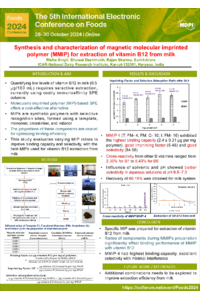
richa poster for foods.pdf
Development of ice cream cones from cassava flour and corn starch: production and optimization
Effect of soybean-to-water ratios on physicochemical properties, proximate composition, and sensory characteristics of soy yogurt