Event submissions
Published
This submission belongs to the session S1. Innovation in Food Technology and Engineering of the event The 5th International Electronic Conference on Foods
Published date
25 Oct, 2024
Academic Editor
'%3e%3cpath%20d='M12.6657%2010.9104C12.4185%2010.325%2012.0599%209.79327%2011.6097%209.34482C11.1609%208.89508%2010.6293%208.5365%2010.0442%208.28888C10.0389%208.28626%2010.0337%208.28495%2010.0285%208.28233C10.8446%207.69279%2011.3752%206.73249%2011.3752%205.64904C11.3752%203.8542%209.92103%202.39999%208.1262%202.39999C6.33136%202.39999%204.87715%203.8542%204.87715%205.64904C4.87715%206.73249%205.40774%207.69279%206.22393%208.28364C6.21869%208.28626%206.21345%208.28757%206.20821%208.29019C5.62129%208.5378%205.09463%208.89284%204.64265%209.34613C4.1929%209.79493%203.83432%2010.3266%203.58671%2010.9117C3.34345%2011.4845%203.21226%2012.0987%203.20023%2012.7209C3.19988%2012.7349%203.20233%2012.7488%203.20744%2012.7619C3.21255%2012.7749%203.22022%2012.7867%203.22998%2012.7968C3.23975%2012.8068%203.25142%2012.8147%203.26431%2012.8202C3.2772%2012.8256%203.29105%2012.8284%203.30504%2012.8284H4.09109C4.14874%2012.8284%204.19459%2012.7825%204.1959%2012.7262C4.2221%2011.7148%204.62823%2010.7676%205.34617%2010.0497C6.08899%209.30683%207.0755%208.89808%208.1262%208.89808C9.17689%208.89808%2010.1634%209.30683%2010.9062%2010.0497C11.6242%2010.7676%2012.0303%2011.7148%2012.0565%2012.7262C12.0578%2012.7838%2012.1037%2012.8284%2012.1613%2012.8284H12.9474C12.9613%2012.8284%2012.9752%2012.8256%2012.9881%2012.8202C13.001%2012.8147%2013.0126%2012.8068%2013.0224%2012.7968C13.0322%2012.7867%2013.0398%2012.7749%2013.0449%2012.7619C13.0501%2012.7488%2013.0525%2012.7349%2013.0522%2012.7209C13.0391%2012.0947%2012.9094%2011.4855%2012.6657%2010.9104ZM8.1262%207.9024C7.52486%207.9024%206.9589%207.6679%206.53312%207.24211C6.10733%206.81633%205.87283%206.25037%205.87283%205.64904C5.87283%205.0477%206.10733%204.48174%206.53312%204.05596C6.9589%203.63018%207.52486%203.39567%208.1262%203.39567C8.72753%203.39567%209.29349%203.63018%209.71927%204.05596C10.1451%204.48174%2010.3796%205.0477%2010.3796%205.64904C10.3796%206.25037%2010.1451%206.81633%209.71927%207.24211C9.29349%207.6679%208.72753%207.9024%208.1262%207.9024Z'%20fill='%235D1EE1'/%3e%3c/g%3e%3c/svg%3e) Joana Amaral
Joana AmaralCitation
Aymen DHAOUADI, Nadia SMIRANI, Souhir Bouazizi, Moktar HAMDI, Mathematical modeling of thin-layer drying of opuntia ficus-indica peels, in Proceedings of The 5th International Electronic Conference on Foods, 28 October–30 October 2024, MDPI: Basel, Switzerland
Share
Email
Facebook
Twitter
LinkedIn
Mathematical modeling of thin-layer drying of opuntia ficus-indica peels
'%3e%3cpath%20d='M12.6647%2010.9104C12.4176%2010.325%2012.0589%209.7933%2011.6088%209.34485C11.16%208.89511%2010.6283%208.53653%2010.0432%208.28891C10.038%208.28629%2010.0327%208.28498%2010.0275%208.28236C10.8437%207.69282%2011.3743%206.73252%2011.3743%205.64907C11.3743%203.85423%209.92005%202.40002%208.12522%202.40002C6.33038%202.40002%204.87618%203.85423%204.87618%205.64907C4.87618%206.73252%205.40677%207.69282%206.22296%208.28367C6.21772%208.28629%206.21248%208.2876%206.20724%208.29022C5.62031%208.53783%205.09365%208.89287%204.64167%209.34616C4.19192%209.79496%203.83334%2010.3266%203.58573%2010.9117C3.34247%2011.4846%203.21128%2012.0987%203.19925%2012.721C3.1989%2012.735%203.20135%2012.7489%203.20646%2012.7619C3.21157%2012.7749%203.21924%2012.7868%203.22901%2012.7968C3.23877%2012.8068%203.25045%2012.8148%203.26334%2012.8202C3.27623%2012.8256%203.29007%2012.8284%203.30406%2012.8284H4.09012C4.14776%2012.8284%204.19362%2012.7825%204.19493%2012.7262C4.22113%2011.7148%204.62726%2010.7676%205.34519%2010.0497C6.08802%209.30686%207.07452%208.89811%208.12522%208.89811C9.17592%208.89811%2010.1624%209.30686%2010.9052%2010.0497C11.6232%2010.7676%2012.0293%2011.7148%2012.0555%2012.7262C12.0568%2012.7839%2012.1027%2012.8284%2012.1603%2012.8284H12.9464C12.9604%2012.8284%2012.9742%2012.8256%2012.9871%2012.8202C13%2012.8148%2013.0117%2012.8068%2013.0214%2012.7968C13.0312%2012.7868%2013.0389%2012.7749%2013.044%2012.7619C13.0491%2012.7489%2013.0515%2012.735%2013.0512%2012.721C13.0381%2012.0947%2012.9084%2011.4856%2012.6647%2010.9104ZM8.12522%207.90243C7.52388%207.90243%206.95792%207.66793%206.53214%207.24215C6.10636%206.81636%205.87185%206.2504%205.87185%205.64907C5.87185%205.04773%206.10636%204.48177%206.53214%204.05599C6.95792%203.63021%207.52388%203.3957%208.12522%203.3957C8.72655%203.3957%209.29252%203.63021%209.7183%204.05599C10.1441%204.48177%2010.3786%205.04773%2010.3786%205.64907C10.3786%206.2504%2010.1441%206.81636%209.7183%207.24215C9.29252%207.66793%208.72655%207.90243%208.12522%207.90243Z'%20fill='%235D1EE1'/%3e%3c/g%3e%3c/svg%3e)
Aymen DHAOUADI 1
Nadia SMIRANI 1
Souhir Bouazizi 1

Moktar HAMDI 1
1. Laboratory of Microbial Ecology and Technology LETMi-INSAT, The National Institute of Applied Science and Technology INSAT, University of Carthage, BP 676, 1080 Tunis.
Abstract
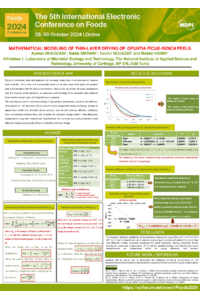
Opuntia ficus indica is a popular summer fruit in Tunisia. It is primarily produced in arid and semi-arid regions and has significant economic implications for rural communities. It is typically sold in local markets as a whole fruit or after removing the peels from the edible pulp. Despite their rich composition in nutrients and bioactive compounds, their peels are undervalued. Within this context, the current study focuses on the potential for peel valorization through the dehydration process. This unit operation is required to reduce the initial high moisture content (about 80%) of fresh peels while preserving their bioactive compounds.
For the experiment, fresh Opuntia ficus-indica peels were collected and sliced into rectangular shapes (5 cm x 4.3 cm) before being placed in trays in a hot-air convective dryer. Three different temperatures (55, 65, and 75°C) were examined. Drying kinetics were determined by measuring the variation in wet mass peels at 20-minute intervals until a constant mass of dried peels was obtained.
The drying kinetics were investigated to determine the diffusion coefficient during the falling rate drying stage. The diffusion coefficient increased from 6.3*10-08 ± 1.38*10-10 to 7.9*10-08 ± 9.18*10-11 m2.s-1 with increasing temperature in the range of 45-75°C. An activation energy value of 24.69 kJ.mol-1, for the Opuntia ficus-indica peel drying process, was deduced from the slope of the linear Arrhenius equation (R2=0.97). Moreover, seven mathematical models were applied to the experimental data. The goodness of fit was assessed using R² and reduced chi-square (χ²). The Page and diffusion models best described the convective drying behavior of Opuntia ficus-indica peels.
In conclusion, modeling the drying process of Opuntia ficus-indica peels contributes to reducing the requirement for the laboratory experiments necessary to design suitable equipment and to adjust process parameters according to specific needs, while maintaining regular dried product quality.
Keywords
Convective drying – Opuntia ficus-indica - peels - Diffusion coefficient - Drying kinetics - Modelling
Poster
099172.pdf
Navigating the New Frontier of Agriculture with Agroecology, Transforming Sustainable Farming Through Nature-Based Solutions and Technological Integration
Comparative Analysis of Functional Properties in Coriander Seed Extracts Using Various Extraction Methods