Event submissions
Published
This submission belongs to the session S10. Application of Artificial Intelligence (AI) and Machine Learning in The Food Industry of the event The 5th International Electronic Conference on Foods
Published date
25 Oct, 2024
Academic Editor
'%3e%3cpath%20d='M12.6657%2010.9104C12.4185%2010.325%2012.0599%209.79327%2011.6097%209.34482C11.1609%208.89508%2010.6293%208.5365%2010.0442%208.28888C10.0389%208.28626%2010.0337%208.28495%2010.0285%208.28233C10.8446%207.69279%2011.3752%206.73249%2011.3752%205.64904C11.3752%203.8542%209.92103%202.39999%208.1262%202.39999C6.33136%202.39999%204.87715%203.8542%204.87715%205.64904C4.87715%206.73249%205.40774%207.69279%206.22393%208.28364C6.21869%208.28626%206.21345%208.28757%206.20821%208.29019C5.62129%208.5378%205.09463%208.89284%204.64265%209.34613C4.1929%209.79493%203.83432%2010.3266%203.58671%2010.9117C3.34345%2011.4845%203.21226%2012.0987%203.20023%2012.7209C3.19988%2012.7349%203.20233%2012.7488%203.20744%2012.7619C3.21255%2012.7749%203.22022%2012.7867%203.22998%2012.7968C3.23975%2012.8068%203.25142%2012.8147%203.26431%2012.8202C3.2772%2012.8256%203.29105%2012.8284%203.30504%2012.8284H4.09109C4.14874%2012.8284%204.19459%2012.7825%204.1959%2012.7262C4.2221%2011.7148%204.62823%2010.7676%205.34617%2010.0497C6.08899%209.30683%207.0755%208.89808%208.1262%208.89808C9.17689%208.89808%2010.1634%209.30683%2010.9062%2010.0497C11.6242%2010.7676%2012.0303%2011.7148%2012.0565%2012.7262C12.0578%2012.7838%2012.1037%2012.8284%2012.1613%2012.8284H12.9474C12.9613%2012.8284%2012.9752%2012.8256%2012.9881%2012.8202C13.001%2012.8147%2013.0126%2012.8068%2013.0224%2012.7968C13.0322%2012.7867%2013.0398%2012.7749%2013.0449%2012.7619C13.0501%2012.7488%2013.0525%2012.7349%2013.0522%2012.7209C13.0391%2012.0947%2012.9094%2011.4855%2012.6657%2010.9104ZM8.1262%207.9024C7.52486%207.9024%206.9589%207.6679%206.53312%207.24211C6.10733%206.81633%205.87283%206.25037%205.87283%205.64904C5.87283%205.0477%206.10733%204.48174%206.53312%204.05596C6.9589%203.63018%207.52486%203.39567%208.1262%203.39567C8.72753%203.39567%209.29349%203.63018%209.71927%204.05596C10.1451%204.48174%2010.3796%205.0477%2010.3796%205.64904C10.3796%206.25037%2010.1451%206.81633%209.71927%207.24211C9.29349%207.6679%208.72753%207.9024%208.1262%207.9024Z'%20fill='%235D1EE1'/%3e%3c/g%3e%3c/svg%3e) Yonghui Li
Yonghui LiCitation
Nicolás Andrés Villagrán dos Santos, Lorena Pepa, Yamila Alen, Pilar Buera, Cristina dos Santos Ferreira, Data analysis of protein–flavor interactions using classification and deep-learning techniques, in Proceedings of The 5th International Electronic Conference on Foods, 28 October–30 October 2024, MDPI: Basel, Switzerland
Share
Email
Facebook
Twitter
LinkedIn
Data analysis of protein–flavor interactions using classification and deep-learning techniques
'%3e%3cpath%20d='M12.6647%2010.9104C12.4176%2010.325%2012.0589%209.7933%2011.6088%209.34485C11.16%208.89511%2010.6283%208.53653%2010.0432%208.28891C10.038%208.28629%2010.0327%208.28498%2010.0275%208.28236C10.8437%207.69282%2011.3743%206.73252%2011.3743%205.64907C11.3743%203.85423%209.92005%202.40002%208.12522%202.40002C6.33038%202.40002%204.87618%203.85423%204.87618%205.64907C4.87618%206.73252%205.40677%207.69282%206.22296%208.28367C6.21772%208.28629%206.21248%208.2876%206.20724%208.29022C5.62031%208.53783%205.09365%208.89287%204.64167%209.34616C4.19192%209.79496%203.83334%2010.3266%203.58573%2010.9117C3.34247%2011.4846%203.21128%2012.0987%203.19925%2012.721C3.1989%2012.735%203.20135%2012.7489%203.20646%2012.7619C3.21157%2012.7749%203.21924%2012.7868%203.22901%2012.7968C3.23877%2012.8068%203.25045%2012.8148%203.26334%2012.8202C3.27623%2012.8256%203.29007%2012.8284%203.30406%2012.8284H4.09012C4.14776%2012.8284%204.19362%2012.7825%204.19493%2012.7262C4.22113%2011.7148%204.62726%2010.7676%205.34519%2010.0497C6.08802%209.30686%207.07452%208.89811%208.12522%208.89811C9.17592%208.89811%2010.1624%209.30686%2010.9052%2010.0497C11.6232%2010.7676%2012.0293%2011.7148%2012.0555%2012.7262C12.0568%2012.7839%2012.1027%2012.8284%2012.1603%2012.8284H12.9464C12.9604%2012.8284%2012.9742%2012.8256%2012.9871%2012.8202C13%2012.8148%2013.0117%2012.8068%2013.0214%2012.7968C13.0312%2012.7868%2013.0389%2012.7749%2013.044%2012.7619C13.0491%2012.7489%2013.0515%2012.735%2013.0512%2012.721C13.0381%2012.0947%2012.9084%2011.4856%2012.6647%2010.9104ZM8.12522%207.90243C7.52388%207.90243%206.95792%207.66793%206.53214%207.24215C6.10636%206.81636%205.87185%206.2504%205.87185%205.64907C5.87185%205.04773%206.10636%204.48177%206.53214%204.05599C6.95792%203.63021%207.52388%203.3957%208.12522%203.3957C8.72655%203.3957%209.29252%203.63021%209.7183%204.05599C10.1441%204.48177%2010.3786%205.04773%2010.3786%205.64907C10.3786%206.2504%2010.1441%206.81636%209.7183%207.24215C9.29252%207.66793%208.72655%207.90243%208.12522%207.90243Z'%20fill='%235D1EE1'/%3e%3c/g%3e%3c/svg%3e)
Nicolás Andrés Villagrán dos Santos 1,2
Lorena Pepa 3
Yamila Alen 4
Pilar Buera 3
Cristina dos Santos Ferreira 5
1. Universidad de Buenos Aires. Facultad de Ciencias Exactas y Naturales. Departamento de Matemática. Buenos Aires, Argentina.
2. Universidad de Buenos Aires. Facultad de Ciencias Exactas y Naturales. Departamento de Química Inorgánica, Analítica y Química Física. Buenos Aires, Argentina.
3. CONICET - Universidad de Buenos Aires. Instituto de Tecnología de Alimentos y Procesos Químicos. Buenos Aires, Argentina.
4. CONICET - Universidad de Buenos Aires. Instituto de Cálculo. Buenos Aires, Argentina.
5. Universidad de Buenos Aires. Facultad de Ciencias Exactas y Naturales. Departamento de Química Orgánica. Buenos Aires, Argentina.
Abstract
Analyzing molecular interactions among food components is of key interest for novel food formulations and for optimizing their shelf-life, but the complexity of food matrices often poses difficulties. In this work, we formulated model systems with gelatin placed in indirect contact with different flavors (citral, cinnamaldehyde, and vanillin) and stored at room temperature during 60, 120, and 150 days. We analyzed how protein characteristics changed over time using Fourier transform infrared spectroscopy viaattenuated total reflectance (FTIR-ATR). The spectra included the amide I, II, and III regions and the region associated with glycation products (altogether around 1850-1100 cm-1). The data (N=37, 750 features) werethen analyzed using Python, and principal components analysis (PCA) was also performed, obtaining a separation into classes depending on flavor and storage time. Features associated with the first principal component were correlated with protein–flavor interactions (wavenumbers in amide III, glycation products, and amide I regions), while the second was associated with changes undergone during storage (wavenumbers in amide I region, including C=O stretching). Afterwards, data were sorted into classes according to flavor or storage time using two models with a 70-30% train–test split: random forest classification (RFC; with leave-one-out cross-validation) and a neural network consisting of a multi-class perceptron (MCP, with 1024 entry nodes and 4 or 3 output nodes, with cross-entropy loss). In both cases, the data were classified (accuracy for flavor classification: 81%—RFC and 83%—MPC; accuracy for storage time: 88%—RFC and 92%—MPC). The most relevant features selected for the RFC model corresponded to the key features previously obtained by PCA, while the MPC showed a greater degree of accuracy in the classification of the systems. This work showcases a novel application of data analysis techniques to simplify protein–flavor interaction complexity and analyze its key features, which could be useful for food formulation development.
Keywords
FTIR-ATR
principal component analysis
random forest classification
neural network
deep learning
protein-flavor interactions
Poster
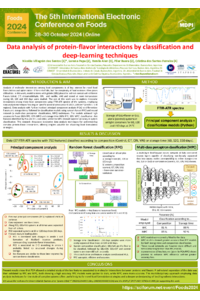
Poster Foods 2024 - PCA y redes neuronales GEL y flavors.pdf
Effects of Instant Cascara Beverage and Purified Diets on Gastrointestinal Motility in Male and Female Rats
The fabrication and physicochemical properties of mackerel surimi gels modified by several polysaccharides