Event submissions
Published
This submission belongs to the session S1. Innovation in Food Technology and Engineering of the event The 5th International Electronic Conference on Foods
Published date
25 Oct, 2024
Academic Editor
'%3e%3cpath%20d='M12.6657%2010.9104C12.4185%2010.325%2012.0599%209.79327%2011.6097%209.34482C11.1609%208.89508%2010.6293%208.5365%2010.0442%208.28888C10.0389%208.28626%2010.0337%208.28495%2010.0285%208.28233C10.8446%207.69279%2011.3752%206.73249%2011.3752%205.64904C11.3752%203.8542%209.92103%202.39999%208.1262%202.39999C6.33136%202.39999%204.87715%203.8542%204.87715%205.64904C4.87715%206.73249%205.40774%207.69279%206.22393%208.28364C6.21869%208.28626%206.21345%208.28757%206.20821%208.29019C5.62129%208.5378%205.09463%208.89284%204.64265%209.34613C4.1929%209.79493%203.83432%2010.3266%203.58671%2010.9117C3.34345%2011.4845%203.21226%2012.0987%203.20023%2012.7209C3.19988%2012.7349%203.20233%2012.7488%203.20744%2012.7619C3.21255%2012.7749%203.22022%2012.7867%203.22998%2012.7968C3.23975%2012.8068%203.25142%2012.8147%203.26431%2012.8202C3.2772%2012.8256%203.29105%2012.8284%203.30504%2012.8284H4.09109C4.14874%2012.8284%204.19459%2012.7825%204.1959%2012.7262C4.2221%2011.7148%204.62823%2010.7676%205.34617%2010.0497C6.08899%209.30683%207.0755%208.89808%208.1262%208.89808C9.17689%208.89808%2010.1634%209.30683%2010.9062%2010.0497C11.6242%2010.7676%2012.0303%2011.7148%2012.0565%2012.7262C12.0578%2012.7838%2012.1037%2012.8284%2012.1613%2012.8284H12.9474C12.9613%2012.8284%2012.9752%2012.8256%2012.9881%2012.8202C13.001%2012.8147%2013.0126%2012.8068%2013.0224%2012.7968C13.0322%2012.7867%2013.0398%2012.7749%2013.0449%2012.7619C13.0501%2012.7488%2013.0525%2012.7349%2013.0522%2012.7209C13.0391%2012.0947%2012.9094%2011.4855%2012.6657%2010.9104ZM8.1262%207.9024C7.52486%207.9024%206.9589%207.6679%206.53312%207.24211C6.10733%206.81633%205.87283%206.25037%205.87283%205.64904C5.87283%205.0477%206.10733%204.48174%206.53312%204.05596C6.9589%203.63018%207.52486%203.39567%208.1262%203.39567C8.72753%203.39567%209.29349%203.63018%209.71927%204.05596C10.1451%204.48174%2010.3796%205.0477%2010.3796%205.64904C10.3796%206.25037%2010.1451%206.81633%209.71927%207.24211C9.29349%207.6679%208.72753%207.9024%208.1262%207.9024Z'%20fill='%235D1EE1'/%3e%3c/g%3e%3c/svg%3e) Moktar Hamdi
Moktar HamdiCitation
Andreea Pușcaș, Ana Berladean, Aliona Ghendov-Moşanu, Vlad Mureșan, Legume-based aquafaba as an ingredient in sponge cake formulation: physicochemical characterization and consumer acceptability, in Proceedings of The 5th International Electronic Conference on Foods, 28 October–30 October 2024, MDPI: Basel, Switzerland
Share
Email
Facebook
Twitter
LinkedIn
Legume-based aquafaba as an ingredient in sponge cake formulation: physicochemical characterization and consumer acceptability

Andreea Pușcaș 1
'%3e%3cpath%20d='M12.6647%2010.9104C12.4176%2010.325%2012.0589%209.7933%2011.6088%209.34485C11.16%208.89511%2010.6283%208.53653%2010.0432%208.28891C10.038%208.28629%2010.0327%208.28498%2010.0275%208.28236C10.8437%207.69282%2011.3743%206.73252%2011.3743%205.64907C11.3743%203.85423%209.92005%202.40002%208.12522%202.40002C6.33038%202.40002%204.87618%203.85423%204.87618%205.64907C4.87618%206.73252%205.40677%207.69282%206.22296%208.28367C6.21772%208.28629%206.21248%208.2876%206.20724%208.29022C5.62031%208.53783%205.09365%208.89287%204.64167%209.34616C4.19192%209.79496%203.83334%2010.3266%203.58573%2010.9117C3.34247%2011.4846%203.21128%2012.0987%203.19925%2012.721C3.1989%2012.735%203.20135%2012.7489%203.20646%2012.7619C3.21157%2012.7749%203.21924%2012.7868%203.22901%2012.7968C3.23877%2012.8068%203.25045%2012.8148%203.26334%2012.8202C3.27623%2012.8256%203.29007%2012.8284%203.30406%2012.8284H4.09012C4.14776%2012.8284%204.19362%2012.7825%204.19493%2012.7262C4.22113%2011.7148%204.62726%2010.7676%205.34519%2010.0497C6.08802%209.30686%207.07452%208.89811%208.12522%208.89811C9.17592%208.89811%2010.1624%209.30686%2010.9052%2010.0497C11.6232%2010.7676%2012.0293%2011.7148%2012.0555%2012.7262C12.0568%2012.7839%2012.1027%2012.8284%2012.1603%2012.8284H12.9464C12.9604%2012.8284%2012.9742%2012.8256%2012.9871%2012.8202C13%2012.8148%2013.0117%2012.8068%2013.0214%2012.7968C13.0312%2012.7868%2013.0389%2012.7749%2013.044%2012.7619C13.0491%2012.7489%2013.0515%2012.735%2013.0512%2012.721C13.0381%2012.0947%2012.9084%2011.4856%2012.6647%2010.9104ZM8.12522%207.90243C7.52388%207.90243%206.95792%207.66793%206.53214%207.24215C6.10636%206.81636%205.87185%206.2504%205.87185%205.64907C5.87185%205.04773%206.10636%204.48177%206.53214%204.05599C6.95792%203.63021%207.52388%203.3957%208.12522%203.3957C8.72655%203.3957%209.29252%203.63021%209.7183%204.05599C10.1441%204.48177%2010.3786%205.04773%2010.3786%205.64907C10.3786%206.2504%2010.1441%206.81636%209.7183%207.24215C9.29252%207.66793%208.72655%207.90243%208.12522%207.90243Z'%20fill='%235D1EE1'/%3e%3c/g%3e%3c/svg%3e)
Ana Berladean 2
Aliona Ghendov-Moşanu 3

Vlad Mureșan 4
1. Food Engineering Department, Faculty of Food Science and Technology, University of Agricultural Sciences and Veterinary Medicine Cluj-Napoca, 3-5 Calea Mănăştur Street no. 3-5, 400372 Cluj-Napoca, 400372, Cluj, Romania
2. Technical University of Moldova
3. Department of Food Technology, Technical University of Moldova
4. University of Agricultural Sciences and Veterinary Medicine of Cluj-Napoca
Abstract
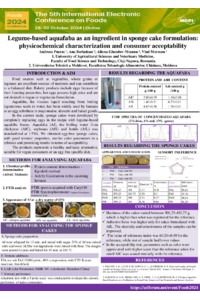
In the current study, sponge cakes were developed by completely replacing eggs in a sponge cake recipe with legume-based aquafaba. Aquafaba (Af), the boiling water from chickpeas (AfC), soybeans (AfS) and lentils (AfL), was standardized at 13⁰Bx. The protein content and total ash were determined according to AOAC-approved methods (950.48 and 923.03). In this study, 70% of Af was whipped for 10 min with sugar and 30% of Af was mixed with sunflower oil. The wet ingredients were mixed with the flour. The dough was poured in pans and baked for 45 min. at 180 ℃. The cakes were characterized in terms of water content (AOAC 925.09 method) and textural attributes (TPA test wit TA11/1000 probe, 40% compression), with a CT3 Texture Analyzer. The whiteness index was calculated from the LAB color parameters (NHR 300 colorimeter Shenzhen, China) and sensory acceptability was tested. The reference cake presented a 25.72±0.15% water content, while the cake with AfC presented 31.35±0.09%. The hardness of the cakes varied between 506.25 and 450.75, which is higher than what was registered for the reference containing eggs (389.75 g). Adhesive force was higher only for cakes formulated with AfL. The elasticity and cohesiveness of the samples can be improved. The crumb of the reference presented the highest value of whiteness index (60.29±0.99), followed by the sample with AfL (50.63±1.69). In the acceptability test, parameters such as color obtained a higher score than the reference for samples containing AfL and AfC, while for smell AfC scored similarly to the reference. Through the development of this technology, it is possible to obtain an egg-free sponge cake using a sustainable ingredient, leading to products with good textural properties, similar color parameters and promising results in terms of acceptability. The product represents a healthy and tasty alternative, suitable for vegan consumers or those with a specific egg-free diet.
Keywords
aquafaba
chickpea
soy
lentils
sponge cakes
Poster
aquafaba legume.pdf
Chigee-derived Lactobacillus acidophilus NX2-6 Improved Lipid Metabolism and Enhanced Intestinal Barrier in High-fat-diet-fed Mice
Agro-industrial by-products for potential development of gluten-free Type 1 sourdoughs