Event submissions
Published
This submission belongs to the session S4. Food Microbiology of the event The 5th International Electronic Conference on Foods
Published date
25 Oct, 2024
Academic Editor
'%3e%3cpath%20d='M12.6657%2010.9104C12.4185%2010.325%2012.0599%209.79327%2011.6097%209.34482C11.1609%208.89508%2010.6293%208.5365%2010.0442%208.28888C10.0389%208.28626%2010.0337%208.28495%2010.0285%208.28233C10.8446%207.69279%2011.3752%206.73249%2011.3752%205.64904C11.3752%203.8542%209.92103%202.39999%208.1262%202.39999C6.33136%202.39999%204.87715%203.8542%204.87715%205.64904C4.87715%206.73249%205.40774%207.69279%206.22393%208.28364C6.21869%208.28626%206.21345%208.28757%206.20821%208.29019C5.62129%208.5378%205.09463%208.89284%204.64265%209.34613C4.1929%209.79493%203.83432%2010.3266%203.58671%2010.9117C3.34345%2011.4845%203.21226%2012.0987%203.20023%2012.7209C3.19988%2012.7349%203.20233%2012.7488%203.20744%2012.7619C3.21255%2012.7749%203.22022%2012.7867%203.22998%2012.7968C3.23975%2012.8068%203.25142%2012.8147%203.26431%2012.8202C3.2772%2012.8256%203.29105%2012.8284%203.30504%2012.8284H4.09109C4.14874%2012.8284%204.19459%2012.7825%204.1959%2012.7262C4.2221%2011.7148%204.62823%2010.7676%205.34617%2010.0497C6.08899%209.30683%207.0755%208.89808%208.1262%208.89808C9.17689%208.89808%2010.1634%209.30683%2010.9062%2010.0497C11.6242%2010.7676%2012.0303%2011.7148%2012.0565%2012.7262C12.0578%2012.7838%2012.1037%2012.8284%2012.1613%2012.8284H12.9474C12.9613%2012.8284%2012.9752%2012.8256%2012.9881%2012.8202C13.001%2012.8147%2013.0126%2012.8068%2013.0224%2012.7968C13.0322%2012.7867%2013.0398%2012.7749%2013.0449%2012.7619C13.0501%2012.7488%2013.0525%2012.7349%2013.0522%2012.7209C13.0391%2012.0947%2012.9094%2011.4855%2012.6657%2010.9104ZM8.1262%207.9024C7.52486%207.9024%206.9589%207.6679%206.53312%207.24211C6.10733%206.81633%205.87283%206.25037%205.87283%205.64904C5.87283%205.0477%206.10733%204.48174%206.53312%204.05596C6.9589%203.63018%207.52486%203.39567%208.1262%203.39567C8.72753%203.39567%209.29349%203.63018%209.71927%204.05596C10.1451%204.48174%2010.3796%205.0477%2010.3796%205.64904C10.3796%206.25037%2010.1451%206.81633%209.71927%207.24211C9.29349%207.6679%208.72753%207.9024%208.1262%207.9024Z'%20fill='%235D1EE1'/%3e%3c/g%3e%3c/svg%3e) Antonio Bevilacqua
Antonio BevilacquaCitation
Karen Irigoytia, Kashika Arora, Andrea Polo, Hana Ameur, Marco Gobbetti, Carolina Genevois, Marina de Escalada Pla, Agro-industrial by-products for potential development of gluten-free Type 1 sourdoughs, in Proceedings of The 5th International Electronic Conference on Foods, 28 October–30 October 2024, MDPI: Basel, Switzerland
Share
Email
Facebook
Twitter
LinkedIn
Agro-industrial by-products for potential development of gluten-free Type 1 sourdoughs
'%3e%3cpath%20d='M12.6647%2010.9104C12.4176%2010.325%2012.0589%209.7933%2011.6088%209.34485C11.16%208.89511%2010.6283%208.53653%2010.0432%208.28891C10.038%208.28629%2010.0327%208.28498%2010.0275%208.28236C10.8437%207.69282%2011.3743%206.73252%2011.3743%205.64907C11.3743%203.85423%209.92005%202.40002%208.12522%202.40002C6.33038%202.40002%204.87618%203.85423%204.87618%205.64907C4.87618%206.73252%205.40677%207.69282%206.22296%208.28367C6.21772%208.28629%206.21248%208.2876%206.20724%208.29022C5.62031%208.53783%205.09365%208.89287%204.64167%209.34616C4.19192%209.79496%203.83334%2010.3266%203.58573%2010.9117C3.34247%2011.4846%203.21128%2012.0987%203.19925%2012.721C3.1989%2012.735%203.20135%2012.7489%203.20646%2012.7619C3.21157%2012.7749%203.21924%2012.7868%203.22901%2012.7968C3.23877%2012.8068%203.25045%2012.8148%203.26334%2012.8202C3.27623%2012.8256%203.29007%2012.8284%203.30406%2012.8284H4.09012C4.14776%2012.8284%204.19362%2012.7825%204.19493%2012.7262C4.22113%2011.7148%204.62726%2010.7676%205.34519%2010.0497C6.08802%209.30686%207.07452%208.89811%208.12522%208.89811C9.17592%208.89811%2010.1624%209.30686%2010.9052%2010.0497C11.6232%2010.7676%2012.0293%2011.7148%2012.0555%2012.7262C12.0568%2012.7839%2012.1027%2012.8284%2012.1603%2012.8284H12.9464C12.9604%2012.8284%2012.9742%2012.8256%2012.9871%2012.8202C13%2012.8148%2013.0117%2012.8068%2013.0214%2012.7968C13.0312%2012.7868%2013.0389%2012.7749%2013.044%2012.7619C13.0491%2012.7489%2013.0515%2012.735%2013.0512%2012.721C13.0381%2012.0947%2012.9084%2011.4856%2012.6647%2010.9104ZM8.12522%207.90243C7.52388%207.90243%206.95792%207.66793%206.53214%207.24215C6.10636%206.81636%205.87185%206.2504%205.87185%205.64907C5.87185%205.04773%206.10636%204.48177%206.53214%204.05599C6.95792%203.63021%207.52388%203.3957%208.12522%203.3957C8.72655%203.3957%209.29252%203.63021%209.7183%204.05599C10.1441%204.48177%2010.3786%205.04773%2010.3786%205.64907C10.3786%206.2504%2010.1441%206.81636%209.7183%207.24215C9.29252%207.66793%208.72655%207.90243%208.12522%207.90243Z'%20fill='%235D1EE1'/%3e%3c/g%3e%3c/svg%3e)
Karen Irigoytia 1
Kashika Arora 2
Andrea Polo 2
Hana Ameur 2
Marco Gobbetti 2
Carolina Genevois 1
Marina de Escalada Pla 3
1. Institute of Food Science and Technology of Entre Ríos (CONICET-UNER), Pte. Perón 1154 (E2820), Gualeguaychú, Entre Ríos, Argentina.
2. Faculty of Science and Technology, Libera Università di Bolzano, Piazza Università, 5, 39100 Bolzano, Italy
3. Institute of Food Technology and Chemical Processes (ITAPROQ-UBA), Intendente Güiraldes 2160 (C1428EGA), Ciudad Autónoma de Buenos Aires, Argentina.
Abstract
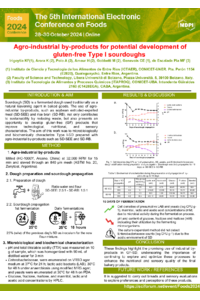
Sourdough (SD) is a fermented dough used traditionally as a natural leavening agent in baked goods. The aim of this work was to microbiologically and biochemically characterize Type 1-SD prepared with agro-industrial by-products such as soybean extruded--expelled meal (SD-SEE) and rice bran (SD-RB). SD-SEE and SD-RB were prepared by mixing tap water and flour in ratios of 2.5:1 and 1.5:1, with dough yields of 350 and 250, respectively. Fermentations were carried out daily at 25°C for 8 h, after a 24 h initial fermentation, with refrigeration at 4°C for 16 h between each fermentation. The backslopping procedure used 25% (w/w) of the previous day's SD as inoculum for the new flour mixture. Enterobacteriaceae, lactic acid bacteria (LAB), and yeasts were enumerated on specific agar media under controlled temperature conditions; pH and total titratable acidity were determined; and carbohydrates, lactic, and acetic acid concentrations were quantified using HPLC. After 10 days of fermentation, a significant decrease in pH was observed, from initial values of 6.7 (SD-SEE) and 6.31 (SD-RB) to 4.5 and 4.2, respectively. Furthermore, a notable increase in lactic and acetic acid concentrations (mM) was recorded in both SDs, underlining the significant microbial activity during the fermentation process. Cell densities of presumptive LAB (log CFU g-1) and yeasts (log CFU g-1) increased significantly, while a decrease in carbohydrate content (mM) was observed, indicating their utilization by the fermenting microorganisms. On the other hand, the culture-dependent method did not detect Enterobacteriaceae counts (log CFU g-1) due to the acidic environment of SD. Selected LAB and yeast isolates from the final SD samples, identified by the culture-dependent method, revealed Pediococcus pentosaceus, Levilactobacillus brevis, and Saccharomyces cerevisiae as the dominant species. These findings highlight the promising use of industrial by-products in GF-SD, underscoring the importance of continuing to explore and optimize these processes to enhance the nutritional and sensory quality of the final bakery products.
Keywords
backslopping
microbial activity
clean label
Poster
Póster Conference.pdf
Legume-based aquafaba as an ingredient in sponge cake formulation: physicochemical characterization and consumer acceptability
Receptor-Targeted Next-Generation Probiotics Ameliorate Mammalian Colitis