Event submissions
Published
This submission belongs to the session S8. Food Quality and Safety of the event The 5th International Electronic Conference on Foods
Published date
25 Oct, 2024
Academic Editor
'%3e%3cpath%20d='M12.6657%2010.9104C12.4185%2010.325%2012.0599%209.79327%2011.6097%209.34482C11.1609%208.89508%2010.6293%208.5365%2010.0442%208.28888C10.0389%208.28626%2010.0337%208.28495%2010.0285%208.28233C10.8446%207.69279%2011.3752%206.73249%2011.3752%205.64904C11.3752%203.8542%209.92103%202.39999%208.1262%202.39999C6.33136%202.39999%204.87715%203.8542%204.87715%205.64904C4.87715%206.73249%205.40774%207.69279%206.22393%208.28364C6.21869%208.28626%206.21345%208.28757%206.20821%208.29019C5.62129%208.5378%205.09463%208.89284%204.64265%209.34613C4.1929%209.79493%203.83432%2010.3266%203.58671%2010.9117C3.34345%2011.4845%203.21226%2012.0987%203.20023%2012.7209C3.19988%2012.7349%203.20233%2012.7488%203.20744%2012.7619C3.21255%2012.7749%203.22022%2012.7867%203.22998%2012.7968C3.23975%2012.8068%203.25142%2012.8147%203.26431%2012.8202C3.2772%2012.8256%203.29105%2012.8284%203.30504%2012.8284H4.09109C4.14874%2012.8284%204.19459%2012.7825%204.1959%2012.7262C4.2221%2011.7148%204.62823%2010.7676%205.34617%2010.0497C6.08899%209.30683%207.0755%208.89808%208.1262%208.89808C9.17689%208.89808%2010.1634%209.30683%2010.9062%2010.0497C11.6242%2010.7676%2012.0303%2011.7148%2012.0565%2012.7262C12.0578%2012.7838%2012.1037%2012.8284%2012.1613%2012.8284H12.9474C12.9613%2012.8284%2012.9752%2012.8256%2012.9881%2012.8202C13.001%2012.8147%2013.0126%2012.8068%2013.0224%2012.7968C13.0322%2012.7867%2013.0398%2012.7749%2013.0449%2012.7619C13.0501%2012.7488%2013.0525%2012.7349%2013.0522%2012.7209C13.0391%2012.0947%2012.9094%2011.4855%2012.6657%2010.9104ZM8.1262%207.9024C7.52486%207.9024%206.9589%207.6679%206.53312%207.24211C6.10733%206.81633%205.87283%206.25037%205.87283%205.64904C5.87283%205.0477%206.10733%204.48174%206.53312%204.05596C6.9589%203.63018%207.52486%203.39567%208.1262%203.39567C8.72753%203.39567%209.29349%203.63018%209.71927%204.05596C10.1451%204.48174%2010.3796%205.0477%2010.3796%205.64904C10.3796%206.25037%2010.1451%206.81633%209.71927%207.24211C9.29349%207.6679%208.72753%207.9024%208.1262%207.9024Z'%20fill='%235D1EE1'/%3e%3c/g%3e%3c/svg%3e) Antonello Santini
Antonello SantiniCitation
Edyta Symoniuk, Aleksandra Rosa, Aleksander Siger, Anna Grygier, Bartosz Kruszewski, Influence of maceration process of selected cold-pressed oils with lyophilized mullein flowers (Verbascum thapsus L.) on their oxidative stability and chemical composition., in Proceedings of The 5th International Electronic Conference on Foods, 28 October–30 October 2024, MDPI: Basel, Switzerland
Share
Email
Facebook
Twitter
LinkedIn
Influence of maceration process of selected cold-pressed oils with lyophilized mullein flowers (Verbascum thapsus L.) on their oxidative stability and chemical composition.

Edyta Symoniuk 1
'%3e%3cpath%20d='M12.6647%2010.9104C12.4176%2010.325%2012.0589%209.7933%2011.6088%209.34485C11.16%208.89511%2010.6283%208.53653%2010.0432%208.28891C10.038%208.28629%2010.0327%208.28498%2010.0275%208.28236C10.8437%207.69282%2011.3743%206.73252%2011.3743%205.64907C11.3743%203.85423%209.92005%202.40002%208.12522%202.40002C6.33038%202.40002%204.87618%203.85423%204.87618%205.64907C4.87618%206.73252%205.40677%207.69282%206.22296%208.28367C6.21772%208.28629%206.21248%208.2876%206.20724%208.29022C5.62031%208.53783%205.09365%208.89287%204.64167%209.34616C4.19192%209.79496%203.83334%2010.3266%203.58573%2010.9117C3.34247%2011.4846%203.21128%2012.0987%203.19925%2012.721C3.1989%2012.735%203.20135%2012.7489%203.20646%2012.7619C3.21157%2012.7749%203.21924%2012.7868%203.22901%2012.7968C3.23877%2012.8068%203.25045%2012.8148%203.26334%2012.8202C3.27623%2012.8256%203.29007%2012.8284%203.30406%2012.8284H4.09012C4.14776%2012.8284%204.19362%2012.7825%204.19493%2012.7262C4.22113%2011.7148%204.62726%2010.7676%205.34519%2010.0497C6.08802%209.30686%207.07452%208.89811%208.12522%208.89811C9.17592%208.89811%2010.1624%209.30686%2010.9052%2010.0497C11.6232%2010.7676%2012.0293%2011.7148%2012.0555%2012.7262C12.0568%2012.7839%2012.1027%2012.8284%2012.1603%2012.8284H12.9464C12.9604%2012.8284%2012.9742%2012.8256%2012.9871%2012.8202C13%2012.8148%2013.0117%2012.8068%2013.0214%2012.7968C13.0312%2012.7868%2013.0389%2012.7749%2013.044%2012.7619C13.0491%2012.7489%2013.0515%2012.735%2013.0512%2012.721C13.0381%2012.0947%2012.9084%2011.4856%2012.6647%2010.9104ZM8.12522%207.90243C7.52388%207.90243%206.95792%207.66793%206.53214%207.24215C6.10636%206.81636%205.87185%206.2504%205.87185%205.64907C5.87185%205.04773%206.10636%204.48177%206.53214%204.05599C6.95792%203.63021%207.52388%203.3957%208.12522%203.3957C8.72655%203.3957%209.29252%203.63021%209.7183%204.05599C10.1441%204.48177%2010.3786%205.04773%2010.3786%205.64907C10.3786%206.2504%2010.1441%206.81636%209.7183%207.24215C9.29252%207.66793%208.72655%207.90243%208.12522%207.90243Z'%20fill='%235D1EE1'/%3e%3c/g%3e%3c/svg%3e)
Aleksandra Rosa 1
Aleksander Siger 2

Anna Grygier 2
Bartosz Kruszewski 1
1. Warsaw University of Life Sciences, Institute of Food Science, Department of Food Technology and Assessment, Nowoursynowska 166, 02-787 Warsaw
2. Poznan University of Life Sciences; Faculty of Food Sciences and Nutrition; Department of Biochemistry and Food, ul. Wojska Polskiego 28, 60-637 Poznan
Abstract
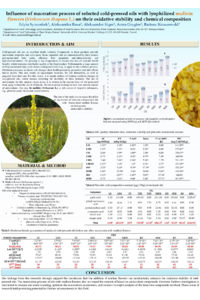
This study aimed to investigate the antioxidant properties of mullein macerates (Ms) in selected cold-pressed oils (CLOs). Macerates were obtained by combining lyophilized mullein flowers with CLOs and their subsequent ultrasound-assisted maceration and filtration. After the maceration process, the oxidative stability of the oils was assessed (80-120°C), and based on the obtained results, their kinetic parameters were calculated. Oils before and after maceration were also evaluated for their quality and safety. The acid value (AV), peroxide value (PV), p-anisidine value (p-AnV), and Totox index of the oils were analyzed. Furthermore, the influence of maceration with mullein flowers on the total antioxidant activity of oils, as well as on their pigment content, phenolic compounds, sterols, tocopherols, and the composition of fatty acids, was determined. After the maceration process, the oils remained of good quality; their fatty acid composition and the content of sterols and tocopherols had changed only slightly. The hydrolysis levels after maceration were lower, but the oxidation degree increased. The biggest change was determined for hemp seed oil, where the Totox index amounted to 17.19 and 28.96 before and after maceration. Based on the results, it was concluded that the best antioxidation effect was obtained for chia and linseed oil. The induction time for those oils was 4.32 and 6.04and 2.25 and 3.77 h, respectively, at 100°C. The protection factor at 100°C was 1.40 and 1.68 for linseed and chia seed oil. A higher content of polyphenolic compounds, especially polyphenolic acids, and overall antioxidant activity increased oxidative stability, inhibiting the oxidation process and increasing the energy required to initiate it.
Keywords
cold-pressed oils
maceration
mullein (Verbascum thapsus L.)
natural antioxidants
oxidative stability
principal component analysis
Rancimat.
Poster
Foods2025_Edyta Symoniuk.pdf
Receptor-Targeted Next-Generation Probiotics Ameliorate Mammalian Colitis
Optimization of Extraction of Bioactive Compounds: Influence of Parameters on the Efficiency of the Microwave-Assisted Technique