Event submissions
Published
This submission belongs to the session S2. Food Nutrition and Functional Foods of the event The 5th International Electronic Conference on Foods
Published date
25 Oct, 2024
Academic Editor
'%3e%3cpath%20d='M12.6657%2010.9104C12.4185%2010.325%2012.0599%209.79327%2011.6097%209.34482C11.1609%208.89508%2010.6293%208.5365%2010.0442%208.28888C10.0389%208.28626%2010.0337%208.28495%2010.0285%208.28233C10.8446%207.69279%2011.3752%206.73249%2011.3752%205.64904C11.3752%203.8542%209.92103%202.39999%208.1262%202.39999C6.33136%202.39999%204.87715%203.8542%204.87715%205.64904C4.87715%206.73249%205.40774%207.69279%206.22393%208.28364C6.21869%208.28626%206.21345%208.28757%206.20821%208.29019C5.62129%208.5378%205.09463%208.89284%204.64265%209.34613C4.1929%209.79493%203.83432%2010.3266%203.58671%2010.9117C3.34345%2011.4845%203.21226%2012.0987%203.20023%2012.7209C3.19988%2012.7349%203.20233%2012.7488%203.20744%2012.7619C3.21255%2012.7749%203.22022%2012.7867%203.22998%2012.7968C3.23975%2012.8068%203.25142%2012.8147%203.26431%2012.8202C3.2772%2012.8256%203.29105%2012.8284%203.30504%2012.8284H4.09109C4.14874%2012.8284%204.19459%2012.7825%204.1959%2012.7262C4.2221%2011.7148%204.62823%2010.7676%205.34617%2010.0497C6.08899%209.30683%207.0755%208.89808%208.1262%208.89808C9.17689%208.89808%2010.1634%209.30683%2010.9062%2010.0497C11.6242%2010.7676%2012.0303%2011.7148%2012.0565%2012.7262C12.0578%2012.7838%2012.1037%2012.8284%2012.1613%2012.8284H12.9474C12.9613%2012.8284%2012.9752%2012.8256%2012.9881%2012.8202C13.001%2012.8147%2013.0126%2012.8068%2013.0224%2012.7968C13.0322%2012.7867%2013.0398%2012.7749%2013.0449%2012.7619C13.0501%2012.7488%2013.0525%2012.7349%2013.0522%2012.7209C13.0391%2012.0947%2012.9094%2011.4855%2012.6657%2010.9104ZM8.1262%207.9024C7.52486%207.9024%206.9589%207.6679%206.53312%207.24211C6.10733%206.81633%205.87283%206.25037%205.87283%205.64904C5.87283%205.0477%206.10733%204.48174%206.53312%204.05596C6.9589%203.63018%207.52486%203.39567%208.1262%203.39567C8.72753%203.39567%209.29349%203.63018%209.71927%204.05596C10.1451%204.48174%2010.3796%205.0477%2010.3796%205.64904C10.3796%206.25037%2010.1451%206.81633%209.71927%207.24211C9.29349%207.6679%208.72753%207.9024%208.1262%207.9024Z'%20fill='%235D1EE1'/%3e%3c/g%3e%3c/svg%3e) Antonello Santini
Antonello SantiniCitation
Mafalda Sofia Duarte Oliveira Silva, Fernando Reboredo, Fernando Lidon, Ana Cristina Ramos, Elsa Margarida Gonçalves, Cultivated Mushrooms: A Comparative Study of Antioxidant Activity and Phenolic Content, in Proceedings of The 5th International Electronic Conference on Foods, 28 October–30 October 2024, MDPI: Basel, Switzerland
Share
Email
Facebook
Twitter
LinkedIn
Cultivated Mushrooms: A Comparative Study of Antioxidant Activity and Phenolic Content
'%3e%3cpath%20d='M12.6647%2010.9104C12.4176%2010.325%2012.0589%209.7933%2011.6088%209.34485C11.16%208.89511%2010.6283%208.53653%2010.0432%208.28891C10.038%208.28629%2010.0327%208.28498%2010.0275%208.28236C10.8437%207.69282%2011.3743%206.73252%2011.3743%205.64907C11.3743%203.85423%209.92005%202.40002%208.12522%202.40002C6.33038%202.40002%204.87618%203.85423%204.87618%205.64907C4.87618%206.73252%205.40677%207.69282%206.22296%208.28367C6.21772%208.28629%206.21248%208.2876%206.20724%208.29022C5.62031%208.53783%205.09365%208.89287%204.64167%209.34616C4.19192%209.79496%203.83334%2010.3266%203.58573%2010.9117C3.34247%2011.4846%203.21128%2012.0987%203.19925%2012.721C3.1989%2012.735%203.20135%2012.7489%203.20646%2012.7619C3.21157%2012.7749%203.21924%2012.7868%203.22901%2012.7968C3.23877%2012.8068%203.25045%2012.8148%203.26334%2012.8202C3.27623%2012.8256%203.29007%2012.8284%203.30406%2012.8284H4.09012C4.14776%2012.8284%204.19362%2012.7825%204.19493%2012.7262C4.22113%2011.7148%204.62726%2010.7676%205.34519%2010.0497C6.08802%209.30686%207.07452%208.89811%208.12522%208.89811C9.17592%208.89811%2010.1624%209.30686%2010.9052%2010.0497C11.6232%2010.7676%2012.0293%2011.7148%2012.0555%2012.7262C12.0568%2012.7839%2012.1027%2012.8284%2012.1603%2012.8284H12.9464C12.9604%2012.8284%2012.9742%2012.8256%2012.9871%2012.8202C13%2012.8148%2013.0117%2012.8068%2013.0214%2012.7968C13.0312%2012.7868%2013.0389%2012.7749%2013.044%2012.7619C13.0491%2012.7489%2013.0515%2012.735%2013.0512%2012.721C13.0381%2012.0947%2012.9084%2011.4856%2012.6647%2010.9104ZM8.12522%207.90243C7.52388%207.90243%206.95792%207.66793%206.53214%207.24215C6.10636%206.81636%205.87185%206.2504%205.87185%205.64907C5.87185%205.04773%206.10636%204.48177%206.53214%204.05599C6.95792%203.63021%207.52388%203.3957%208.12522%203.3957C8.72655%203.3957%209.29252%203.63021%209.7183%204.05599C10.1441%204.48177%2010.3786%205.04773%2010.3786%205.64907C10.3786%206.2504%2010.1441%206.81636%209.7183%207.24215C9.29252%207.66793%208.72655%207.90243%208.12522%207.90243Z'%20fill='%235D1EE1'/%3e%3c/g%3e%3c/svg%3e)
Mafalda Sofia Duarte Oliveira Silva 1,2

Fernando Reboredo 3

Fernando Lidon 3
Ana Cristina Ramos 4,5

Elsa Margarida Gonçalves 3,4
1. Instituto Nacional de Investigação Agrária e Veterinária, Unidade de Tecnologia e Inovação (UTI), I.P., Oeiras, 2780-157, Portugal
2. FCT/UNL- Faculdade de Ciências e Tecnologia da Universidade NOVA de Lisboa, Caparica, Portugal.
3. GeoBioTec - Geobiociências, Geoengenharias e Geotecnologias, FCT-UNL, Caparica, Portugal.
4. INIAV - Instituto Nacional de Investigação Agrária e Veterinária, Unidade de Tecnologia e Inovação, Oeiras, Portugal.
5. GeoBioTec - Geobiociências, Geoengenharias e Geotecnologias, FCT-UNL, Caparica, Portugal
Abstract
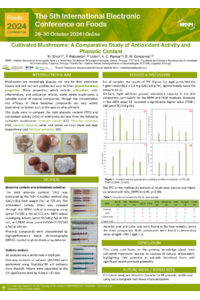
Mushrooms are becoming increasingly popular, not only for their distinctive flavors and rich nutrient profiles, but also for their potent bioactive properties. These properties, which include antioxidant, anti-inflammatory, and anticancer effects, make edible mushrooms a valuable source of natural compounds. Although, the concentration and efficacy of these bioactive compounds can vary widely depending on factors such as the species of mushroom. This study aims to compare the total phenolic content (TPC) and antioxidant activity (AOx) of methanolic extracts from the following cultivated mushrooms: Lentinula edodes (LE), Pleurotus ostreatus (PO), Agaricus bisporus, white and brown varieties (AgW and AgB, respectively), and Hericium erinaceus (HE).
The TPC was evaluated by the Folin–Ciocalteu method [mg GAE/100 g fresh weight (fw)], and the AOx was assessed through the DPPH radical scavenging assay (µmol TE/100 g fw), ABTS radical scavenging activity (µmol TE/100 g fw), and FRAP assay (mmol FeSO4•7H2O/100 g fw). Each mushroom species was evaluated in triplicate. Analysis of variance (ANOVA) was performed using StatisticaTM v.8 software. The means were separated at the 5% significance level by Tukey’s HSD test.
The AgW extract exhibited the highest antioxidant potential (3093.3 ± 138.2 mg GAE/100 g fw and 2.3 ± 0.3 mmol FeSO4•7H2O/100 g fw, assessed by DPPH and FRAP, respectively), along with the highest phenolic content (46.2 ± 6.4 mg GAE/100 g). The TPC of the methanolic extracts of the mushroom species was highly correlated with AOx_DPPH (r=0.85; p<0.05). Moreover, the HE and PO extracts measured by ABTS also showed significant antioxidant properties. Chlorogenic acid and ascorbic acid, identified as the most abundant phenolics in TPC by HPLC, are likely the primary contributors to the observed AOx.
This study contributes to the growing knowledge of fresh cultivated mushroom species as sources of natural antioxidants, highlighting their potential as valuable functional foods with significant health-promoting benefits.
Keywords
Cultivated mushrooms
Total phenolic content
Antioxidant activity.
Poster
Poster ICFoods2024_emg.pdf
Determination of the fungal biomass via n-acetyl glucosamine analysis in the production of an inoculum of monascus purpureus using quinoa flour.
Assessment of Antibacterial Edible Coatings derived from Coffee Husk Pectin for extending Grapefruit Shelf life.