Event submissions
Published
This submission belongs to the session S7. Novel Preservation and Packaging Technologies of the event The 5th International Electronic Conference on Foods
Published date
25 Oct, 2024
Academic Editor
'%3e%3cpath%20d='M12.6657%2010.9104C12.4185%2010.325%2012.0599%209.79327%2011.6097%209.34482C11.1609%208.89508%2010.6293%208.5365%2010.0442%208.28888C10.0389%208.28626%2010.0337%208.28495%2010.0285%208.28233C10.8446%207.69279%2011.3752%206.73249%2011.3752%205.64904C11.3752%203.8542%209.92103%202.39999%208.1262%202.39999C6.33136%202.39999%204.87715%203.8542%204.87715%205.64904C4.87715%206.73249%205.40774%207.69279%206.22393%208.28364C6.21869%208.28626%206.21345%208.28757%206.20821%208.29019C5.62129%208.5378%205.09463%208.89284%204.64265%209.34613C4.1929%209.79493%203.83432%2010.3266%203.58671%2010.9117C3.34345%2011.4845%203.21226%2012.0987%203.20023%2012.7209C3.19988%2012.7349%203.20233%2012.7488%203.20744%2012.7619C3.21255%2012.7749%203.22022%2012.7867%203.22998%2012.7968C3.23975%2012.8068%203.25142%2012.8147%203.26431%2012.8202C3.2772%2012.8256%203.29105%2012.8284%203.30504%2012.8284H4.09109C4.14874%2012.8284%204.19459%2012.7825%204.1959%2012.7262C4.2221%2011.7148%204.62823%2010.7676%205.34617%2010.0497C6.08899%209.30683%207.0755%208.89808%208.1262%208.89808C9.17689%208.89808%2010.1634%209.30683%2010.9062%2010.0497C11.6242%2010.7676%2012.0303%2011.7148%2012.0565%2012.7262C12.0578%2012.7838%2012.1037%2012.8284%2012.1613%2012.8284H12.9474C12.9613%2012.8284%2012.9752%2012.8256%2012.9881%2012.8202C13.001%2012.8147%2013.0126%2012.8068%2013.0224%2012.7968C13.0322%2012.7867%2013.0398%2012.7749%2013.0449%2012.7619C13.0501%2012.7488%2013.0525%2012.7349%2013.0522%2012.7209C13.0391%2012.0947%2012.9094%2011.4855%2012.6657%2010.9104ZM8.1262%207.9024C7.52486%207.9024%206.9589%207.6679%206.53312%207.24211C6.10733%206.81633%205.87283%206.25037%205.87283%205.64904C5.87283%205.0477%206.10733%204.48174%206.53312%204.05596C6.9589%203.63018%207.52486%203.39567%208.1262%203.39567C8.72753%203.39567%209.29349%203.63018%209.71927%204.05596C10.1451%204.48174%2010.3796%205.0477%2010.3796%205.64904C10.3796%206.25037%2010.1451%206.81633%209.71927%207.24211C9.29349%207.6679%208.72753%207.9024%208.1262%207.9024Z'%20fill='%235D1EE1'/%3e%3c/g%3e%3c/svg%3e) Miguel Cerqueira
Miguel CerqueiraCitation
Divyashri G, Swathi R, T P Krishnamurthy, Anagha M, Sindhu O, Sharada B, Assessment of Antibacterial Edible Coatings derived from Coffee Husk Pectin for extending Grapefruit Shelf life., in Proceedings of The 5th International Electronic Conference on Foods, 28 October–30 October 2024, MDPI: Basel, Switzerland
Share
Email
Facebook
Twitter
LinkedIn
Assessment of Antibacterial Edible Coatings derived from Coffee Husk Pectin for extending Grapefruit Shelf life.
'%3e%3cpath%20d='M12.6647%2010.9104C12.4176%2010.325%2012.0589%209.7933%2011.6088%209.34485C11.16%208.89511%2010.6283%208.53653%2010.0432%208.28891C10.038%208.28629%2010.0327%208.28498%2010.0275%208.28236C10.8437%207.69282%2011.3743%206.73252%2011.3743%205.64907C11.3743%203.85423%209.92005%202.40002%208.12522%202.40002C6.33038%202.40002%204.87618%203.85423%204.87618%205.64907C4.87618%206.73252%205.40677%207.69282%206.22296%208.28367C6.21772%208.28629%206.21248%208.2876%206.20724%208.29022C5.62031%208.53783%205.09365%208.89287%204.64167%209.34616C4.19192%209.79496%203.83334%2010.3266%203.58573%2010.9117C3.34247%2011.4846%203.21128%2012.0987%203.19925%2012.721C3.1989%2012.735%203.20135%2012.7489%203.20646%2012.7619C3.21157%2012.7749%203.21924%2012.7868%203.22901%2012.7968C3.23877%2012.8068%203.25045%2012.8148%203.26334%2012.8202C3.27623%2012.8256%203.29007%2012.8284%203.30406%2012.8284H4.09012C4.14776%2012.8284%204.19362%2012.7825%204.19493%2012.7262C4.22113%2011.7148%204.62726%2010.7676%205.34519%2010.0497C6.08802%209.30686%207.07452%208.89811%208.12522%208.89811C9.17592%208.89811%2010.1624%209.30686%2010.9052%2010.0497C11.6232%2010.7676%2012.0293%2011.7148%2012.0555%2012.7262C12.0568%2012.7839%2012.1027%2012.8284%2012.1603%2012.8284H12.9464C12.9604%2012.8284%2012.9742%2012.8256%2012.9871%2012.8202C13%2012.8148%2013.0117%2012.8068%2013.0214%2012.7968C13.0312%2012.7868%2013.0389%2012.7749%2013.044%2012.7619C13.0491%2012.7489%2013.0515%2012.735%2013.0512%2012.721C13.0381%2012.0947%2012.9084%2011.4856%2012.6647%2010.9104ZM8.12522%207.90243C7.52388%207.90243%206.95792%207.66793%206.53214%207.24215C6.10636%206.81636%205.87185%206.2504%205.87185%205.64907C5.87185%205.04773%206.10636%204.48177%206.53214%204.05599C6.95792%203.63021%207.52388%203.3957%208.12522%203.3957C8.72655%203.3957%209.29252%203.63021%209.7183%204.05599C10.1441%204.48177%2010.3786%205.04773%2010.3786%205.64907C10.3786%206.2504%2010.1441%206.81636%209.7183%207.24215C9.29252%207.66793%208.72655%207.90243%208.12522%207.90243Z'%20fill='%235D1EE1'/%3e%3c/g%3e%3c/svg%3e)
Divyashri G 1
Swathi R 1
T P Krishnamurthy 1
Anagha M 1
Sindhu O 1
Sharada B 1
1. Department of Biotechnology, M S Ramaiah Institute of Technology, Bangalore, India
Abstract
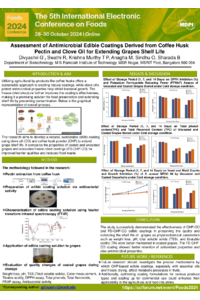
By 2050, the global population is expected to reach 9.7 billion, with a majority living in urban areas. This growth will increase food demand and reliance on processed foods, raising contamination risks. A composite coating made from coffee husk pectin (CHP) and clove oil (CO) was tested to extend grapefruit shelf life. Coated and uncoated grapefruits were evaluated for their physicochemical properties (weight loss, color, pH, total soluble solids, titrable acidity), bioactive compounds (total phenolics, total flavonoids), and antioxidant and antimicrobial activities over 14 days at room temperature (25 ± 1°C) and cold storage (4 ± 1°C). The coated grapefruits maintained better visual quality, color, texture, and freshness over 14 days compared to the uncoated ones. The uncoated samples showed significant weight loss, increasing from 1.69 ± 0.24% after 7 days to 3.89 ± 1.63% after 14 days at room temperature ($p < 0.05). Grapefruits coated with CHP-CO (**p < 0.001) and FD-CHP-CO (***p < 0.001) had significantly lower weight loss, with the freeze-dried coating (FD-CHP-CO) being the most effective. The pH of the coated grapefruits remained more stable, particularly with FD-CHP-CO. The coated grapefruits also retained more total phenolics and flavonoids. The coated samples showed enhanced antioxidant and antimicrobial properties. The microbial load increased from 4000 to 46000 CFU/g in the uncoated grapefruits, from 1800 to 31500 CFU/g in the CHP-CO-coated samples, and from 1500 to 29000 CFU/g in FD-CHP-CO-coated samples. These results highlight the potential of FD-CHP-CO and CHP-CO edible coatings to prolong grapefruit shelf life and quality. For FD-CHP-CO, freeze-drying was used to further increase the coating’s efficacy by forming a strong barrier against microbial invasion and moisture loss. These results highlight the potential of FD-CHP-CO and CHP-CO edible coatings to prolong grapefruit shelf life and quality, hence lowering food waste and raising consumer satisfaction. To promote sustainability and food security, future research should investigate the underlying mechanisms that can be used to optimize these coatings for greater application in the agricultural and food industries.
Keywords
Keywords: Grapefruits
Edible composite coating
Coffee husk pectin
Clove oil
Freeze drying
Antioxidant and antibacterial properties
Poster
Foods Poster -Swathi R.pdf
Cultivated Mushrooms: A Comparative Study of Antioxidant Activity and Phenolic Content
IMPACT OF EVAPORATION AND DRYING METHODS ON COLOR PARAMETERS OF WHOLE MILK POWDER