Event submissions
Published
This submission belongs to the session S3. Sustainable Food Security and Food System of the event The 5th International Electronic Conference on Foods
Published date
25 Oct, 2024
Academic Editor
'%3e%3cpath%20d='M12.6657%2010.9104C12.4185%2010.325%2012.0599%209.79327%2011.6097%209.34482C11.1609%208.89508%2010.6293%208.5365%2010.0442%208.28888C10.0389%208.28626%2010.0337%208.28495%2010.0285%208.28233C10.8446%207.69279%2011.3752%206.73249%2011.3752%205.64904C11.3752%203.8542%209.92103%202.39999%208.1262%202.39999C6.33136%202.39999%204.87715%203.8542%204.87715%205.64904C4.87715%206.73249%205.40774%207.69279%206.22393%208.28364C6.21869%208.28626%206.21345%208.28757%206.20821%208.29019C5.62129%208.5378%205.09463%208.89284%204.64265%209.34613C4.1929%209.79493%203.83432%2010.3266%203.58671%2010.9117C3.34345%2011.4845%203.21226%2012.0987%203.20023%2012.7209C3.19988%2012.7349%203.20233%2012.7488%203.20744%2012.7619C3.21255%2012.7749%203.22022%2012.7867%203.22998%2012.7968C3.23975%2012.8068%203.25142%2012.8147%203.26431%2012.8202C3.2772%2012.8256%203.29105%2012.8284%203.30504%2012.8284H4.09109C4.14874%2012.8284%204.19459%2012.7825%204.1959%2012.7262C4.2221%2011.7148%204.62823%2010.7676%205.34617%2010.0497C6.08899%209.30683%207.0755%208.89808%208.1262%208.89808C9.17689%208.89808%2010.1634%209.30683%2010.9062%2010.0497C11.6242%2010.7676%2012.0303%2011.7148%2012.0565%2012.7262C12.0578%2012.7838%2012.1037%2012.8284%2012.1613%2012.8284H12.9474C12.9613%2012.8284%2012.9752%2012.8256%2012.9881%2012.8202C13.001%2012.8147%2013.0126%2012.8068%2013.0224%2012.7968C13.0322%2012.7867%2013.0398%2012.7749%2013.0449%2012.7619C13.0501%2012.7488%2013.0525%2012.7349%2013.0522%2012.7209C13.0391%2012.0947%2012.9094%2011.4855%2012.6657%2010.9104ZM8.1262%207.9024C7.52486%207.9024%206.9589%207.6679%206.53312%207.24211C6.10733%206.81633%205.87283%206.25037%205.87283%205.64904C5.87283%205.0477%206.10733%204.48174%206.53312%204.05596C6.9589%203.63018%207.52486%203.39567%208.1262%203.39567C8.72753%203.39567%209.29349%203.63018%209.71927%204.05596C10.1451%204.48174%2010.3796%205.0477%2010.3796%205.64904C10.3796%206.25037%2010.1451%206.81633%209.71927%207.24211C9.29349%207.6679%208.72753%207.9024%208.1262%207.9024Z'%20fill='%235D1EE1'/%3e%3c/g%3e%3c/svg%3e) Theodoros Varzakas
Theodoros VarzakasCitation
M. Rosario Ramírez-Bernabé, Jonathan Delgado-Adámez, Miriam Sánchez-Ordóñez, M. Jesús Martín-Mateos, Matilde D'Arrigo, Esperanza Valdés, Process of Obtaining an Antioxidant Ingredient from Red Grape Pomace var. Tempranillo and Its Application in Fresh and Dry-Cured Meat Products, in Proceedings of The 5th International Electronic Conference on Foods, 28 October–30 October 2024, MDPI: Basel, Switzerland
Share
Email
Facebook
Twitter
LinkedIn
Process of Obtaining an Antioxidant Ingredient from Red Grape Pomace var. Tempranillo and Its Application in Fresh and Dry-Cured Meat Products

M. Rosario Ramírez-Bernabé 1
'%3e%3cpath%20d='M12.6647%2010.9104C12.4176%2010.325%2012.0589%209.7933%2011.6088%209.34485C11.16%208.89511%2010.6283%208.53653%2010.0432%208.28891C10.038%208.28629%2010.0327%208.28498%2010.0275%208.28236C10.8437%207.69282%2011.3743%206.73252%2011.3743%205.64907C11.3743%203.85423%209.92005%202.40002%208.12522%202.40002C6.33038%202.40002%204.87618%203.85423%204.87618%205.64907C4.87618%206.73252%205.40677%207.69282%206.22296%208.28367C6.21772%208.28629%206.21248%208.2876%206.20724%208.29022C5.62031%208.53783%205.09365%208.89287%204.64167%209.34616C4.19192%209.79496%203.83334%2010.3266%203.58573%2010.9117C3.34247%2011.4846%203.21128%2012.0987%203.19925%2012.721C3.1989%2012.735%203.20135%2012.7489%203.20646%2012.7619C3.21157%2012.7749%203.21924%2012.7868%203.22901%2012.7968C3.23877%2012.8068%203.25045%2012.8148%203.26334%2012.8202C3.27623%2012.8256%203.29007%2012.8284%203.30406%2012.8284H4.09012C4.14776%2012.8284%204.19362%2012.7825%204.19493%2012.7262C4.22113%2011.7148%204.62726%2010.7676%205.34519%2010.0497C6.08802%209.30686%207.07452%208.89811%208.12522%208.89811C9.17592%208.89811%2010.1624%209.30686%2010.9052%2010.0497C11.6232%2010.7676%2012.0293%2011.7148%2012.0555%2012.7262C12.0568%2012.7839%2012.1027%2012.8284%2012.1603%2012.8284H12.9464C12.9604%2012.8284%2012.9742%2012.8256%2012.9871%2012.8202C13%2012.8148%2013.0117%2012.8068%2013.0214%2012.7968C13.0312%2012.7868%2013.0389%2012.7749%2013.044%2012.7619C13.0491%2012.7489%2013.0515%2012.735%2013.0512%2012.721C13.0381%2012.0947%2012.9084%2011.4856%2012.6647%2010.9104ZM8.12522%207.90243C7.52388%207.90243%206.95792%207.66793%206.53214%207.24215C6.10636%206.81636%205.87185%206.2504%205.87185%205.64907C5.87185%205.04773%206.10636%204.48177%206.53214%204.05599C6.95792%203.63021%207.52388%203.3957%208.12522%203.3957C8.72655%203.3957%209.29252%203.63021%209.7183%204.05599C10.1441%204.48177%2010.3786%205.04773%2010.3786%205.64907C10.3786%206.2504%2010.1441%206.81636%209.7183%207.24215C9.29252%207.66793%208.72655%207.90243%208.12522%207.90243Z'%20fill='%235D1EE1'/%3e%3c/g%3e%3c/svg%3e)
Jonathan Delgado-Adámez 1
Miriam Sánchez-Ordóñez 1
M. Jesús Martín-Mateos 1
Matilde D'Arrigo 1

Esperanza Valdés 1
1. CICYTEX. Centro de Investigaciones Científicas y Tecnológicas de Extremadura
Abstract
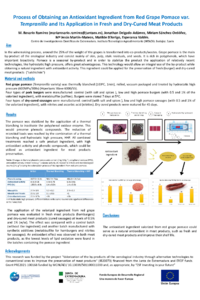
The wine industry is one of the agri-food sectors that generates the most by-products. Pomace, which consists of seeds, skins, stems, and pulp remaining after grape pressing operations, is the most abundant by-product of this industry. Red grape pomace var. Tempranillo was valorized by the application of high hydrostatic pressure, and the effect of the obtained ingredient was evaluated in meat products. A soft thermal treatment prior to high-hydrostatic-pressure treatment was applied to obtain an ingredient rich in phenolic compounds with antioxidant activity from red grape pomace. These processes resulted in a reduction in microbial loads and a decrease in the activity of the polyphenol oxidase enzyme in the pomace, thus yielding a safe product while preserving the phenolic compounds. The antioxidant activity was also well maintained in the valorized ingredient. This valorization process avoids the use of solvents to extract bioactive compounds and allows the entire by-product to be used in meat products, generating no waste. The application of this bioactive ingredient from red grape pomace was evaluated in fresh meat products (hamburgers) and dry-cured meat products (cured sausages) at levels of 0.5% and 1% (w/w). The effect was compared with a control batch (without the ingredient) and another batch manufactured with synthetic additives (metabisulfite for hamburgers and nitrites for sausages). An antioxidant effect was observed in both meat products, as the lowest levels of lipid oxidation were found in the batches containing the pomace ingredient. Therefore, incorporating the bioactive ingredient from red grape pomace into meat products could serve as a natural antioxidant and improve the shelf life of both fresh and dry-cured meat products.
Keywords
red grape pomace
by-products
valorization
high hydrostatic pressure
lipid oxidation
antioxidants
Poster
Ingredient red grape pomace.pdf
Chinese yam polysaccharides ameliorate high-fat-diet-induced atherosclerosis and modulate the gut microbiota in ApoE−/− mice
THE USE OF the FT-IR Technique TO PREDICT the CONTENT OF OLEAGINOUS YEAST BIOMASS