Event submissions
Published
This submission belongs to the session S8. Food Quality and Safety of the event The 5th International Electronic Conference on Foods
Published date
25 Oct, 2024
Academic Editor
'%3e%3cpath%20d='M12.6657%2010.9104C12.4185%2010.325%2012.0599%209.79327%2011.6097%209.34482C11.1609%208.89508%2010.6293%208.5365%2010.0442%208.28888C10.0389%208.28626%2010.0337%208.28495%2010.0285%208.28233C10.8446%207.69279%2011.3752%206.73249%2011.3752%205.64904C11.3752%203.8542%209.92103%202.39999%208.1262%202.39999C6.33136%202.39999%204.87715%203.8542%204.87715%205.64904C4.87715%206.73249%205.40774%207.69279%206.22393%208.28364C6.21869%208.28626%206.21345%208.28757%206.20821%208.29019C5.62129%208.5378%205.09463%208.89284%204.64265%209.34613C4.1929%209.79493%203.83432%2010.3266%203.58671%2010.9117C3.34345%2011.4845%203.21226%2012.0987%203.20023%2012.7209C3.19988%2012.7349%203.20233%2012.7488%203.20744%2012.7619C3.21255%2012.7749%203.22022%2012.7867%203.22998%2012.7968C3.23975%2012.8068%203.25142%2012.8147%203.26431%2012.8202C3.2772%2012.8256%203.29105%2012.8284%203.30504%2012.8284H4.09109C4.14874%2012.8284%204.19459%2012.7825%204.1959%2012.7262C4.2221%2011.7148%204.62823%2010.7676%205.34617%2010.0497C6.08899%209.30683%207.0755%208.89808%208.1262%208.89808C9.17689%208.89808%2010.1634%209.30683%2010.9062%2010.0497C11.6242%2010.7676%2012.0303%2011.7148%2012.0565%2012.7262C12.0578%2012.7838%2012.1037%2012.8284%2012.1613%2012.8284H12.9474C12.9613%2012.8284%2012.9752%2012.8256%2012.9881%2012.8202C13.001%2012.8147%2013.0126%2012.8068%2013.0224%2012.7968C13.0322%2012.7867%2013.0398%2012.7749%2013.0449%2012.7619C13.0501%2012.7488%2013.0525%2012.7349%2013.0522%2012.7209C13.0391%2012.0947%2012.9094%2011.4855%2012.6657%2010.9104ZM8.1262%207.9024C7.52486%207.9024%206.9589%207.6679%206.53312%207.24211C6.10733%206.81633%205.87283%206.25037%205.87283%205.64904C5.87283%205.0477%206.10733%204.48174%206.53312%204.05596C6.9589%203.63018%207.52486%203.39567%208.1262%203.39567C8.72753%203.39567%209.29349%203.63018%209.71927%204.05596C10.1451%204.48174%2010.3796%205.0477%2010.3796%205.64904C10.3796%206.25037%2010.1451%206.81633%209.71927%207.24211C9.29349%207.6679%208.72753%207.9024%208.1262%207.9024Z'%20fill='%235D1EE1'/%3e%3c/g%3e%3c/svg%3e) Antonello Santini
Antonello SantiniCitation
Makaziwe Edith Chabula, Ishmael Festus Jaja, Knowledge, attitude, and practice of dairy workers about toxoplasmosis and other zoonoses on the farm in the Eastern Cape Province, South Africa, in Proceedings of The 5th International Electronic Conference on Foods, 28 October–30 October 2024, MDPI: Basel, Switzerland
Share
Email
Facebook
Twitter
LinkedIn
Knowledge, attitude, and practice of dairy workers about toxoplasmosis and other zoonoses on the farm in the Eastern Cape Province, South Africa

Makaziwe Edith Chabula 1

Ishmael Festus Jaja 2
1. 1.Department of Livestock and Pasture Science, University of Fort Hare, Private Bag X1314, Alice 5700, South Africa
2.Risk and vulnerability science center (RAVAC), University of Fort Hare, South Africa, Private Bag X1314, Alice 5700, South Africa
2. 1. Department of Livestock and Pasture Science, University of Fort Hare, Private Bag X1314, Alice 5700, South Africa
2. Risk and vulnerability science center (RAVAC), University of Fort Hare, South Africa, Private Bag X1314, Alice 5700, South Africa
Abstract
Toxoplasma gondii is a zoonotic parasite of medical and veterinary importance. This study evaluated dairy workers knowledge, attitude, and practices regarding toxoplasmosis in the Eastern Cape Province, South Africa. Using a close-ended-structured questionnaire, the data were collected from 150 registered dairy farms in five district municipalities (Amathole, OR Tambo, Chris Hani, Cacadu, and Alfred Nzo). The structured questionnaire was utilized to collect data. Responses from the farmers were analyzed against various potential risk factors and the public health implications assessed for them to be monitored. Of the respondents, 15.8% correctly acknowledged knowing about toxoplasmosis. The majority of the respondents could not correctly recognize the following parasitic zoonosis as being food-borne pathogens: Toxoplasma (84.2%), Cryptosporidia (82.0%), Entamoeba (93.5%), Trichinella (88.5%), Hymenolepis (92.1%), Giardia (90.6%), Cysticercus (92.1%), Echinococcus (87.8%), and Dicrocoelium (92.8%). Most respondents (77%) responded that they assisted infected cows during calving without the use of gloves or sanitation practices, which could cause infection in humans. This study contributed to the knowledge and awareness of the parasitic disease that is Toxoplasma gondii. The study highlighted a deficiency in knowledge about toxoplasmosis and food-borne illnesses. Hence, it presents an opportunity for various stakeholders in the health, veterinary, and other government parastatals to institute mitigation measures aimed at training and re-training farm workers to always practice hygiene.
Keywords
Toxoplasma gondii
zoonotic
parasite
knowledge
Poster
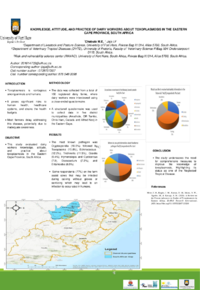
Chabula ME (201614733ufh.ac.za) poster For Foods conference.pdf
EnzyRxn-Transformer: A generative platform for rational experiment design in biotransformation
pLM4CPPs: Protein Language Model-Based Predictor for Cell-Penetrating Peptides