Event submissions
Published
This submission belongs to the session S3. Sustainable Food Security and Food System of the event The 5th International Electronic Conference on Foods
Published date
28 Oct, 2024
Academic Editor
'%3e%3cpath%20d='M12.6657%2010.9104C12.4185%2010.325%2012.0599%209.79327%2011.6097%209.34482C11.1609%208.89508%2010.6293%208.5365%2010.0442%208.28888C10.0389%208.28626%2010.0337%208.28495%2010.0285%208.28233C10.8446%207.69279%2011.3752%206.73249%2011.3752%205.64904C11.3752%203.8542%209.92103%202.39999%208.1262%202.39999C6.33136%202.39999%204.87715%203.8542%204.87715%205.64904C4.87715%206.73249%205.40774%207.69279%206.22393%208.28364C6.21869%208.28626%206.21345%208.28757%206.20821%208.29019C5.62129%208.5378%205.09463%208.89284%204.64265%209.34613C4.1929%209.79493%203.83432%2010.3266%203.58671%2010.9117C3.34345%2011.4845%203.21226%2012.0987%203.20023%2012.7209C3.19988%2012.7349%203.20233%2012.7488%203.20744%2012.7619C3.21255%2012.7749%203.22022%2012.7867%203.22998%2012.7968C3.23975%2012.8068%203.25142%2012.8147%203.26431%2012.8202C3.2772%2012.8256%203.29105%2012.8284%203.30504%2012.8284H4.09109C4.14874%2012.8284%204.19459%2012.7825%204.1959%2012.7262C4.2221%2011.7148%204.62823%2010.7676%205.34617%2010.0497C6.08899%209.30683%207.0755%208.89808%208.1262%208.89808C9.17689%208.89808%2010.1634%209.30683%2010.9062%2010.0497C11.6242%2010.7676%2012.0303%2011.7148%2012.0565%2012.7262C12.0578%2012.7838%2012.1037%2012.8284%2012.1613%2012.8284H12.9474C12.9613%2012.8284%2012.9752%2012.8256%2012.9881%2012.8202C13.001%2012.8147%2013.0126%2012.8068%2013.0224%2012.7968C13.0322%2012.7867%2013.0398%2012.7749%2013.0449%2012.7619C13.0501%2012.7488%2013.0525%2012.7349%2013.0522%2012.7209C13.0391%2012.0947%2012.9094%2011.4855%2012.6657%2010.9104ZM8.1262%207.9024C7.52486%207.9024%206.9589%207.6679%206.53312%207.24211C6.10733%206.81633%205.87283%206.25037%205.87283%205.64904C5.87283%205.0477%206.10733%204.48174%206.53312%204.05596C6.9589%203.63018%207.52486%203.39567%208.1262%203.39567C8.72753%203.39567%209.29349%203.63018%209.71927%204.05596C10.1451%204.48174%2010.3796%205.0477%2010.3796%205.64904C10.3796%206.25037%2010.1451%206.81633%209.71927%207.24211C9.29349%207.6679%208.72753%207.9024%208.1262%207.9024Z'%20fill='%235D1EE1'/%3e%3c/g%3e%3c/svg%3e) Theodoros Varzakas
Theodoros VarzakasCitation
EVA MARTÍNEZ IBÁÑEZ, JARA LASO CORTABITARTE, ANA FERNÁNDEZ RÍOS, MARÍA MARGALLO BLANCO, RUBE ALDACO GARCÍA, SMART-FOODPRINT PROJECT: Advancing Traceability and Sustainability in Spanish Food Supply Chains, in Proceedings of The 5th International Electronic Conference on Foods, 28 October–30 October 2024, MDPI: Basel, Switzerland
Share
Email
Facebook
Twitter
LinkedIn
SMART-FOODPRINT PROJECT: Advancing Traceability and Sustainability in Spanish Food Supply Chains

EVA MARTÍNEZ IBÁÑEZ 1

JARA LASO CORTABITARTE 1
'%3e%3cpath%20d='M12.6647%2010.9104C12.4176%2010.325%2012.0589%209.7933%2011.6088%209.34485C11.16%208.89511%2010.6283%208.53653%2010.0432%208.28891C10.038%208.28629%2010.0327%208.28498%2010.0275%208.28236C10.8437%207.69282%2011.3743%206.73252%2011.3743%205.64907C11.3743%203.85423%209.92005%202.40002%208.12522%202.40002C6.33038%202.40002%204.87618%203.85423%204.87618%205.64907C4.87618%206.73252%205.40677%207.69282%206.22296%208.28367C6.21772%208.28629%206.21248%208.2876%206.20724%208.29022C5.62031%208.53783%205.09365%208.89287%204.64167%209.34616C4.19192%209.79496%203.83334%2010.3266%203.58573%2010.9117C3.34247%2011.4846%203.21128%2012.0987%203.19925%2012.721C3.1989%2012.735%203.20135%2012.7489%203.20646%2012.7619C3.21157%2012.7749%203.21924%2012.7868%203.22901%2012.7968C3.23877%2012.8068%203.25045%2012.8148%203.26334%2012.8202C3.27623%2012.8256%203.29007%2012.8284%203.30406%2012.8284H4.09012C4.14776%2012.8284%204.19362%2012.7825%204.19493%2012.7262C4.22113%2011.7148%204.62726%2010.7676%205.34519%2010.0497C6.08802%209.30686%207.07452%208.89811%208.12522%208.89811C9.17592%208.89811%2010.1624%209.30686%2010.9052%2010.0497C11.6232%2010.7676%2012.0293%2011.7148%2012.0555%2012.7262C12.0568%2012.7839%2012.1027%2012.8284%2012.1603%2012.8284H12.9464C12.9604%2012.8284%2012.9742%2012.8256%2012.9871%2012.8202C13%2012.8148%2013.0117%2012.8068%2013.0214%2012.7968C13.0312%2012.7868%2013.0389%2012.7749%2013.044%2012.7619C13.0491%2012.7489%2013.0515%2012.735%2013.0512%2012.721C13.0381%2012.0947%2012.9084%2011.4856%2012.6647%2010.9104ZM8.12522%207.90243C7.52388%207.90243%206.95792%207.66793%206.53214%207.24215C6.10636%206.81636%205.87185%206.2504%205.87185%205.64907C5.87185%205.04773%206.10636%204.48177%206.53214%204.05599C6.95792%203.63021%207.52388%203.3957%208.12522%203.3957C8.72655%203.3957%209.29252%203.63021%209.7183%204.05599C10.1441%204.48177%2010.3786%205.04773%2010.3786%205.64907C10.3786%206.2504%2010.1441%206.81636%209.7183%207.24215C9.29252%207.66793%208.72655%207.90243%208.12522%207.90243Z'%20fill='%235D1EE1'/%3e%3c/g%3e%3c/svg%3e)
ANA FERNÁNDEZ RÍOS 1

MARÍA MARGALLO BLANCO 1

RUBE ALDACO GARCÍA 1
1. Department of Chemical and Biomolecular Engineering, University of Cantabria, Av. de Los Castros s/n, 39005 Santander, Spain.
Abstract
In the contemporary food industry, the importance of traceability and food supply chain management are widely recognized for their critical roles in safeguarding food safety, ensuring quality standards, and enhancing transparency throughout the production and distribution processes. However, environmental problems have been tackled in isolation, considering the production on the one hand, and the consumption of products on the other. Therefore, most advanced management models are changing towards integrated approaches that allow for the establishment of relationships between production and consumption, as well as environmental and quality aspects. Furthermore, in response to the lack of transparency in the food supply chain, there is a need for the establishment of a science-based food traceability system, utilizing improved methods for authenticity testing.
In this context, the SMART-FOODPRINT project aims to develop a user-friendly and high-quality traceability system to enhance transparency within the food industry. SMART-FOODPRINT comprises seven work packages (WPs). The first two WPs are designed to ensure the feasibility and success of the project. Regarding the technical work, WP3 addresses the analytical techniques and procedures for evaluating food traceability. Subsequently, WP4 focuses on environmental assessment, WP5 is oriented towards the creation of the ECO- SMART-FOODPRINT application, and WP6 aims to integrate an ecological labeling certification system. Finally, WP7 represents the case studies in which the application will be tested.
The expected results for the first period of the project include the design of a reliable analytical infrastructure and the formulation of the corresponding life cycle model. Regarding the first objective, we will start with the compilation of a DNA barcode library for fish authentication and the development of an NIR Standard Operating Procedure to determine information about seafood products. Subsequently, to verify the environmental aspects, Life Cycle Assessment (LCA) methodology will be applied to calculate the impact of food fraud along this chain.
Keywords
Fisheries system
Traceability
Eco-labeling
Life cycle assessment
Poster
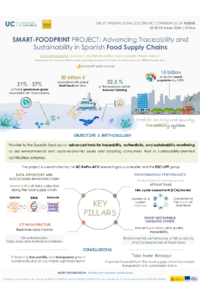
Poster_SmartFoodprint Project_MartínezIbáñezEva.pdf
Ensuring Food Safety and Quality: An Integrated Approach
Applying negative emissions technologies in the superfoods sector: How far are we from achieving a carbon neutral spirulina production?