Event submissions
Published
This submission belongs to the session S3. Sustainable Food Security and Food System of the event The 5th International Electronic Conference on Foods
Published date
28 Oct, 2024
Academic Editor
'%3e%3cpath%20d='M12.6657%2010.9104C12.4185%2010.325%2012.0599%209.79327%2011.6097%209.34482C11.1609%208.89508%2010.6293%208.5365%2010.0442%208.28888C10.0389%208.28626%2010.0337%208.28495%2010.0285%208.28233C10.8446%207.69279%2011.3752%206.73249%2011.3752%205.64904C11.3752%203.8542%209.92103%202.39999%208.1262%202.39999C6.33136%202.39999%204.87715%203.8542%204.87715%205.64904C4.87715%206.73249%205.40774%207.69279%206.22393%208.28364C6.21869%208.28626%206.21345%208.28757%206.20821%208.29019C5.62129%208.5378%205.09463%208.89284%204.64265%209.34613C4.1929%209.79493%203.83432%2010.3266%203.58671%2010.9117C3.34345%2011.4845%203.21226%2012.0987%203.20023%2012.7209C3.19988%2012.7349%203.20233%2012.7488%203.20744%2012.7619C3.21255%2012.7749%203.22022%2012.7867%203.22998%2012.7968C3.23975%2012.8068%203.25142%2012.8147%203.26431%2012.8202C3.2772%2012.8256%203.29105%2012.8284%203.30504%2012.8284H4.09109C4.14874%2012.8284%204.19459%2012.7825%204.1959%2012.7262C4.2221%2011.7148%204.62823%2010.7676%205.34617%2010.0497C6.08899%209.30683%207.0755%208.89808%208.1262%208.89808C9.17689%208.89808%2010.1634%209.30683%2010.9062%2010.0497C11.6242%2010.7676%2012.0303%2011.7148%2012.0565%2012.7262C12.0578%2012.7838%2012.1037%2012.8284%2012.1613%2012.8284H12.9474C12.9613%2012.8284%2012.9752%2012.8256%2012.9881%2012.8202C13.001%2012.8147%2013.0126%2012.8068%2013.0224%2012.7968C13.0322%2012.7867%2013.0398%2012.7749%2013.0449%2012.7619C13.0501%2012.7488%2013.0525%2012.7349%2013.0522%2012.7209C13.0391%2012.0947%2012.9094%2011.4855%2012.6657%2010.9104ZM8.1262%207.9024C7.52486%207.9024%206.9589%207.6679%206.53312%207.24211C6.10733%206.81633%205.87283%206.25037%205.87283%205.64904C5.87283%205.0477%206.10733%204.48174%206.53312%204.05596C6.9589%203.63018%207.52486%203.39567%208.1262%203.39567C8.72753%203.39567%209.29349%203.63018%209.71927%204.05596C10.1451%204.48174%2010.3796%205.0477%2010.3796%205.64904C10.3796%206.25037%2010.1451%206.81633%209.71927%207.24211C9.29349%207.6679%208.72753%207.9024%208.1262%207.9024Z'%20fill='%235D1EE1'/%3e%3c/g%3e%3c/svg%3e) Theodoros Varzakas
Theodoros VarzakasCitation
Ana Fernández Ríos, Isabela Butnar, Jara Laso, Aiduan Borrion, Ruben Aldaco, Maria Margallo, Applying negative emissions technologies in the superfoods sector: How far are we from achieving a carbon neutral spirulina production?, in Proceedings of The 5th International Electronic Conference on Foods, 28 October–30 October 2024, MDPI: Basel, Switzerland
Share
Email
Facebook
Twitter
LinkedIn
Applying negative emissions technologies in the superfoods sector: How far are we from achieving a carbon neutral spirulina production?
'%3e%3cpath%20d='M12.6647%2010.9104C12.4176%2010.325%2012.0589%209.7933%2011.6088%209.34485C11.16%208.89511%2010.6283%208.53653%2010.0432%208.28891C10.038%208.28629%2010.0327%208.28498%2010.0275%208.28236C10.8437%207.69282%2011.3743%206.73252%2011.3743%205.64907C11.3743%203.85423%209.92005%202.40002%208.12522%202.40002C6.33038%202.40002%204.87618%203.85423%204.87618%205.64907C4.87618%206.73252%205.40677%207.69282%206.22296%208.28367C6.21772%208.28629%206.21248%208.2876%206.20724%208.29022C5.62031%208.53783%205.09365%208.89287%204.64167%209.34616C4.19192%209.79496%203.83334%2010.3266%203.58573%2010.9117C3.34247%2011.4846%203.21128%2012.0987%203.19925%2012.721C3.1989%2012.735%203.20135%2012.7489%203.20646%2012.7619C3.21157%2012.7749%203.21924%2012.7868%203.22901%2012.7968C3.23877%2012.8068%203.25045%2012.8148%203.26334%2012.8202C3.27623%2012.8256%203.29007%2012.8284%203.30406%2012.8284H4.09012C4.14776%2012.8284%204.19362%2012.7825%204.19493%2012.7262C4.22113%2011.7148%204.62726%2010.7676%205.34519%2010.0497C6.08802%209.30686%207.07452%208.89811%208.12522%208.89811C9.17592%208.89811%2010.1624%209.30686%2010.9052%2010.0497C11.6232%2010.7676%2012.0293%2011.7148%2012.0555%2012.7262C12.0568%2012.7839%2012.1027%2012.8284%2012.1603%2012.8284H12.9464C12.9604%2012.8284%2012.9742%2012.8256%2012.9871%2012.8202C13%2012.8148%2013.0117%2012.8068%2013.0214%2012.7968C13.0312%2012.7868%2013.0389%2012.7749%2013.044%2012.7619C13.0491%2012.7489%2013.0515%2012.735%2013.0512%2012.721C13.0381%2012.0947%2012.9084%2011.4856%2012.6647%2010.9104ZM8.12522%207.90243C7.52388%207.90243%206.95792%207.66793%206.53214%207.24215C6.10636%206.81636%205.87185%206.2504%205.87185%205.64907C5.87185%205.04773%206.10636%204.48177%206.53214%204.05599C6.95792%203.63021%207.52388%203.3957%208.12522%203.3957C8.72655%203.3957%209.29252%203.63021%209.7183%204.05599C10.1441%204.48177%2010.3786%205.04773%2010.3786%205.64907C10.3786%206.2504%2010.1441%206.81636%209.7183%207.24215C9.29252%207.66793%208.72655%207.90243%208.12522%207.90243Z'%20fill='%235D1EE1'/%3e%3c/g%3e%3c/svg%3e)
Ana Fernández Ríos 1
Isabela Butnar 2

Jara Laso 1
Aiduan Borrion 3

Ruben Aldaco 1

Maria Margallo 1
1. Department of Chemical and Biomolecular Engineering, University of Cantabria. Av. De los Castros s/n, 39005 Santander, Spain.
2. Institute for Sustainable Resources, University College London, Central House, 14 Upper Woburn Place, London WC1H 0NN, UK.
3. Department of Civil, Environmental and Geomatic Engineering, University College London, London WC1E 6DE, UK.
Abstract
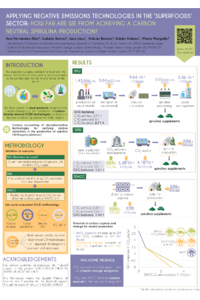
Environmental degradation is one of the biggest challenges of our time, with a negative influence on society by stressing food and forestry systems. However, these negative effects are reciprocal, as around 50% of food is produced under conditions transgressing some planetary boundaries. As a consequence, new opportunities for food supply chain stakeholders are occurring around the world; among them, the development of alternative nutrient sources and the implementation of carbon removal technologies are highlighted as mitigation pathways compliant with carbon neutrality targets.
This study seeks to prove the effectiveness, through carbon accounting and carbon footprint (CF), of two carbon capture and utilization techniques in the production of spirulina, an increasingly known and consumed ‘superfood’. Spirulina is considered an important CO2 consumer and in its industrial production this supply is made by means of synthetic CO2. Two scenarios that aim to reduce the associated burdens are compared: (i) use of CO2 recovered from the fermentation of beer (SP_BRW), and (ii) use of CO2 from a direct air carbon capture unit (SP_DACC).
The results show that both scenarios present better environmental performance than current production methods. The CFs are estimated at 1.03 tons and 1.37 tons CO2 eq./year for the SP_BRW and SP_DACC scenarios, respectively. In accordance, carbon accounting confirms that only CO2 emissions can be reduced, compared with the business-as-usual scenario, by up to 51.1% by using residual emissions from breweries and 47% by capturing CO2 from air. These findings provide a starting point in developing robust and transparent carbon accounting that verifies the efficiency of carbon removal in food systems, particularly in the superfoods sector. Future challenges focus on technical feasibility, in terms of the technology readiness level and implementation, as well as economic feasibility, since their actual application, especially of the DACC, would require a significant investment.
Keywords
Arthrospira platensis
life cycle assessment
carbon footprint
carbon capture
Poster
Poster Foods.pdf
SMART-FOODPRINT PROJECT: Advancing Traceability and Sustainability in Spanish Food Supply Chains
Steeped processed products of bird's eye chilli: A geographical indication-tagged chilli of Mizoram